



Hyperliquid’s fully diluted valuation has officially surpassed Solana’s by $50 billion to $56 billion, and the margin, slim as it is, is the market’s way of indicating the ranking has changed.
The HYPE token is trading at $58.60, up 20% in 24 hours, while SOL managed only 2.20% in the same session.
This divergence in daily momentum is not noise. This is a directional statement from capital allocators who have spent the last 18 months watching a Perp DEX built on its own mainnet dismantle the assumption that general purpose L1s own the liquidity narrative.
The hyperliquid did not arrive here by chance. It launched a purpose-built L1 optimized for low-latency perpetual futures execution, attracted institutional attention with sub-second finality, and then structured its token economy to redirect actual protocol fees directly to stakers, at returns that currently exceed Solana’s liquid staking derivatives by a significant spread.
Discover: The best crypto to diversify your portfolio
Perp DEX Dominance: How Hyperliquid’s Fee Engine Really Works and Why DeFi Liquidity Concentration is the Real Story
Hyperliquid is not a DEX bolted on a general purpose chain. It runs on its own L1, specifically designed for high-frequency derivatives execution, with a 0.045% taker fee and 0.015% maker fee on perpetuals, significantly lower than what most centralized sites charge and are structured to attract a professional flow rather than retail speculation.
The result is a fee engine that has begun to produce numbers that force direct comparisons to on-chain Solana.
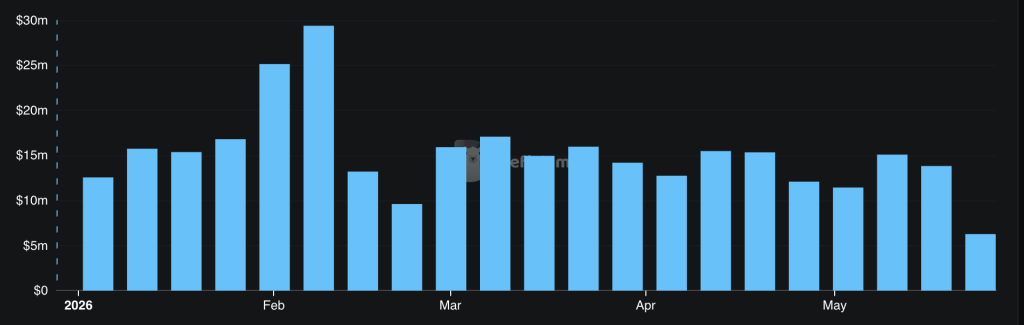
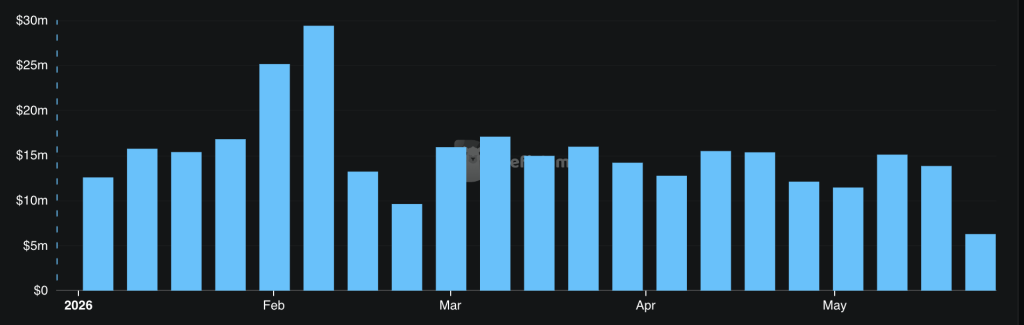
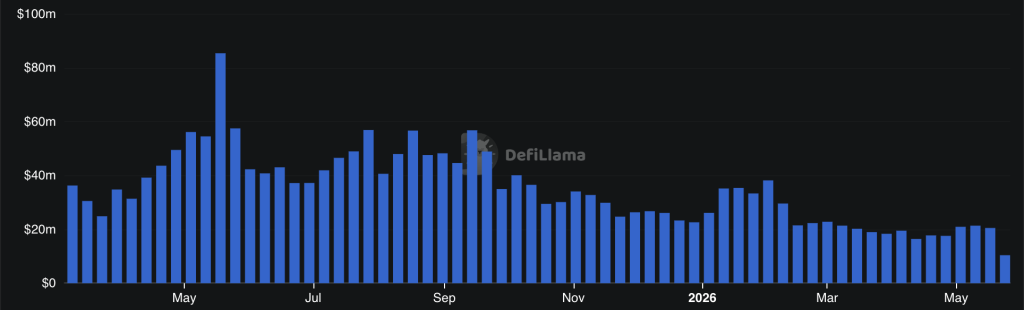
Data shows that Hyperliquid outperformed Solana in protocol fees over 7 days, $12.6 million versus Solana’s $11.8 million, a crossover that would have been dismissed as implausible 12 months ago.
Artemis data places the notional volume of Hyperliquid throughout 2025 at $26 trillion, moving at a pace that has compressed years of typical DeFi adoption into a single cycle.
This ratio is important because it indicates that DeFi liquidity on Hyperliquid is active, fee-generating capital, not passive capital stored in yield farms awaiting release.
Solana vs Hyperliquide: where each chain really opposes the other
The FDV crossover is real, but this comparison is not uniformly bullish for Hyperliquid across all dimensions. The benefits of Solana are structural and deep.
The chain processes consumer apps, memecoins, payment infrastructure, and NFT settlement at a scale that Hyperliquid has never targeted. Visa, PayPal, and Stripe are all opting for Solana, a fact that speaks to an institutional integration that a derivatives-focused channel simply cannot replicate in the short term.
Amundi, Europe’s largest asset manager, has decided to place Solana in the same institutional allocation conversation as Ethereum and Bitcoin, and this institutional adoption story represents a capital channel largely independent of who wins the volume race.
The number of developers, decentralization of validators, and diversity of consumer applications still favor Solana to a large extent.
However, the context is not uniformly optimistic for Hyperliquid. Its application-specific L1 model creates concentration risk if perpetual sentiment changes or competing infrastructure emerges at a lower cost, Hyperliquid’s moat is narrower than Solana’s by design.
Jupiter and Drift on Solana are not far behind, and Solana’s own liquidity has improved as trading activity is now a key battleground for the chain’s relevance.
The structural implication for capital allocation is that these are increasingly different bets. Solana is a broad ecosystem with institutional adoption across payments, consumer applications, and the broader L1 competitive landscape.
Hyperliquid is a concentrated bet on derivatives infrastructure capturing an outsized share of DeFi’s highest-margin business. Both can be simultaneously correct. They are not playing the same game.
Discover: Best Pre-Launch Token Sales
The article Hyperliquid vs. Solana: The Battle for the “King of Liquidity” in 2026 appeared first on Cryptonews.


