





Intercontinental Exchange founder and CEO Jeff Sprecher said crypto-native exchange Hyperliquid has become impossible for traditional market operators to ignore, pointing to its weekend oil trading, stablecoin settlement, high leverage and retail price discovery as signs of a broader shift in global markets.
Speaking in an excerpt from Bernstein’s presentation dated May 27, 2026, Sprecher said ICE, the parent company of the New York Stock Exchange, was closely monitoring Hyperliquid as the decentralized platform moves into markets historically dominated by traditional venues. He said he met with the Hyperliquid team several times to discuss what the platform builds, what ICE does, and where the two might have overlapping interests.
Hyperliquid Gets a Major Nod on Wall Street
“First of all, we know them well, and I’ve met with them personally several times to talk about what they do, what we do, what commonalities we can work on,” Sprecher said. “They have attracted attention because they trade oil on weekends, when our traditional oil markets are closed. And this is happening in this time of conflict in the Middle East, there has been a lot of activity, a lot of decisions and things happening on the weekend.”
This weekend activity, he says, has made Hyperliquid relevant not only as a crypto venue, but also as a source of after-hours price discovery for markets that still operate on more limited traditional hours. ICE’s response, according to Sprecher, will not be to keep oil markets open through the weekend, after pushback from major oil companies. Instead, he said ICE planned to extend trading very late on Friday and reopen very early on Monday, narrowing the window for traditional oil markets to close.
Sprecher framed the issue as a “wake-up call” for the industry. Many institutional clients in the energy sector, he said, do not trade on foreign blockchain-based platforms and may not be allowed to do so under internal controls. They nevertheless monitor the activity and the prices that form there.
“They all watch it, and they watch price discovery,” Sprecher said. “And whether they admit it or not, this is part of the zeitgeist of our markets opening, very early on Monday.”
The ICE chief also focused on the broader structure of the Hyperliquid market. He described the platform as “a true DeFi exchange” that sits on blockchain rails, uses stablecoins and has attracted market makers and early adopters who would otherwise be active in traditional markets. He also highlighted the risks associated with his leverage model.
“It’s on a blockchain. It’s settled with stablecoins, settled algorithmically. It has a very high margin. You can have leverage up to 100:1, which is part of the appeal.”
Sprecher said the platform’s listing of a SpaceX-related derivative could become a test of whether private market price discovery on a DeFi site is important to the financial system as a whole. He said market participants and regulators would soon be able to judge whether the price formed on Hyperliquide was “irrelevant” or “very relevant” once the company goes public, according to the excerpt.
The most striking part of Sprecher’s remarks came near the end of the exchange, when he openly praised Hyperliquid’s builders and compared the platform’s scale to that of Nasdaq, although the excerpt did not specify the metric behind that comparison.
“I love it. I wish I was younger and did it,” Sprecher said. “By the way, the number of billionaires that are being created through this. This hyperliquidity that we’re talking about – if you haven’t heard of it, it’s bigger than Nasdaq, okay? It’s got 11 people.”
This tension is already visible in Washington. Before Sprecher’s Bernstein remarks surfaced, ICE and CME pressed U.S. officials to examine Hyperliquid’s role in oil-related offshore trading, arguing that anonymous markets, open 24/7, could affect commodity price discovery and create risks of manipulation or sanctions evasion.
Hyperliquide pushed back against this framework, arguing that continuous on-chain markets reduce rather than increase market risk. The split leaves Sprecher’s comments with a clearer advantage: ICE can admire what Hyperliquid has built, but the platform’s rise also forces traditional exchanges to decide whether to compete with the crypto-native market structure, lobby against it, or try to absorb parts of it in regulated venues.
At press time, HYPE was trading at $61.526.
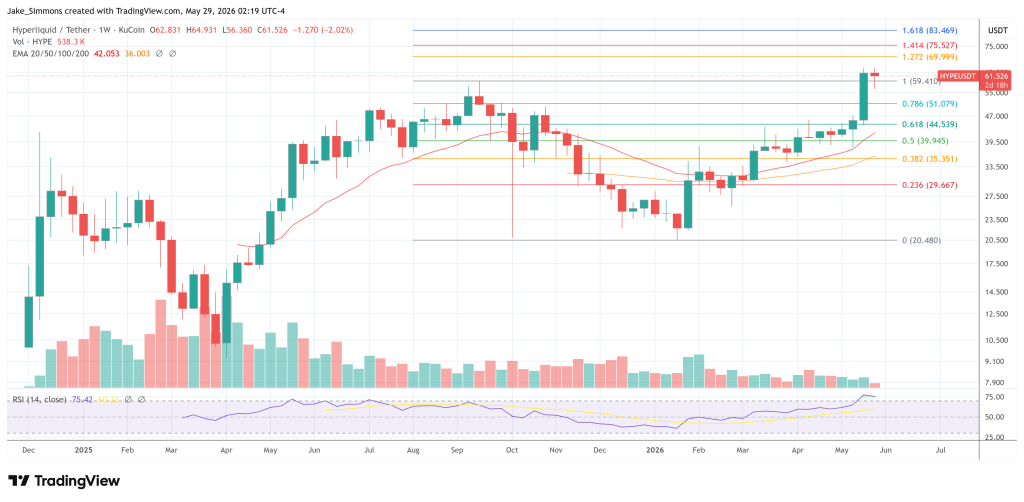
Featured image created with DALL.E, chart from TradingView.com
Editorial process as Bitcoinist focuses on providing thoroughly researched, accurate and unbiased content. We follow strict sourcing standards and every page undergoes careful review by our team of top technology experts and seasoned editors. This process ensures the integrity, relevance and value of our content to our readers.


