



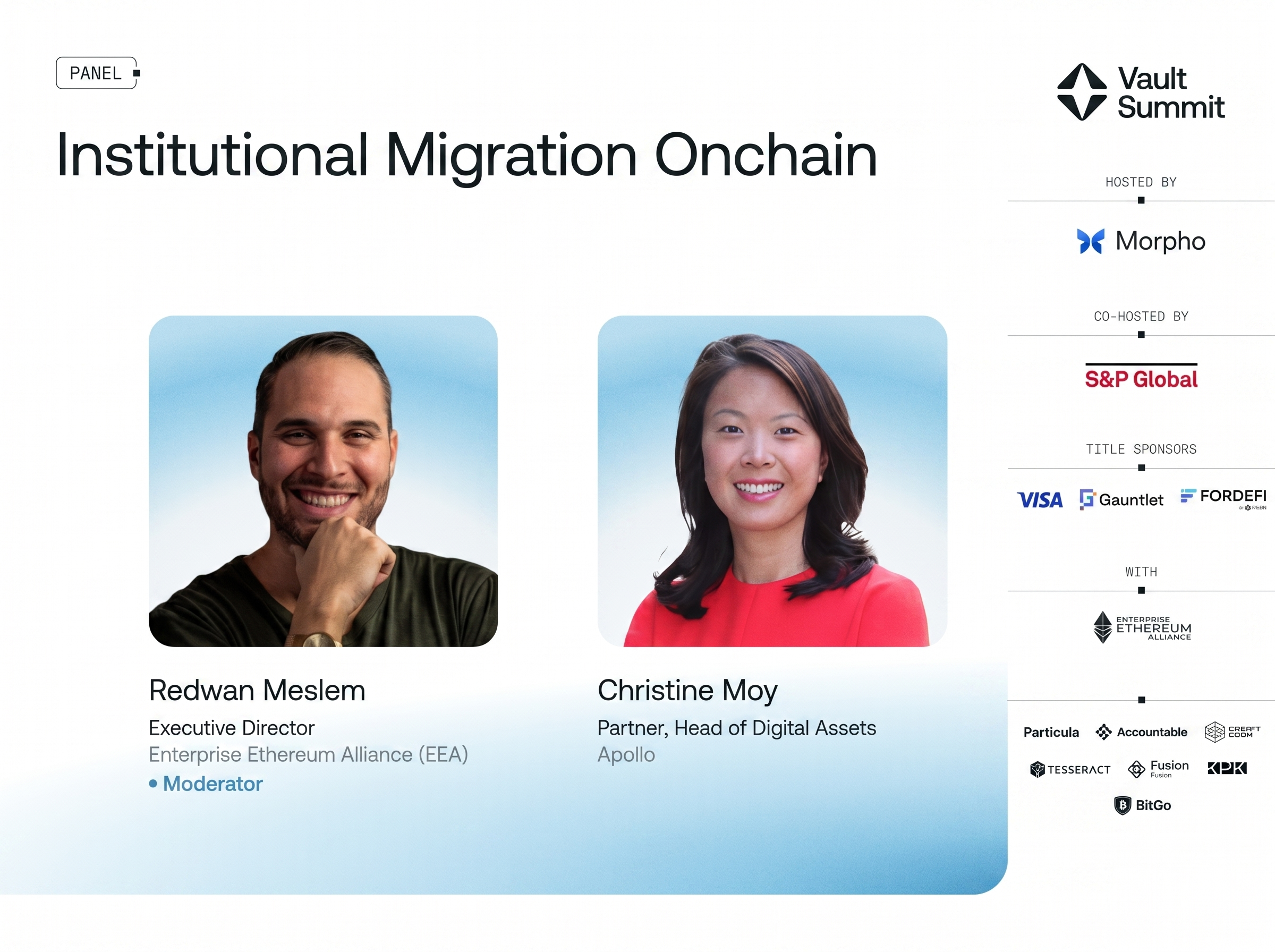
At this year’s Vault Summit, AEE Executive Director Redwan Meslem sat down with pioneering market architect Christine Moy, Partner and Head of Digital Assets at Apollo, for an intimate fireside chat. The dialogue focused on the rigorous operational parameters required to deploy alternative asset portfolios natively on Ethereum institutional infrastructure.
Amid the debate over how to successfully transition a $1 trillion legacy asset manager to public networks, one major question has been answered:
How can we preserve instant, automated execution of permissionless protocols while fully complying with the strict compliance obligations required for regulated securities?
Overcoming tokenization inertia to achieve 10x operational advantage
The digital assets industry has moved beyond what Christine Moy describes as the “amoeba stage” of tokenization. Wrap private debt, real estate or alternative credit portfolios in on-chain smart contracts is now only an entry condition; the real goal is to deliver a 10x better business user experience than existing systems can deliver.
Traditional financial models possess deep systemic inertia, meaning that corporate allocators and wealthy wealth networks will not change their back-office behaviors to achieve marginal improvements. Capital will only scale on-chain if programmable assets directly unlock more money, higher operational speed, and immediate utility.
“The act of tokenization is definitely not the end all be all, you know. I think the mission is how do we create finance on the blockchain using smart contracts and tokens and DeFi, become a 10x better experience than what’s out there today, like that’s the mission, and that’s the goal, and let’s keep it real. Nobody’s going to get on the chain if we can’t make it happen…unless you’re able to build something, design something, to ship something super compelling that makes someone say, like: wow, I’m definitely going to make more money… So rest assured, like no one is accessing your tokenized products on chain —. Christine Moy, Apollo
Achieving this standard requires translating complex onchain mechanisms into clear business value propositions. Traditional allocators no more need to understand the configuration of the underlying code of an automated market maker or settlement oracle than they need to understand the backend architecture of cloud database providers. The user experience should be entirely focused on the bottom line.
Accelerating the Velocity of Alternative Assets via Automated Onchain Collateral Infrastructure
For alternative asset managers, there is a key business benefit to moving private credit vehicles and specialist funds onto the chain: enabling structural liquidity for historically opaque and illiquid assets. Traditional fund financing and secondary wealth channels rely on cumbersome, non-automated paperwork that limits secondary transfers to large-scale institutional blocks.
By placing a $100 million private credit vehicle on-chain, market participants can automate complex administrative processes. Integrating these tokenized funds directly as collateral into isolated lending markets shows how the technology delivers real scale:
- Instant financing: Enables sponsors to obtain liquidity on their tokenized fund shares in seconds via web interfaces, removing weeks of manual paperwork.
- Intra-quarterly secondary markets: Enable split secondary transactions so investors can instantly and seamlessly enter or exit private fund exposures in small amounts without massive administrative costs.
Align the universality of the protocol with regulatory enforcement frameworks
The primary barrier preventing this infrastructure from scaling across multi-billion dollar alternative asset networks is the structural friction between permissionless code and regulated security compliance. Standard compliance checks, KYC/AML settings, and investor verification rules often compromise immediate settlement capabilities. Production-grade Ethereum applicationsleading to fractured user experiences.
The next structural evolution of the digital asset ecosystem is to move beyond simply copying and pasting existing regulatory processes onto public blockchains. True scale requires a fundamental, pristine design approach.
“We love permissionless blockchain. We love the magic of a click, like trades or automated transactions… but when you talk about regulated instruments, when you talk about securities, there are requirements for KYC, AML compliance, etc., and then when you add those elements, you start now, you start, you know, you start bastardizing like this beautiful, magical, permissionless experience… How can we preserve the magic of permissionless, while still maintaining the compliance required for traditional real-world assets on-chain?” — Christine Moy, Apollo
Designing compliant, non-custodial market standards is the main challenge for institutions that transfer capital on-chain. The goal is to create automated verification layers that work in parallel with public execution spaces, ensuring that sovereign wealth managers, corporate treasuries and automated AI agents can securely interact with real-world assets without compromising the immutability of the protocol.
Strategic takeaways for asset managers
- Design for business results: Evaluate all tokenization initiatives solely on their business performance, ensuring they deliver clear, measurable improvements over existing distribution channels.
- Automate private asset liquidity: Deploy tokenized wrappers around private credit and alternative assets to unlock instant funds funding and low-friction secondary market liquidity.
- Implement Clean-Sheet compliance: Avoid applying existing regulatory processes directly to public ledgers; instead, create purpose-built verification layers that safeguard automated execution of unauthorized networks.
- Prepare the infrastructure for autonomous agents: Position your enterprise product suite for future distribution models where programmatic AI agents systematically evaluate and localize optimized on-chain fund products.
The Enterprise Ethereum Alliance provides the neutral engagement layer where global companies, regulators, and infrastructure teams coordinate to develop production quality standards. Contact the AEE team today.


