



Key takeaways
-
The collapse of the Iranian currency in 2025 significantly reduced the purchasing power of the rial, eroding household savings, pushing up prices and weakening confidence in the banking system.
-
As pressure on fiat currencies intensified, public debate in Iran expanded to financial alternatives. Bitcoin has entered these discussions largely because it operates outside of national monetary and banking frameworks.
-
The historical cases of Argentina, Lebanon and Turkey demonstrate a recurring trend. When national currencies lose credibility, digital assets tend to receive more attention in public discourse.
-
At the same time, major obstacles limit the widespread adoption of Bitcoin. These include price volatility, unequal access to technology, regulatory uncertainty, legal risks and practical operational challenges.
When Iran’s national currency, the rial, fell to a record low against the U.S. dollar, many Iranians saw the value of their savings decline rapidly. Prices of everyday consumer goods have risen sharply and confidence in the financial system has weakened.
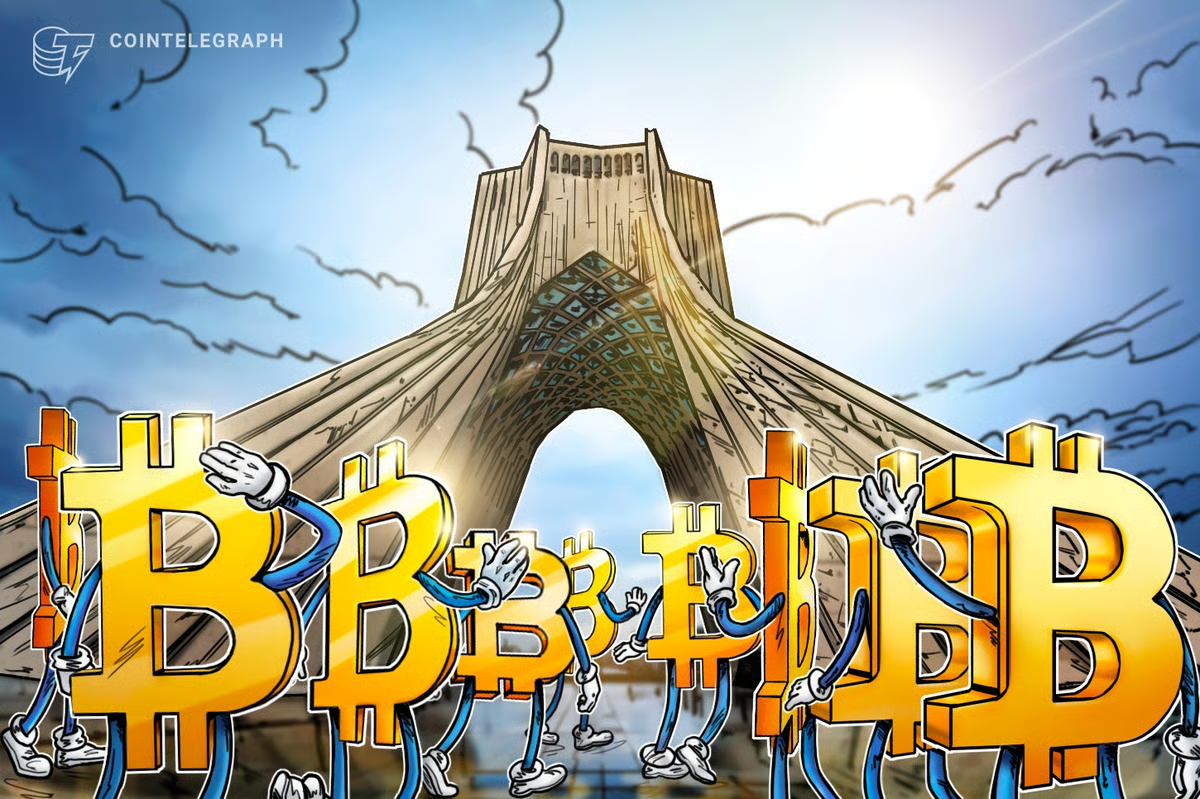
As monetary pressure on the rial intensified, public debate grew around the financial alternatives available in the event of a fiat currency crisis. In this context, Bitcoin (BTC) has started to appear in discussions as a potential exit option.
This article examines cases where Bitcoin is considered as an exit option during times of financial crisis. It describes the factors behind the decline of the Iranian rial in 2025, the debate around Bitcoin as a financial alternative, the comparative prospects of other struggling economies, and the limits of wider adoption of Bitcoin.
The collapse of the Iranian currency in 2025 and its structural causes
Iran’s currency difficulties have existed for a long time, but recent events have intensified the pressure. The rial has depreciated steadily over the decades, with the pace of decline accelerating amid high inflation, sanctions and prolonged economic mismanagement. As of December 30, 2025, the Financial Times reported that the rial had lost more than 40% of its purchasing power since June 2025, falling to approximately 1.4 million rials per US dollar.

Problems in the banking sector have further eroded the value of the rial. Iran’s central bank has warned that several national banks risk being dissolved unless reforms are implemented, and at least one major state lender has already gone bankrupt. These developments have fueled public anger and uncertainty, contributing to protests and political resignations, including that of the central bank governor.
Extensive international sanctions, imposed in response to Iran’s nuclear program and its support for regional militant groups, have further strained the economy. These measures limited access to the US dollar and global financial networks while weakening the domestic banking system.
The crisis intensified in October when Ayandeh Bank, one of Iran’s largest private lenders, collapsed after racking up $5.1 billion in losses and nearly $3 billion in debt. The assets of more than 42 million customers have been absorbed by Bank Melli, the country’s largest state-owned lender.
Earlier, in February 2025, the Central Bank of Iran warned that eight more national banks were at risk of being dissolved unless they undertake immediate reforms.
Bitcoin enters the conversation
Bitcoin is a digital asset that operates outside of national monetary systems. Its role in financial discussions often becomes more visible during periods of repeated economic mismanagement. When confidence in a currency deteriorates, public attention tends to turn to alternatives that are not directly controlled by the same institutions.
Bitcoin’s design as a decentralized and globally traded asset, without relying on a single government, makes it a frequent point of reference in these debates. Although barriers to adoption remain and adoption is neither immediate nor universal, Bitcoin is often discussed as a possible alternative in times of national currency tensions.
Did you know? During several currency crises, governments imposed cash withdrawal limits before interest in cryptocurrencies increased.
A recurring pattern: lessons from Argentina to Iran
Iran is not the first country where serious currency tensions have coincided with increased debate over cryptocurrencies.
In Argentina, decades of inflation and capital controls have pushed citizens into parallel financial systems. The use of cryptocurrencies has grown alongside the continued reliance on the US dollar and stablecoins. In Latin America, Argentina ranks among the countries with the highest levels of cryptocurrency ownership, with approximately 19.8% of the population holding digital assets.
Lebanon offers another example. The 2019 banking collapse and subsequent hyperinflation severely eroded public trust in the traditional financial system. As bank accounts were frozen, some people turned to Bitcoin and other digital assets to circumvent restrictive banking controls.
Turkey has also experienced periods of high inflation which have coincided with increasing cryptocurrency trading volumes. As inflation intensified, some citizens turned to digital assets during bouts of currency instability. Although adoption was not uniform across all segments of society, the level of activity was sufficient to attract the attention of regulators and the media.
Taken together, these cases reveal a recurring pattern. When national currencies lose credibility, digital assets tend to enter public discourse. Although the underlying conditions vary by country, the common trigger is the loss of confidence in fiat currency.
Did you know? In inflationary economies, younger populations tend to discuss Bitcoin more frequently online, while older generations often prioritize physical assets such as cash and gold.
Why Bitcoin Emerges During Institutional Failure
The recurring appearance of Bitcoin during financial crises can be attributed to several factors:
-
Loss of confidence in state-issued currency: When purchasing power declines rapidly, people begin to question whether money can reliably store value over time. This often leads them to explore alternatives, both traditional and digital.
-
Frustration with constrained financial systems: Sanctions, capital controls or bank failures can restrict access to foreign currencies and global markets. In such environments, assets that operate outside of conventional payment systems tend to attract attention.
-
Distinction between symbolism and practicality: In many cases, stablecoins are used more directly than Bitcoin. In these scenarios, Bitcoin’s role is often more conceptual, serving as a reference point in discussions about financial independence rather than as the primary medium of exchange.
Did you know? In crisis economies, peer-to-peer Bitcoin markets sometimes grow even when overall cryptocurrency ownership remains low, highlighting the gap between public debate and actual usage.
Barriers to Bitcoin Adoption
Despite the attention it receives, Bitcoin faces significant adoption limitations:
-
Unequal access: Reliable internet connectivity, secure devices, and technical knowledge are prerequisites that many people lack. Regulatory uncertainty further complicates adoption. Although activities such as cryptocurrency trading may be permitted in some jurisdictions, the rules regarding practices such as self-custody may remain unclear.
-
Volatility: Price volatility is another major constraint. The value of Bitcoin can fluctuate sharply over short periods of time, making it difficult to compare with more stable alternatives during times of acute financial stress.
-
Legal and operational risks: Governments facing currency crises often tighten financial controls, and cryptocurrency users may face sudden restrictions. Security risks also persist. Exchange hacks, like the $81 million Nobitex hack in June 2025, add another layer of uncertainty.
What crisis stories reveal about the future of money
The appearance of Bitcoin in discussions during the Iranian monetary crisis does not suggest a single or unified solution. Instead, it reflects a broader shift in how individuals view money during periods of extreme economic instability.
As seen in Argentina, Lebanon and Turkey, declining trust in traditional financial systems often coincides with an increased focus on digital assets. These discussions are driven by a mixture of frustration and experimentation, although significant practical obstacles remain.
The presence of Bitcoin in these debates suggests that monetary systems are no longer considered fixed or immutable. During crises, people tend to look beyond national currencies, although their ability to access and use viable alternatives varies greatly.
This article does not contain investment advice or recommendations. Every investment and trading move involves risk, and readers should conduct their own research before making a decision. Although we strive to provide accurate and timely information, Cointelegraph does not guarantee the accuracy, completeness or reliability of the information contained in this article. This article may contain forward-looking statements that are subject to risks and uncertainties. Cointelegraph will not be liable for any loss or damage arising from your reliance on such information.


