




Key points to remember:
- JD Vance’s net job approval fell 21 points between January 2025 and April 2026, according to CNN poll data.
- Polymarket’s 2028 Presidential Market Reached $521.6 Million in volumewith Vance leading with an 18.9% rating.
- Kalshi gives Vance a 21% chance in 2028, but Gavin Newsom at 17% is quickly closing the gap.
JD Vance endorsement hits lowest VP rating in modern era as 2028 speculation grows in prediction markets
CNN data analyst Harry Enten reported a decline in a recent segment, citing a poll that puts Vance’s net job approval at -18 as of early April 2026. A CNN/SSRS survey from late March showed 37% approval compared to 62% disapproval. In January 2025, the same measure was approved by 41% and disapproved by 58%. Civiqs, in an April 8 poll, estimated his preference at 37% favorable and 57% unfavorable. Enten described the early-term net rating as the lowest recorded for a vice president in modern polls.
The phrase “the most unpopular vice president in American history” is often repeated, but it carries an asterisk. Historical vice presidential polls are rare before recent decades. Former Vice President Dan Quayle and former Vice President Dick Cheney both saw unfAvorables climb into the 60% range over the course of their term, but not necessarily to the same extent in their first term. Former Vice President Kamala Harris faced similar claims during her time in office. The comparison matters most as a directional signal, not as an established historical verdict.
The causes of this decline are not difficult to trace. US military involvement in strikes on Iranian sites coincided with gas prices climb above $4 a gallon nationally and widespread disapproval of the administration’s handling of the inflation. Some polls show that only 27% of respondents approve of the administration’s decision. inflation management. Voter dissatisfaction with cost of living pressures has persisted even as underlying economic data shows GDP growth forecasts around 2% and unemployment near 4.3 to 4.4%. Public perception of the economy and how the administration actually manages it has diverged sharply.
Tariffs have added to the pressure. Broad trade measures, the threat of 50% tariffs on countries aiding Iran and ongoing supply chain frictions have driven up prices of consumer goods in the public mind, regardless of the underlying data. This perception gap is politically damaging as the 2026 midterm elections approach.
The erosion of the coalition has also become visible. Voter groups that shifted to the Trump-Vance ticket in 2024, including Latinos, younger voters and independents, showed measurable decline in 2026 polls. White non-college voters also declined in some polls. Vance’s numbers closely follow P’sresident Trump’s own approval, which has fallen to between 35 and 35 in several recent polls from CNN, Reuters/Ipsos and UMass.
On Polymarket, the 2028 US presidential election market generated a total of $521.6 million trade volume. Vance currently holds an 18.9% win probability, with over $10.2 million in individual contract volume. California Governor Gavin Newsom sits at 16.9% with the highest individual volume among the top candidates at $14.1 million.
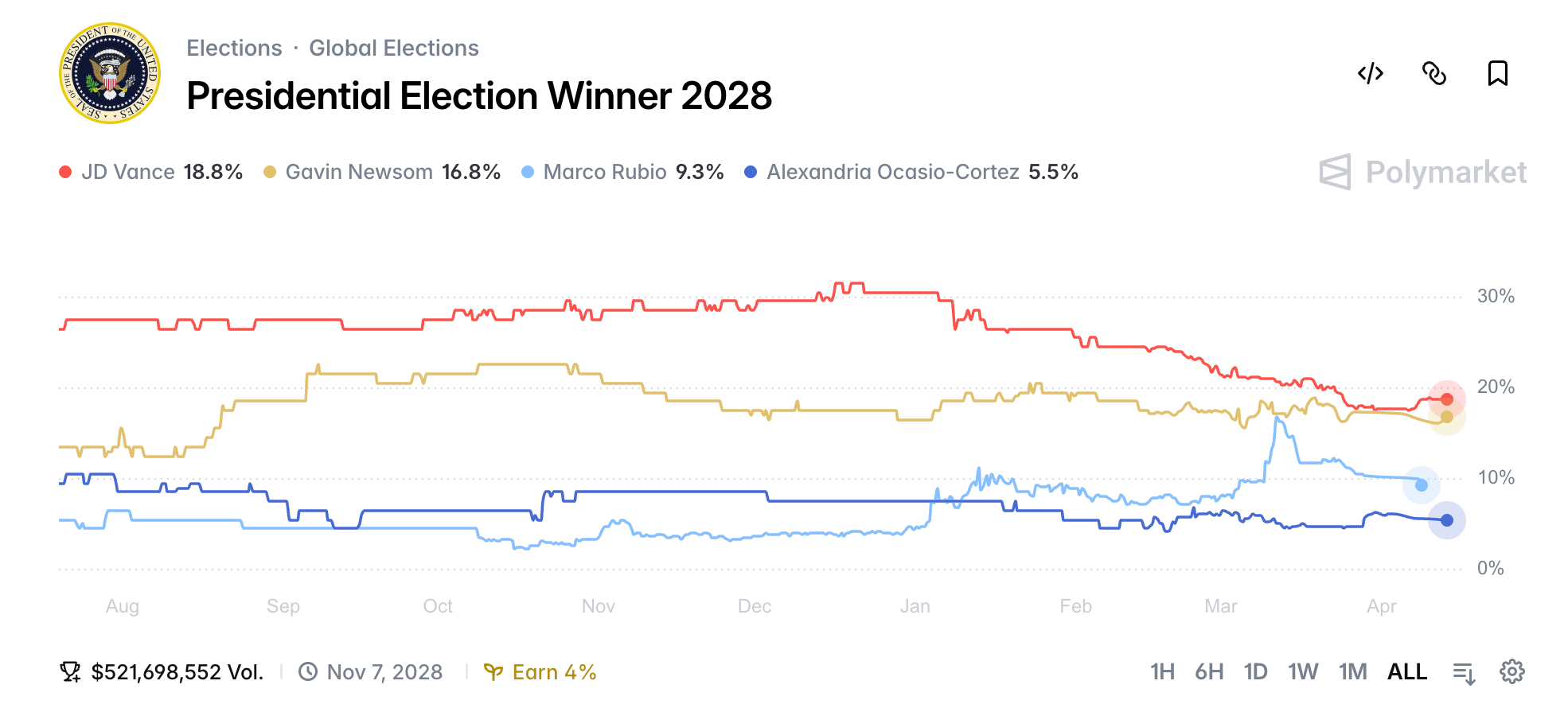
Senator Marco Rubio has 9.5% and Representative Alexandria Ocasio-Cortez (AOC) 5.5%. Long-term volumes on this platform have produced some striking numbers: LeBron James and Kim Kardashian, each holding 1% ratings, generated $46.4 million and $32.8 million in trading activity, respectively. Traders are clearly positioning themselves early and, in some cases, speculatively.
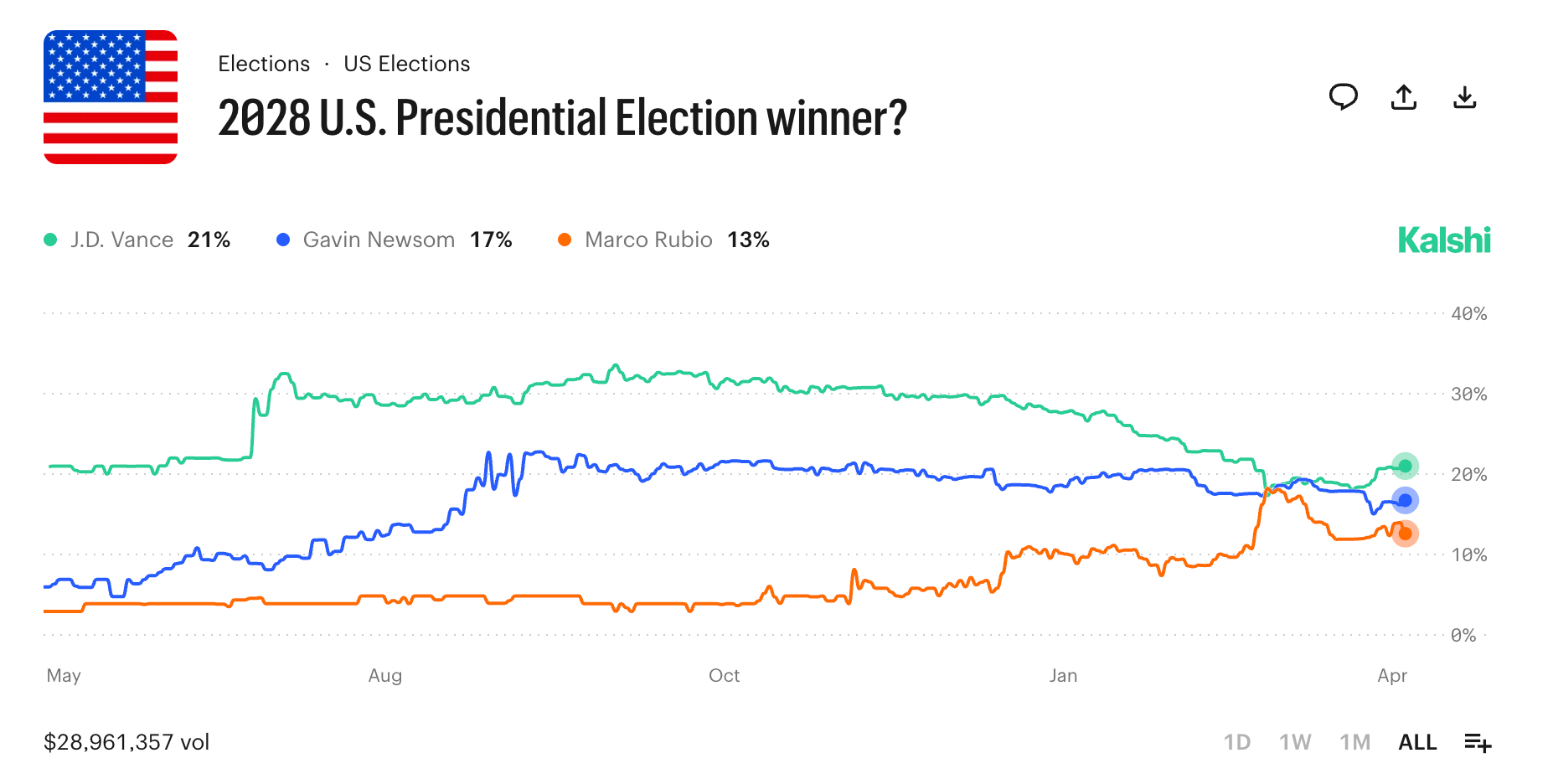
The Kalshi market in 2028, with a total volume of $28.9 million, presents a similar picture at the top. Vance leads with 21%, Newsom follows with 17% and Rubio is third with 13%. On the Democratic side, Ocasio-Cortez holds 6.4%, Jon Ossoff 4.5%, Josh Shapiro 3.6% and Kamala Harris 3.5%. The Republican bench lags behind the leaders: Donald Trump sits at 2.6%, Ron DeSantis at 1.9%, ad Tucker Carlson at 1.9%. Nontraditional entries include JPMorgan Chase CEO Jamie Dimon and ESPN analyst Stephen A. Smith, both at 0.9%.
Vance enjoys strong support among the Republican base. That hasn’t changed. But the broader approval numbers and narrowing gap with Newsom on both platforms reflect a less comfortable political position than it was 15 months ago.
Polling aggregates have margins of error and public opinion can change quickly. A strong, lasting ceasefire in Iran, lower gas prices, or a break in economic anxiety could stabilize the trend line. Midterm dynamics tend to punish the ruling party when financial concerns dominate, and that is currently the case.
The 2028 race is still two and a half years away. The betting markets are open and the field is vast. Vance leads them both, but the margin is narrowing by the day.


