




Kaito (KAITO) soared 13% in the past 24 hours, one of its biggest gains in recent sessions, driven largely by a surge in buying activity in the market.
The question now is whether KAITO can maintain the trend in a market that has yet to fully recover – a rally that took shape as retail investors took control of the trend, even as selling pressure gradually builds.
Individual investors take over KAITO
Retail investors have been behind much of KAITO’s rise, with Whale Delta data indicating a clear takeover of the market.
The whale-to-retail ratio measures which group determines the trend of an asset, turning green when whales dominate the movement and red when retail traders have the upper hand.
This is the first time that retail investors have taken over the asset since January 14, as whales have dominated for much of the year, and this retail participation has directly fueled the rally.
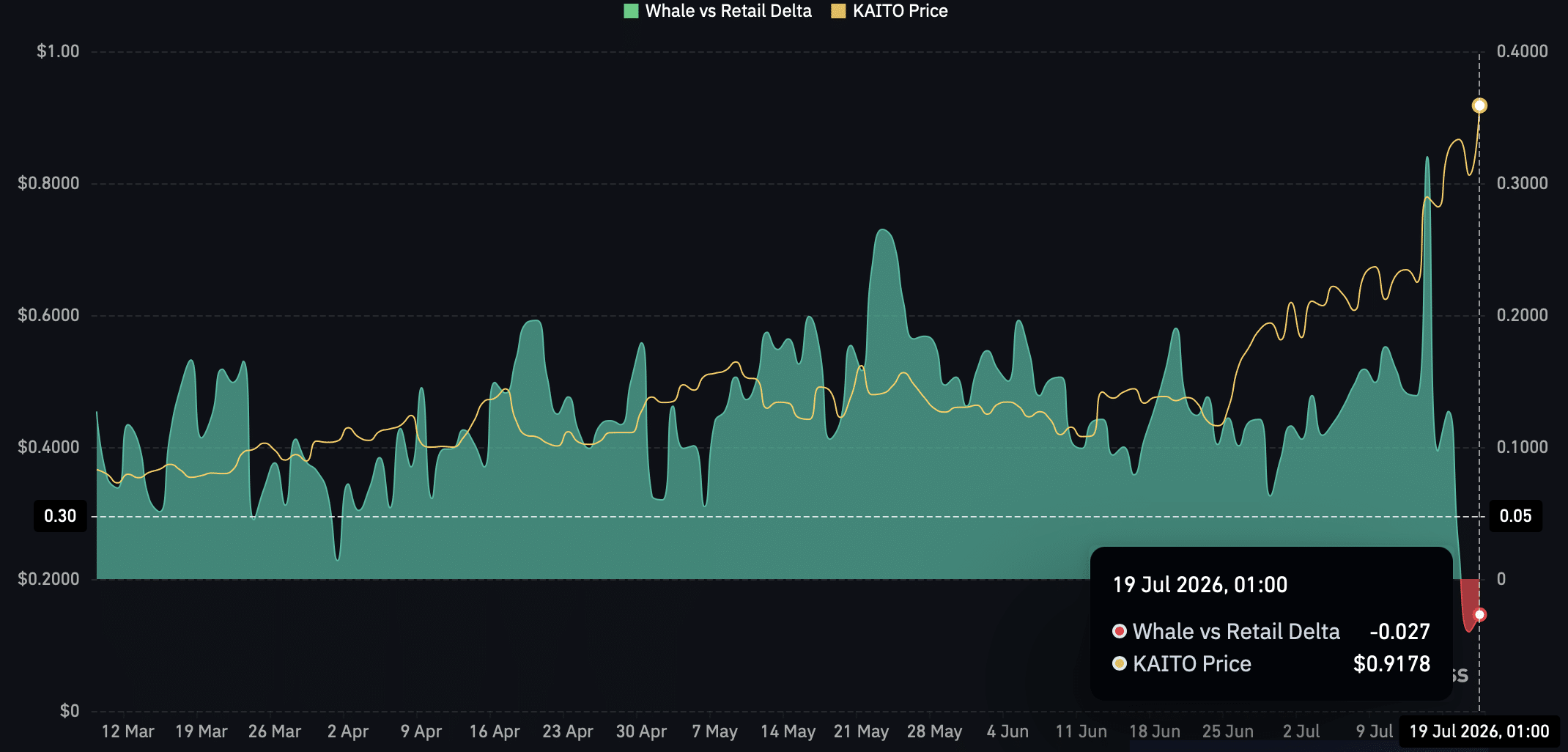
Early signs point to a growing seller base, however, as spot market data shows selling pressure gradually increasing.
Data from CoinGlass, whose spot flow measure tracks these sales, records a total sale of approximately $3.22 million compared to total purchases of $2.77 million. This gap between buyers and sellers leaves the net cash flow at a net outflow of approximately $447,580.
While this move may reflect profit-taking, it nevertheless indicates increasing dominance of sellers over the same period.
Perpetual market drives recovery, but risk rises
The perpetual market has become one of the main drivers of the recovery, with derivatives activity dominating the movement.
Open interest in the perpetual market jumped 15% in the last 24 hours, with the balance reaching $122 million at the time of writing, as traders pump capital into the market.
The funding rate confirms this, remaining positive at 0.0021% and showing that most perpetual capital in the market is in long positions. This figure, however, slipped from the high of 0.0039% the day before, July 18.
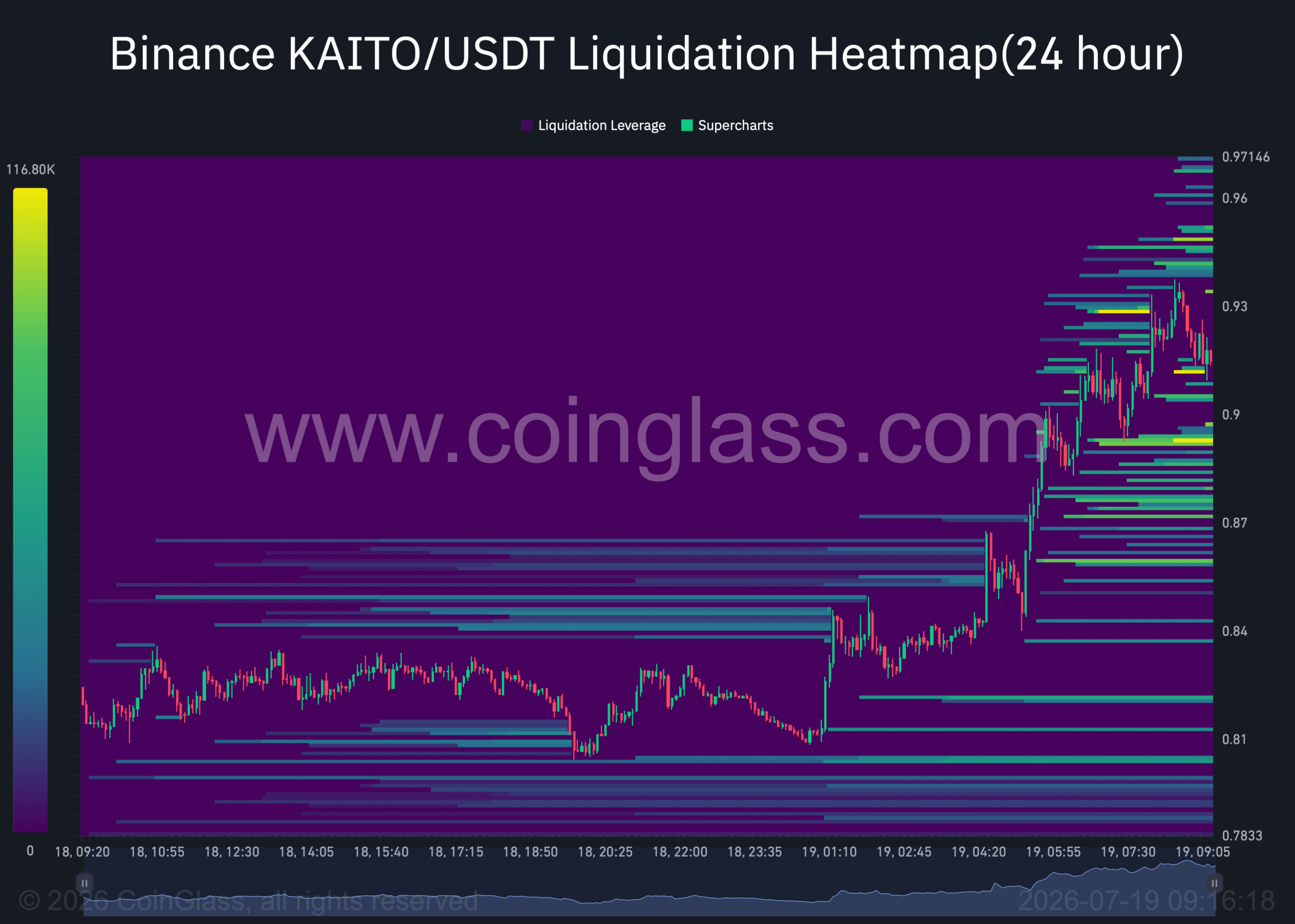
This decline indicates a decrease in long exposure as short contracts expand in parallel, and the liquidation heatmap warns that any pullback could extend well below current levels.
The liquidation heat map, which maps interest groups on the chart that tend to pull prices towards them, shows that KAITO could slide down to $0.78 where the cluster extends over a 24-hour period.
The rally could be a bull trap
Spot profit-taking and falling funding rate suggest traders are positioning for an upcoming selloff, leading to speculation the rally is a bull trap.
A bull trap forms when traders take long positions in an asset hoping for a rally, only for a large sell-off to follow and trigger the stop losses on those long positions.
This view relies on the upcoming token unlock of KAITO, which, according to DeFiLlama tracking, will release $15.84 million in assets to the market on July 20, or 7.29% of its circulating float.
This increase in supply is expected to shift the balance between supply and demand and put downward pressure on KAITO, resulting in significant risk to long positions still open at that time.
Final summary
- Retail investors took the reins of KAITO’s 13% jump, marking their first real hold on the asset since January after months of whales in charge.
- Kaito’s rally is on shaky ground, with a $15.84 million token unlock on July 20 and traders quietly reducing their bullish bets.


