



In sub-Saharan Africa, only 3% of the 48 million smallholder farmers are insured. Owning 1 acre of land and earning approximately $1.40 per person per day characterizes a small farmer. Smallholder farmers often have a combination of cash crops and subsistence or non-commercial farming; and they lack the financial and technological resources of large-scale factory farms. As extreme weather events become more frequent due to climate change, a flood or drought can push these farmers into the cycle of poverty, without protection through crop insurance.
The following is an update from Ethereum Foundation Fellow Benson Njuguna.

Benson’s mission is to uplift humanity economically through innovative ideas driven by technology. He is a business transformation specialist at ACRE Africaa microinsurance service provider based in Kenya. To learn more about the Ethereum Foundation Scholarship Program, read this blog post.
Barriers for farmers: trust and affordability
Companies like ACRE Africa have supported farmers by offering risk management solutions and agricultural insurance products that address the precarious and uncertain livelihoods farmers face. One of the challenges in this area is that farmers have a negative preconceived notion of insurers due to a history of delayed or absent payments. Farmers are not used to receiving crucial information regarding their policy, even something as simple as confirmation of whether they will receive compensation for losses incurred.
At ACRE Africa, a typical small farmer with a half-acre plot pays around USD 50, which is just enough to cover agricultural inputs such as seeds and fertilizers.
For insurance companies, such low premiums mean they need scale to break even, let alone turn a profit. Savings from digitalization and automation are crucial, not only for the commercial viability of insurance companies, but also to ensure that farmers can afford the insurance premium.
The problem: the old crop insurance payment system
Every farmer’s life is shaped by two seasons in Kenya and the region: the long rainy season and the short rainy season. The long rainy season begins in April and ends in July, while the short rainy season begins in October and ends in December. For the first cycle of the long rainy season, in April, farmers start purchasing insurance. To get started, they have to fill out lots of forms. Once the forms are completed and the insurance product is purchased, ACRE Africa tracks risk and climate until the end of the season. In short, if there is a weather event during the period for which a farmer has insurance, they will not be paid until after the start of the next season. However, without insurance, farmers would have suffered financial losses and would have struggled to continue their farming activities the following season.
The solution: BIMA PIMA from ACRE
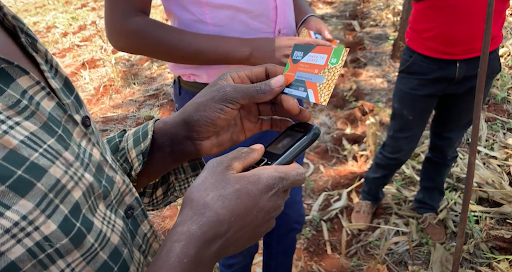
A farmer in Embu County, Kenya, activates his insurance policy using a scratch card included in the bag of seeds he purchased. (Thanks to Acre Africa for providing this photo)
The BIMA PIMA product, which literally means small installment insurance, is one of ACRE Africa’s newest insurance solutions. It was implemented in partnership with Aetheriskwhose team developed a decentralized insurance platform on Ethereum.

Farmers seeking coverage with BIMA PIMA first purchase seed for the season from a partner agricultural supplier. Each seed packet includes a scratch card with a unique registration code. For the pilot, we included the price of basic insurance in the seed price, but farmers can also purchase additional coverage through a mobile payment network (M-PESA).
While planting the seeds, the farmer will use SMS/USSD to activate the insurance policy. Upon USSD activation, their location and phone number, along with all other relevant details obtained from the registration code (such as crop type and quantity covered) are transmitted into the policy smart contract on the xDai Channel; this process is known as triangulation and results in the automatic creation of a new policy. The farmer immediately receives an SMS informing him that the policy is active.
The alternative system monitors and compares actual and historical weather data that triggers the approval of a claim. Here, payment is not based on human assessment, but rather on predefined “windows” or phases throughout the agricultural seasons (i.e. germination, vegetation, flowering, excess rain). As long as the weather and climate data collected meets the criteria agreed in the policy, the claim is approved; farmers then receive payments during the current season and do not have to wait until the end of the season, as was the case previously. Farmers will receive an SMS after the policy is triggered and can check the status of their insurance policy via a mobile device.
Our goal is to earn the trust of every farmer by providing more relevant information, faster payments, reduced insurance product costs as well as an audit trail for accountability.
First payment made via blockchain
Earlier this year, we made our first payment to a farmer, Samuel, who took out an insurance policy for corn seeds!
To date, 511 mid-season payments, totaling KES 75,295 (2,766 USD) were made.
Next obstacles and steps
Although this new system addresses existing challenges and improves on current systems in Kenya (and soon in Tanzania and Zambia), it has not been without hiccups. We are still far from a fully “decentralized” insurance solution. Payments, for example, although technically possible, are not yet fully automated. One of the main challenges remains improving processing times for claim approvals. Just like in the old payment system, claims end up on someone’s desk, awaiting approval. Likewise, the parties external to our project (e.g. the insurer, the reinsurer who supports us in processing claims and the regulator) also have their own autonomous system, and there are still aspects which become bottlenecks. ‘throttling because they require manual approval. process. Moving forward, we will share relevant policy information with all stakeholders. With direct access to a system via custom dashboards, we imagine each stakeholder accessing a source with a full audit trail.
I hope our BIMA PIMA insurance product can serve as a successful model for revitalizing much-needed trust between farmers and insurers. I took up IT to help my community and realized from a young age that technology was necessary to enable countries like Kenya to be part of the global market. I’m excited to be a part of it and work toward a future where millions more family farmers and billions of people in developing countries experience the beginnings of decentralization.
We hope that you will continue to stay in touch with the Scholarship Programand we would love to hear from you if you would like to contact us by email at bourse@ethereum.org. Finally, connect with Benson on Twitteror contact online to contact other fellowsor to learn more about the program.


