



A U.S. bankruptcy court approved Linqto’s sale of approximately $130 million worth of Ripple Labs common stock to four institutional buyers, with Galaxy Digital anchoring the deal at $60 million, followed by Arrington Capital at $50 million, the Private Shares Fund at $16 million and GAM Alternatives Lux at $4 million, with the proceeds going to the Chapter 11 Wind-Down Trust to support recovery of customers.
This is not simply a liquidation of distressed assets. It’s a structured demonstration that institutional demand for Ripple’s private market equity spans a wide price range, even as the bankrupt company’s bulk moves to unwind a platform that once served retail investors seeking pre-IPO access.
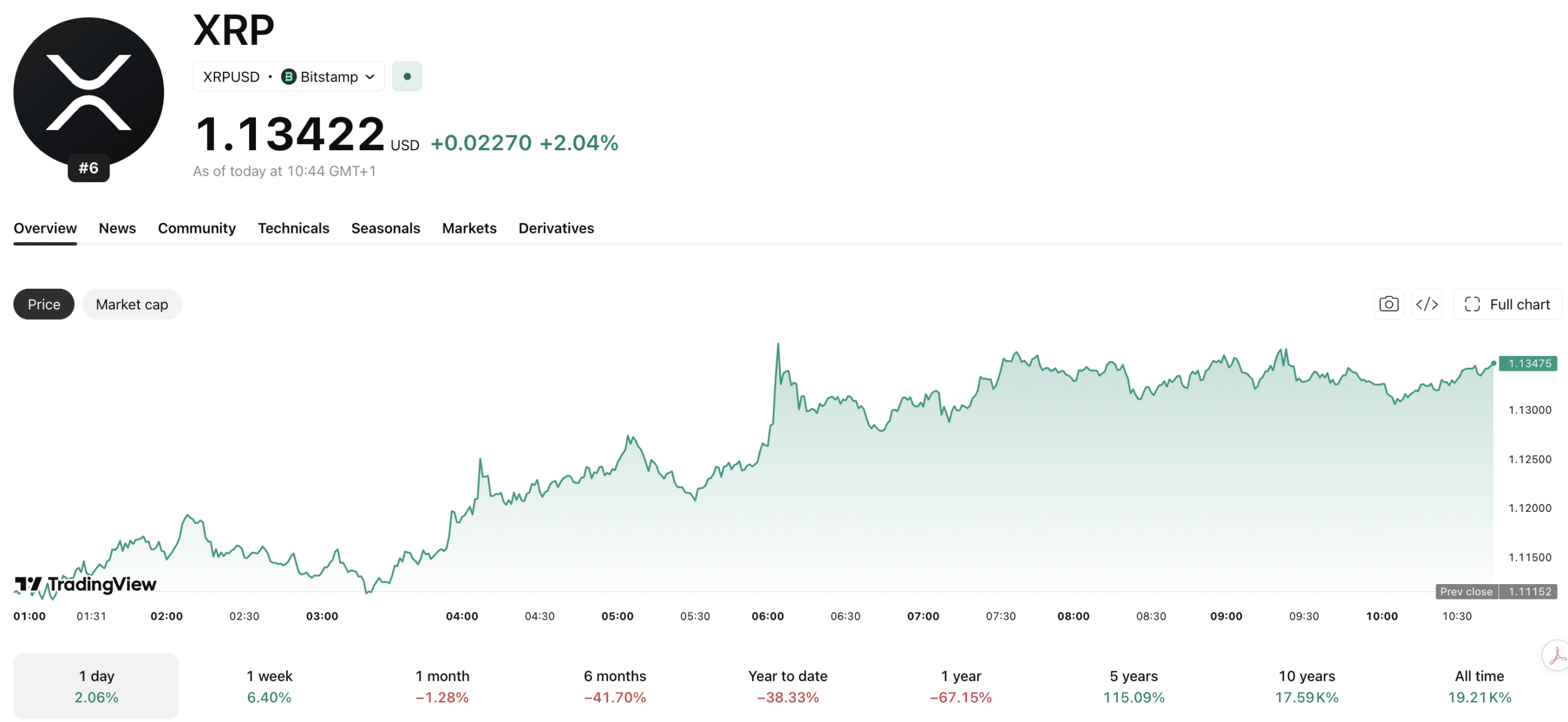
This decline in Ripple came as XRP surged almost +4% overnight, trading at $1.13 and clearing the $1.10 resistance. The daily trading volume also increased day by day and stands at $1.29 billion.
🚨 The court just approved Linqto’s sale of $130 million in private Ripple shares.
Galaxy Digital, Arrington Capital, Private Shares Fund and GAM Alternatives are acting as buyers. Ripple-exempt ROFR institutions are still lining up for XRP exposure at private valuations. 👀 pic.twitter.com/ClRG18ycE6
– 𝗕𝗮𝗻𝗸XRP (@BankXRP) July 20, 2026
Ripple Stock Sale: Buyer Allocations, Price, and ROFR Waiver
The four simultaneous transactions result in significantly different per-share prices: Galaxy Digital acquired shares as part of its $60 million allocation, while Arrington Capital paid $50 million, and Private Shares Fund and GAM Alternatives Lux paid $16 million and $4 million, respectively.
Galaxy’s block is the largest of the four in terms of number of shares and gross proceeds, according to the summary of the asset purchase agreement reviewed by Bondoro. Ripple waived its right of first refusal (ROFR) on the Galaxy block, validating the transaction without requiring co-sale adjustments.
Galaxy’s $60 million entry represents a reduction from the $50 million, $16 million and $4 million paid by other institutional buyers in that same sale. The pattern of institutional accumulation during periods of secondary market dislocation is consistent with Galaxy’s historical approach to Ripple exposure.
The transaction is a secondary sale of shares. It does not convey any IPO signals and has no direct impact on XRP holders or the XRP token economy. Investor materials from Ripple’s November 2025 round indicate that this does not affect XRP holders.
Linqto has obtained court approval to sell approximately $130 million worth of @Ripple shares as it prepares for the Ch. 11 release. Ripple has declined its right of first refusal on transfers. Buyers:
Digital Galaxy ~$60
Arrington Capital ~$50 million
The Private Equity Fund $16M
GAM Alternatives (Lux) $4 million
The funds support the recovery of clients.… pic.twitter.com/57GGyBjwyQ– 🌸Eri ~ Carpe Diem (@sentosumosaba) July 20, 2026
DISCOVER: Best Meme Coins to Buy in 2026
Bankruptcy of Linqto: context and global conflict with Forge
Linqto closed its doors in March 2025 and filed Chapter 11 in July 2025 after new management identified potential securities law violations dating back to 2020 involving the structure of special purpose vehicles used to pool client investments.
The bankruptcy estate covers stakes in approximately 111 private companies valued at more than $500 million. On February 6, 2026, the court upheld Linqto’s restructuring plan with approximately 95% customer support, proposing recovery via a liquidation fund, a publicly traded open-end fund holding private shares, or a combination of both.
This recovery process now faces a new complication. According to Bloomberg Law, Linqto and its official unsecured creditors committee sued Forge Global Holdings after the private marketplace platform attempted to withdraw from its role as trustee of the clients’ recovery trust just five days before the July 20 launch date.
Forge cited demands from its new parent company, Charles Schwab, to justify its withdrawal. Forge was to hold client assets, manage share transfers and administer the recovery plan.
The court is asked to force Forge to honor its agreement. The dispute could delay asset transfers and increase legal costs, but it does not affect the validity of Ripple shares already sold or the value of XRP. For Linqto users indirectly exposed to Ripple, the key question is administrative timing and not asset integrity.
Institutional Importance: What the Ripple Price Gap Indicates
(SOURCE: TradingView)
The sale includes allocations between four buyers, with Galaxy Digital’s $60 million block representing the largest gross proceeds. Galaxy’s discount likely reflects its block size and the mechanics of a struggling secondary trading rather than a divergent view on Ripple’s intrinsic value.
Sustained institutional demand for Ripple shares at these price levels, alongside Ripple targeting a $1 billion revenue run rate in 2026, suggests that the private market valuation floor holds even under bankruptcy sale conditions.
The Linqto Ripple block is likely the first, not the last, major institutional sale of this holding as the liquidating trust proceeds to monetize its broader portfolio of 111 companies.
EXPLORE: The Best Meme Coins to Buy in July
following
Disclaimer: Coinspeaker is committed to providing unbiased and transparent reporting. This article is intended to provide accurate and current information, but should not be considered financial or investment advice. Because market conditions can change quickly, we encourage you to verify the information for yourself and consult a professional before making any decisions based on this content.

Daniel Frances is a technical writer and Web3 educator specializing in macroeconomics and DeFi mechanics. Hailing from crypto since 2017, Daniel leverages his experience in on-chain analytics to write evidence-based reports and in-depth guides. He holds certifications from the Blockchain Council and is dedicated to providing “insight gain” that overcomes market hype to find real utility for blockchain.


