



Key takeaways
- Jensen Huang’s 2026 AI Factory Map highlighted NVIDIA’s DSX development framework.
- Marvell has gained 241% year to date; AI infrastructure companies could see increased investor attention.
- NVIDIA plans 100 GW of AI factories by 2030, drawing attention to ecosystem partners.
The following guest post is from Ziven.io, a public market intelligence platform providing data on companies exposed to bitcoin miningartificial intelligence and crypto cash flow strategies. Originally published on June 18, 2026 by Cindy Feng.
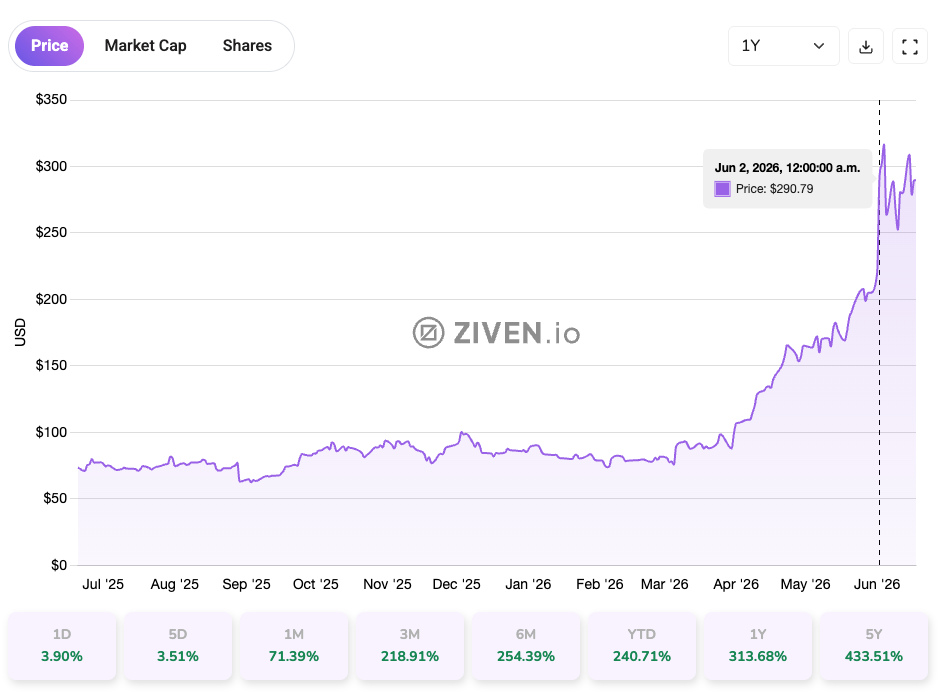
Since Jensen Huang took the Computex stage and called Marvell “the next trillion-dollar company,” MRVL hasn’t looked back. A stock that was trading between $50 and $100 in April is now around $300, with an ATH of around $316 and a year-to-date gain of around 241%. One sentence from Jensen and a quarter-trillion dollar revalued company.
Not surprisingly, a new exercise has begun: comb through everything Jensen says, find the next name he will bless, and become rich.
I understand that impulse, but what’s clear from listening to Jensen’s entire speech is that most people are looking at the wrong thing. Jensen didn’t just throw out a hot name, he laid out a complete map of how an AI factory is actually built, layer by layer, company by company. This card is the part worth knowing about, because it still works long after the hype has worn off. I’m going to walk you through this specific slide, but first let’s start with the part that confused a lot of people.
RTX, DGX, DSX: worker, team, factory
Jensen divided the NVIDIA brands into three layers, each one a unit larger than the previous one:
- RTX is the GPU, the worker. The chip that does the actual calculation. A pair of hands.
- DGX it’s the system, the team. Wire a stack of these chips into a single machine and you get a DGX. A crew acting as a single unit.
- DSX it’s the infrastructure, the factory. The building these teams work in, and the power, cooling, networking, and software needed to keep thousands of them running around the clock.
RTX and DGX which you have probably heard of. DSX is the new one, and it’s the one worth understanding, because it’s where NVIDIA stops selling you a chip and starts selling you a way to build the entire factory.
What is DSX?
In Jensen’s words, DSX is “a blueprint, a reference design for building and operating AI factories with maximum efficiency and profitability.”
In simpler terms, it’s a recipe and toolkit for starting a gigawatt of computing and keeping it profitable. NVIDIA even named the elements of the toolbox: a digital twin to design and test the entire factory before shipping a single rack (DSXSim), an operating system to run it once it’s up and running (DSX OS), and tools to fit more GPUs into the same power budget and scale to the grid (DSX Max LPS, DSX FLEX). The argument is that 100 gigawatts of these plants will come online before the end of the decade, and that those built by DSX will operate cheaper and lean more gently on the grid.
This all sounds like something NVIDIA would sell you on its own. This is actually not the case.
No single company can build an entire AI factory
A gigawatt AI factory is now a 30 to 100 billion dollars project, according to Jensen. At this scale, it ceases to be a server room and becomes an infrastructure on the order of a refinery or a power plant.
NVIDIA can’t build this alone. It doesn’t pour concrete, run high-voltage lines, make chillers, or negotiate with local utilities. And you can’t put these pieces together one by one, because the chips, racks, networking, power, and cooling all have to be designed together from day one. Every hour the factory sits idle means lost revenue, so such an expensive build has to work the first time.
So NVIDIA did the reasonable thing: it published the plan and assembled a coalition of partners to cover all the layers it doesn’t manage itself. This coalition has a name, the AI Factory Ecosystemand Jensen put the whole list on one slide. This slide is the map.
The Map: Who Really Builds an AI Factory
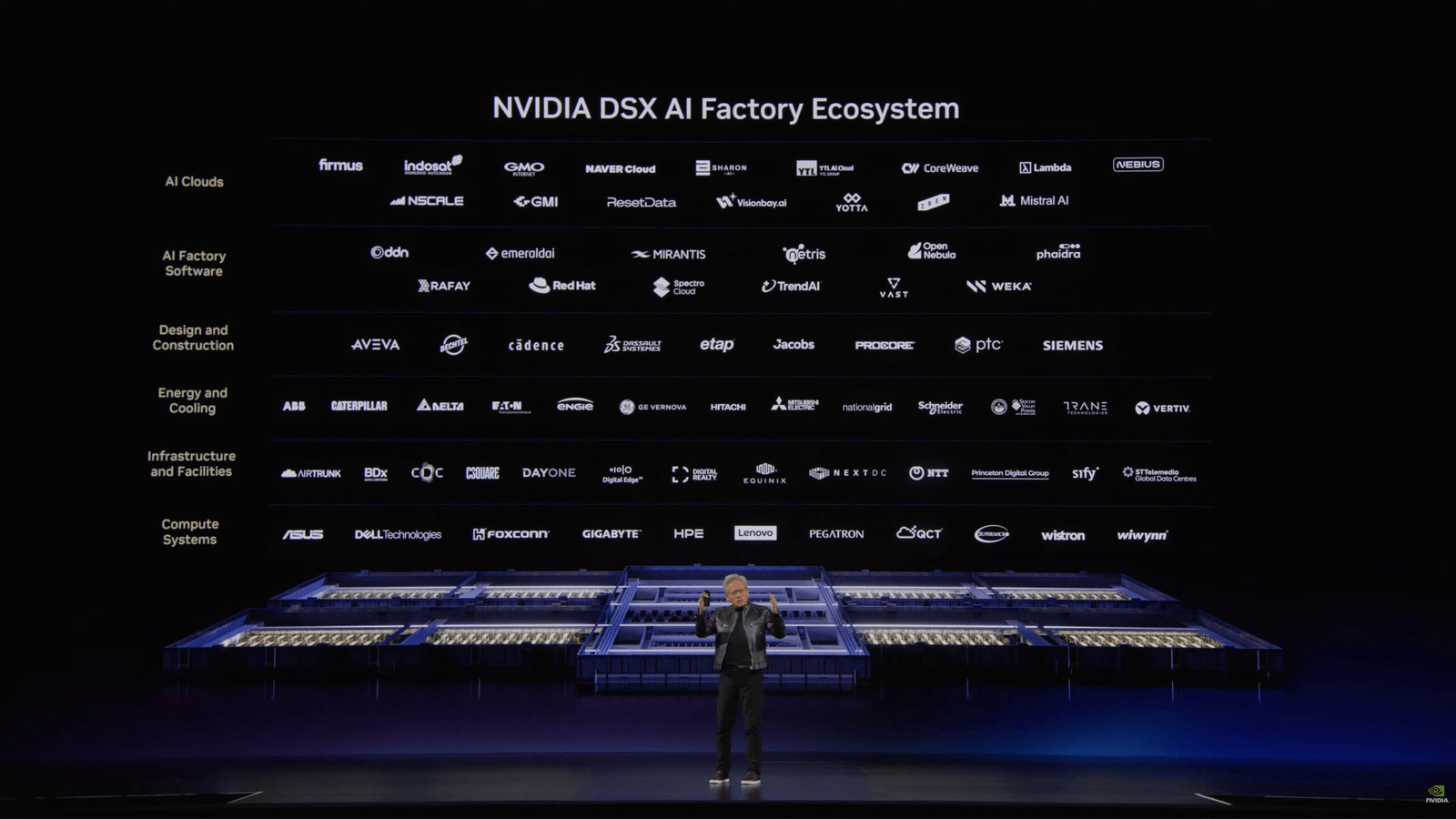
Most of these companies are privately held or listed overseas, but there are still a large number of companies listed in the United States. I created a table to list all the publicly traded names from the map. The last column is my rough reading from every company that actually relies on AI developmentbecause being on the slide (could be based on marketing objectives) and being moved by it are two very different things.
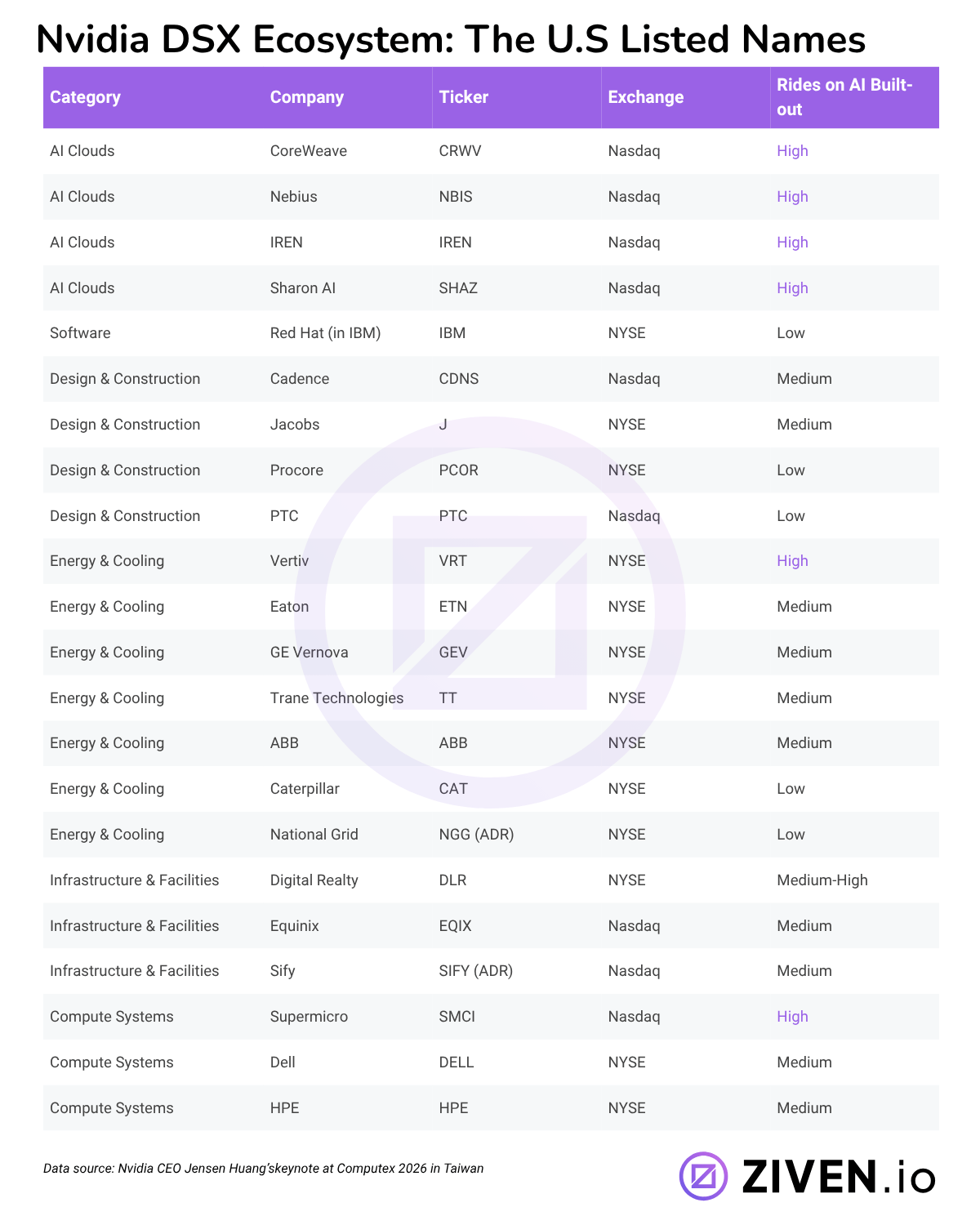
Please note that publicly traded or foreign names are excluded from the table. If you want the full CSV list, just send me a message and I’ll send it to you. Additionally, a few names are still private with upcoming IPOs, such as Lambda (US), Nscale (UK), Firmus (Australia), and Yotta (India).
Important note
You need to understand that a logo tells you that a company is involved, but it doesn’t tell you if the involvement is significant. For CoreWeave or Vertiv, demand from AI factories is essentially the whole story. For Caterpillar or National Grid, it’s a fragment of a much larger company that will barely move its inventory. THE “High rows give you torque and volatility in equal measure. THE “Low” linesyou offer a more stable business with only a thin thread tied to AI-integrated commerce.
Final Thoughts
Maybe one of these names will become the next Marvell, maybe none will. It’s not a decision I can make from a slide, and chasing the logo you hope Jensen will bless next is closer to a guessing game than a strategy.
The lasting value here is the map, plus a more specific question to consider. For any name on this chart, how much of their business is actually based on AI development? How much pricing power does its layer hold? Diversified incumbents and commodities certainly have different levers and risk profiles.
Here’s what doesn’t change: Every hyperscaler deal you talk about, every “X gigawatt data center” title, is quietly dependent on this entire stack being delivered. Someone designs it, someone builds it, someone powers it, someone cools it, someone sets up the servers, someone manages it. This table is the list of actors. Choose a layer that interests you and weigh its exposure against the pricing power it holds. This is where the real work begins. The map won’t tell you what to buy, but it’s a framework you can refer to.


