



picture:
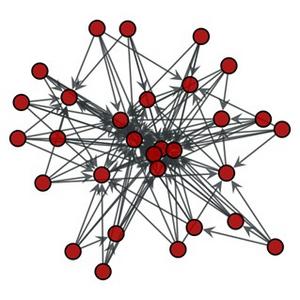
Conceptual illustration of peer-to-peer connections in an IoT-blockchain network. The proposed Dual Perigee algorithm can dynamically reorganize these links to improve data transmission efficiency.
see more
Credit: Renepick from Wikimedia Commons Source link:
The vision of a fully connected world is quickly becoming a reality thanks to the Internet of Things (IoT), a growing network of physical devices that collect and share data over the Internet, ranging from small sensors to autonomous vehicles and industrial equipment. To ensure that this data is secure and not tampered with, engineers are increasingly turning to blockchain as a promising solution. Although often associated with cryptocurrencies, blockchain is essentially a decentralized digital ledger; instead of a single company controlling the data, it is shared and managed collectively across a network of computers.
Unfortunately, existing blockchain systems may be too slow for the split-second decisions required in real-world IoT environments. The main cause of this slowness is not the blockchain protocol itself, but the disorganized way that nodes in peer-to-peer networks communicate. Most previous research has ignored the impact of the overall shape of these connections, called “network topology,” on the speed of IoT-blockchain systems.
To fill this knowledge gap, a research team led by Associate Professor Kien Nguyen from the Institute of Advanced University Research/Graduate School of Computer Science, Chiba University, Japan, studied how to streamline operations in IoT-blockchain networks. Their study, published in the journal IEEE Transactions on Network and Services Management on December 17, 2025, examines the impact of different network topologies on performance and introduces a new method to ensure efficient data flow. “Our goal was to bridge the gap between theoretical design and practical deployment of IoT-blockchain systems by identifying the root causes of their high latency and proposing a decentralized solution that is both simple and effective,“, explains Dr. Nguyen. The study was co-authored by Koki Koshikawa, Yue Su and Hiroo Sekiya, all from Chiba University.
First, to understand the root cause of the delays, the researchers implemented a method to generate different network topologies and connect simulated blockchain clients. After analyzing different representative cases, they showed that the decentralized nature of IoT networks often leads to redundant data transmissions. Specifically, they found that current protocols for sharing “transactions” (individual data entries) and “blocks” (the largest sets of verified records) can cause an exponential increase in data copies. This causes network congestion and queue delays, especially when nodes are connected in a way that creates too many overlapping paths.
In response to this problem, researchers developed “Dual Perigee,” a lightweight, decentralized algorithm that allows each node to intelligently choose its preferred “neighbors” in the network. Instead of sticking to a series of random connections, a node using Dual Perigee assigns scores to its peers based on how quickly they deliver both individual transactions and full blocks. If a neighbor is consistently slow, the node automatically disconnects and tries new peers. Over time, the entire network self-organizes into a high-throughput configuration without the need for a central controller.
After testing in a simulated 50-node IoT environment, the Dual Perigee algorithm reduced block delays by 48.54% compared to the standard approach used in the popular Ethereum blockchain. It also outperformed state-of-the-art methods, such as the original Perigee algorithm, by more than 23%. Notably, the researchers achieved these gains without adding additional computational load to the IoT devices themselves, because the algorithm relies on “passive” measurements of the data that the devices were already receiving and requires only minimal calculations.
This work has significant implications in many technological areas. By minimizing the time it takes for a blockchain to confirm and share data, the system becomes responsive enough for time-sensitive tasks. “The proposed decentralized latency-aware peer selection mechanism can serve as a foundation for future blockchain platforms that will support critical IoT services in real-time, thereby enabling more secure, responsive, and reliable digital infrastructures.“, explains Dr. Nguyen.
As the size and complexity of IoT networks continue to grow, the need for decentralized and reliable means of communication will only increase. The research team believes Dual Perigee could play a key role in the near future, as Dr Nguyen notes: “Our approach can be applied to emerging IoT-based services that require fast and reliable data sharing, such as smart cities, smart homes, industrial monitoring, healthcare systems, and supply chain tracking.»
To see more news from Chiba University, click here.
About Associate Professor Kien Nguyen from Chiba University, Japan
Dr. Kien Nguyen received a bachelor’s degree in electronics and telecommunications from Hanoi University of Science and Technology (HUST), Vietnam, in 2004, and a Ph.D. degree in computer science from Graduate University for Advanced Studies, Japan, in 2012. He joined Chiba University in 2018, where he is currently an associate professor. His research covers a wide range of topics related to networks and distributed systems, including the Internet, Internet of Things technologies, and distributed ledger technologies. His research results have been disseminated through three patents, several IETF Internet releases, and more than 160 publications in peer-reviewed journals and conferences.
Funding:
This work was supported by the Japan Society for the Promotion of Science (JSPS) (grant number: 23H03377) and in part by the Japan Science and Technology Agency (JST) through the establishment of University Scholarships for Creating Scientific and Technological Innovations (grant number: JPMJFS2107).
Reference:
Authors: Koki Koshikawa1Yue Su1Jong Deok Kim2Won-Joo Hwang2Zhetao Li3Kien Nguyen4.5and Hiroo Sekiya4
Memberships: 1Graduate School of Science and Engineering, Chiba University, Japan
2School of Computer Science and Engineering, Pusan National University, South Korea
3College of Information Science and Technology, Jinan University, China
4Graduate School of Computer Science, Chiba University, Japan
5Institute of Advanced University Research, Chiba University, Japan
DOÏ: 10.1109/TNSM.2025.3645139
Newspaper
IEEE Transactions on Network and Services Management
Research method
Experimental study
Research subject
Not applicable
Article title
Impacts of overlay topologies and peer selection on latencies in IoT blockchain
Article publication date
December 17, 2025
COI Statement
The authors declare no conflict of interest.


