



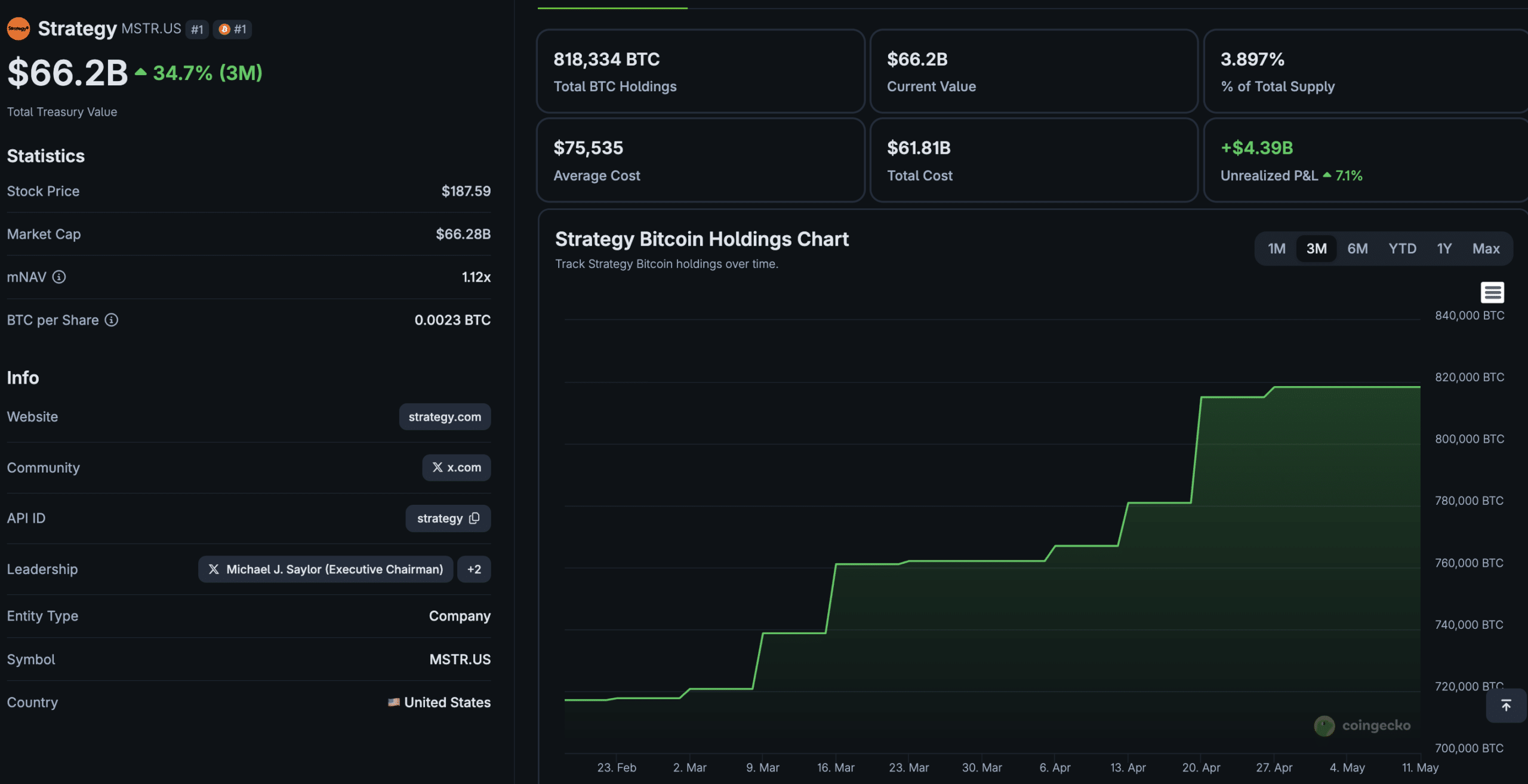
MicroStrategy Bitcoin’s stash now contains approximately 818,334 Bitcoins, worth approximately $66.2 billion at current prices, making it the largest Bitcoin holding company on the planet, by a margin that no other company is close to shutting down.
Chairman Michael Saylor recently confirmed that the company would buy an additional 10 to 20 Bitcoins for every Bitcoin sold, reinforcing a Bitcoin accumulation strategy so aggressive that JPMorgan estimates MicroStrategy’s purchases this year could reach $30 billion.
Here’s the question worth asking: What does all this really mean for someone who doesn’t run a Nasdaq-listed company with access to convertible notes and institutional capital markets? Turns out it’s a lot, but only if you know which parts of the playbook are translated and which could cause serious problems for a retail investor.
MicroStrategy’s Bitcoin Strategy: What It Really Is in Plain English
MicroStrategy’s approach is simple in principle, even if the mechanisms are complex. The company decided in August 2020 that holding cash was a losing strategy in a world of persistent inflation, so it began converting its cash into Bitcoin. That first purchase was 21,454 BTC for $250 million, a bet that stunned the corporate world at the time.
Think of it as a homeowner who decides to stop keeping his savings in a bank account that earns next to nothing, and instead buys a property whenever he has available capital – and then continues to buy more properties even as he borrows against those he already owns. MicroStrategy does the same thing with Bitcoin: it issues shares, raises debt via convertible notes, and funnels the profits into BTC.
(SOURCE: CoinGecko)
As of September 2022, the company has spent approximately $3.98 billion, accumulating approximately 130,000 BTC at an average cost of $30,639 per coin. Today, holdings stand at 818,334 BTC, funded in part by billions of convertible notes and, more recently, high-yielding perpetual securities.
This is what large-scale institutional adoption of crypto looks like. The HODL strategy, buy, hold, never sell, is not a sticker philosophy for MicroStrategy; this is an officially declared capital management policy. Saylor explicitly stated that the company should never be a net seller of Bitcoin and should end each year with more BTC than when it started.
Lesson 1: Belief without a written plan is just stubbornness
Saylor’s belief is authentic and documented. This distinction is more important than most beginners think. MicroStrategy doesn’t hold Bitcoin because Saylor has a hunch; she holds Bitcoin because the company has a written policy, board-level approval, and a publicly stated thesis: Bitcoin is a superior store of value compared to fiat currency, and the math supports its accumulation over time.
The lesson here is not “be like Saylor and never sell.” The lesson is that belief without a framework is just emotion disguised as strategy. If you’re buying Bitcoin because a podcast got you excited and you haven’t thought about the price drop that would freak you out, you don’t have a strategy; you have hope.
Saylor’s approach raises a real question: Is pure HODLing the right approach for everyone? The honest answer is this: It depends entirely on whether your belief is rooted in something more durable than recent price action.
The practical conclusion is simple: before buying a single satoshi, note the price level at which you will truly reconsider your thesis, not panic, but reconsider. This document differentiates between strategy and noise.
Lesson 2: Dollar cost averaging is what makes “buying on every dip” actually work
Mexican billionaire Ricardo Salinas’ stock portfolio: 70% Bitcoin, 30% gold. No bonds, no stocks.
His advice: “Buy the dip in BTC, think 10 years out because it’s a limited asset. Dollar cost is monthly average to eliminate uncertainty.” pic.twitter.com/P7aUlqyju3
– Document Saylor (@saylordocs) May 11, 2026
 Mexican billionaire Ricardo Salinas’ stock portfolio: 70% Bitcoin, 30% gold. No bonds, no stocks.
MicroStrategy Bitcoin’s purchase history is a great example of dollar cost averaging (DCA) in action. The company acquired Bitcoin at various prices, including $11,000 in late 2020, $52,000 during the 2021 bull run, and at higher prices during the 2022 bear market. This strategy resulted in an average acquisition cost that reflects the market cycle rather than just lucky moments.
Retail investors can replicate this strategy without leverage. For example, if you have consistently purchased $100 worth of Bitcoin every month since January 2020, your average cost would be lower than if you had tried to time the market.
A DCA approach for beginners involves:
– Set a fixed amount that you can afford to lose.
– Choose a defined interval (weekly or monthly) for purchases.
– Buy regardless of the price of Bitcoin to eliminate emotional decisions.
– Review your investment thesis every six months.
Although MicroStrategy’s Bitcoin purchases are not feasible for most, buying $50 worth of Bitcoin each week follows the same principle on a manageable scale.
DISCOVER: The Best Crypto Presales to Watch Now
Follow 99Bitcoins on X (Twitter) for the latest market updates and subscribe on YouTube for daily market analysis from experts.
MicroStrategy Bitcoin Holdings Reached $66 Billion: What’s Next for Saylor? appeared first on 99Bitcoins.


