




Bitcoin price is currently trading around $65,150, down -0.8% in the last 24 hours. The main risk below this price level is not macro rates or ETF flows, but rather Strategy’s (MSTR) upcoming second quarter earnings report on July 31.
As the largest publicly traded Bitcoin holder, the company’s falling metrics could have a direct impact on BTC. In the first quarter of 2026, Strategy reported an operating loss of $14.5 billion, largely due to falling Bitcoin prices, despite a surge in software revenue that reached $124.3 million.
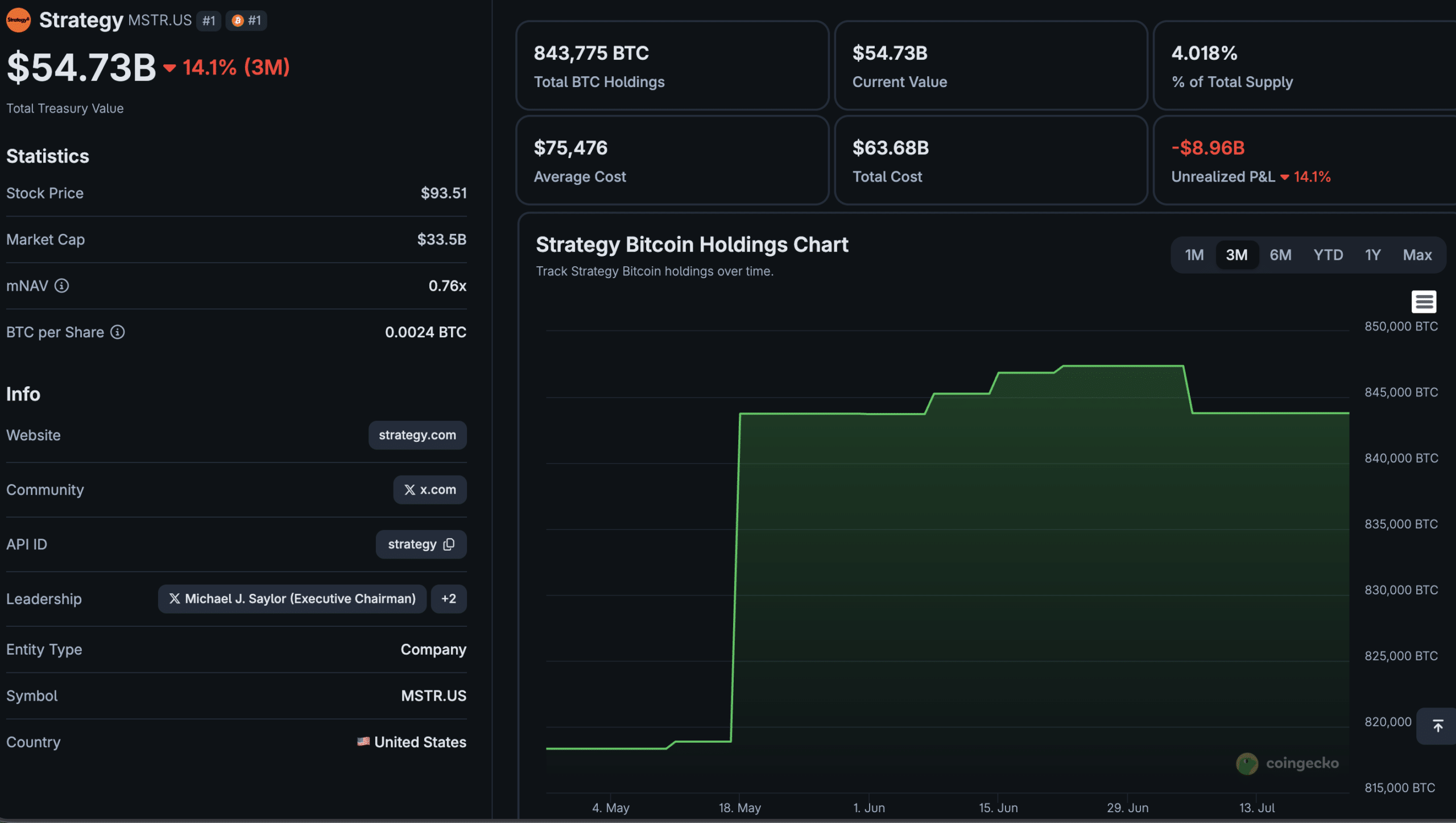
(SOURCE: CoinGecko)
Accretion metrics deteriorated, with Bitcoin yield falling to 5.8% and Bitcoin growth per share declining to 8% year over year. The second quarter consensus for the London Stock Exchange Group (LSEG) is for a return to operating profit of $3.86 billion.
This is based on limited analyst estimates and could lead to a downside surprise, especially given Bitcoin’s decline in the second quarter to around $59,100 from around $68,100 at the end of the first quarter.
Can Bitcoin Price Hold $60,000 as Strategy’s mNAV Risk Increases?
The strategy holds over $51,000,000,000,000 BTC.
But the company itself is now only valued at $29.5 billion.
For years, investors have treated $MSTR like a leveraged Bitcoin ETF.
The model was simple:
Issue more shares → Buy more Bitcoin → BTC rises → Investors continue to pay a…
— Ted (@TedPillows) June 27, 2026
The $60,000 to $61,000 area is now the critical support band. A decisive breakout lower opens the way to the mid-$50,000s, where the next significant demand group lies. Resistance lies between $66,000 and $68,000, with prior highs above $70,000 representing the upper scenario target.
Three scenarios frame the short-term range:
The case of the bull: macro data becomes favorable, Bitcoin ETF (exchange-traded fund) spot flows resume and BTC reclaims the $60,000 high, the strategy’s mNAV stabilizes above 1.22x and the accretion pattern holds.
The base case: Bitcoin price hovers between $60,000 and $65,000 as open interest normalizes and traders wait for signals from the Federal Reserve, with mNAV hovering just above parity.
The case of the bear: $60,000 fails, mNAV falls back toward or below the 0.99x low it hit in late June, and the prospect of Strategy being forced to sell BTC introduces real structural selling pressure.
The latter scenario is one that most traders have underestimated. When mNAV is below 1.22x, management’s stated break-even point after debt and preferred stock are taken into account, each equity issue destroys rather than creates value, and the buying pressure that the strategy has historically placed on Bitcoin evaporates.
The model that made MSTR a leveraged BTC proxy only works at a premium. Without this, the strategy becomes a holder rather than an accumulator, a subtle but consequential change to market structure.
EXPLORE: The Best Meme Coins to Buy in July
Bitcoin Hyper Targets Infrastructure Upside as Spot BTC Stalls
Traders monitoring the Bitcoin price range as structural support for the strategy fades are increasingly turning to early-stage exposure across the entire Bitcoin stack, where upside potential is asymmetric and price action is decoupled from BTC spot volatility.
Bitcoin Hyper ($HYPER) positions itself on this infrastructure layer, specifically as the first Bitcoin 2 layer with Solana Virtual Machine (SVM) integration, targeting sub-second finality and low-cost smart contract execution while preserving Bitcoin’s underlying security model.
The project addresses Bitcoin’s key constraints – slow throughput, high fees, and limited programmability – through a decentralized canonical bridge for BTC transfers and SVM-based execution that the team claims outperforms Solana itself in terms of transaction latency.
The presale raised $32,977,147.17 at the current token price of $0.0136835, with stakes available for participants.
Visit the Bitcoin Hyper presale website here.
DISCOVER: Best Meme Coins to Buy in 2026
following
Disclaimer: Coinspeaker is committed to providing unbiased and transparent reporting. This article is intended to provide accurate and current information, but should not be considered financial or investment advice. Because market conditions can change quickly, we encourage you to verify the information for yourself and consult a professional before making any decisions based on this content.

Daniel Frances is a technical writer and Web3 educator specializing in macroeconomics and DeFi mechanics. Hailing from crypto since 2017, Daniel leverages his experience in on-chain analytics to write evidence-based reports and in-depth guides. He holds certifications from the Blockchain Council and is dedicated to providing “insight gain” that overcomes market hype to find real utility for blockchain.


