




Ripple and Bitso announced on June 13, 2026 the expansion of their partnership to bring MXNB, a regulated, peso-backed stablecoin issued by Juno, a subsidiary of Bitso, natively to the
This is not just a network extension for an existing asset. This is an attempt to recast XRPL as an enterprise-grade regulated liquidity infrastructure for one of the world’s busiest remittance corridors.
Secondary sources, including Bitget coverage, cite annual flows in excess of $60 billion between the United States and Mexico, a figure that Ripple’s main press release does not list but which frames the business logic of the pairing.
🚨 KNOW: #Ripple has just expanded its Bitso partnership and placed Mexico’s stable peso directly on the authorized $XRP Ledger DEX.
Ripple and Bitso, Latin America’s leading digital finance company, are introducing $MXNB, a Mexican peso-regulated stablecoin, on the XRP Ledger.… pic.twitter.com/gtVSwoB60Q
— RippleXity (@RippleXity) June 13, 2026
MXNB on XRPL: how the settlement mechanism works
MXNB, already available on Arbitrum, Ethereum and Avalanche, is now deployed in XRPL’s permissioned DEX, a compliance-focused environment in which only KYC/AML-verified institutional counterparties can access liquidity pools and settlement rails, separate from XRPL’s public DEX.
Combined with RLUSD, Ripple’s corporate USD stablecoin, the two assets form a single exchange and settlement layer for cross-border payments without relying on corresponding banking rails.
MXNB reserves are held 1:1 in Mexican pesos in secure accounts with licensed financial institutions in Mexico, according to reserve disclosures published by Bitso.
Juno operates as an electronic payment institution authorized under Mexican fintech law, providing the regulatory basis on which Ripple relies to market the product to institutional clients rather than retail users.
The $XRP bullish macro signal has just been triggered…
The 2W GC reliably captured cyclical behavior during bear markets, with price consistently marking the lower regression band to mark cycle lows EVERY three years (2017, 2020, 2023). POC 2026 confirmed at $1.04.
We are getting closer… pic.twitter.com/fREqDtFmwq
– 🇫🇷 ChartNerd 📊 (@ChartNerdTA) June 24, 2026
DISCOVER: Best Meme Coins to Buy in 2026
History of the Ripple and Bitso partnership: the LATAM On-Ramp context
Ripple first made Bitso a preferred liquidity provider in 2019, using XRP-based on-demand liquidity flows to process hundreds of millions of dollars in remittances to Mexico.
This relationship made Bitso one of Ripple’s primary on- and off-ramps across Latin America and laid the operational foundation for what is now a stablecoin settlement layer rather than a pure XRP liquidity play.
Silvio Pegado, general manager of LATAM at Ripple, described the integration as “the next evolution of how value moves between dollars and pesos,” stating in the official press release that the RLUSD and MXNB pair on the XRPL-licensed DEX creates “a regulated on-chain liquidity infrastructure purpose-built for cross-border enterprise payments.”
Ben Reid, head of stablecoins at Bitso Business, said MXNB “was designed from the ground up for enterprise settlement” and the integration gives institutional users “access to on-chain peso-denominated liquidity, with the compliance certainty and settlement efficiency that enterprise use cases demand.”
Implication for Industry: A Model for Regional Stablecoin Infrastructure
(SOURCE: DéfiLlama)
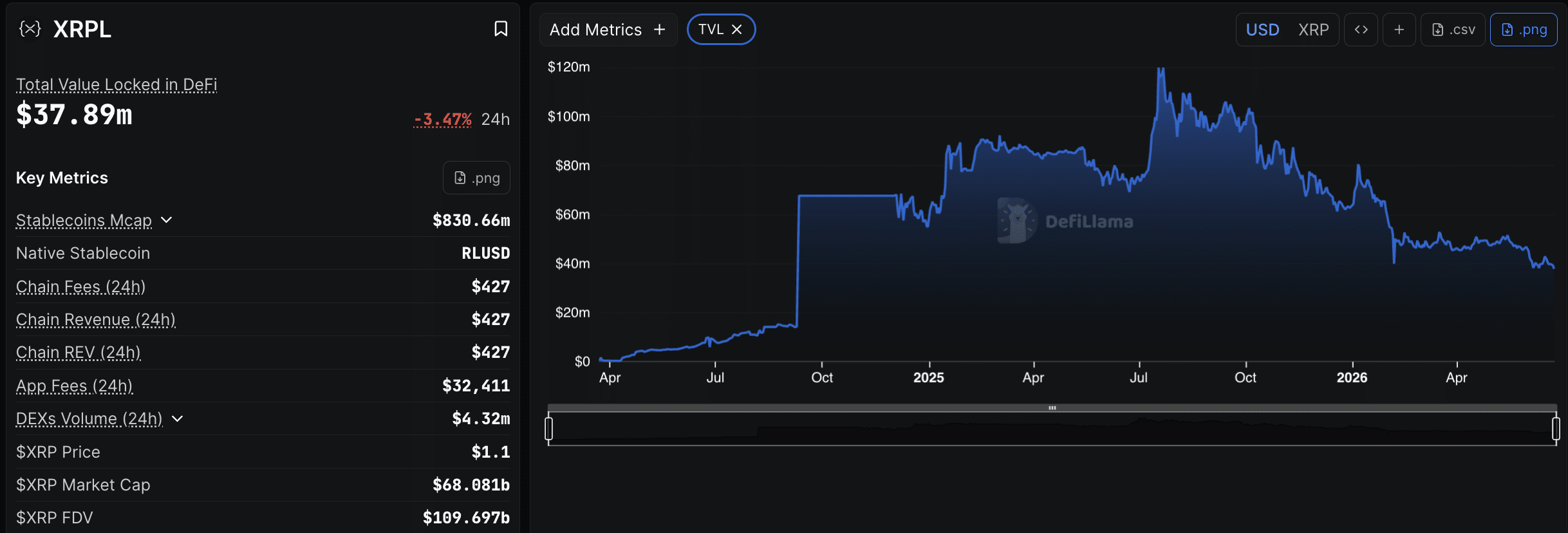
The analytical question is no longer whether XRPL can support stablecoin activity; RLUSD growth has already demonstrated this. The question is whether the XRPL-enabled DEX can attract enough institutional counterparties, banks, payment processors and fintechs to establish the network density required for on-chain MXN FX liquidity to compete with traditional settlement rails in terms of cost and speed.
Ripple’s own framing positions the MXNB/RLUSD pairing as a model for locally native stablecoin settlement infrastructure on additional LATAM corridors, with the US-Mexico corridor as a proof of concept.
We believe the signal to watch in the near term is not the price action on
DISCOVER: Best Meme Pieces to Buy for June
following
Disclaimer: Coinspeaker is committed to providing unbiased and transparent reporting. This article is intended to provide accurate and current information, but should not be considered financial or investment advice. Because market conditions can change quickly, we encourage you to verify the information for yourself and consult a professional before making any decisions based on this content.

Daniel Frances is a technical writer and Web3 educator specializing in macroeconomics and DeFi mechanics. Hailing from crypto since 2017, Daniel leverages his experience in on-chain analytics to write evidence-based reports and in-depth guides. He holds certifications from the Blockchain Council and is dedicated to providing “insight gain” that overcomes market hype to find real utility for blockchain.


