



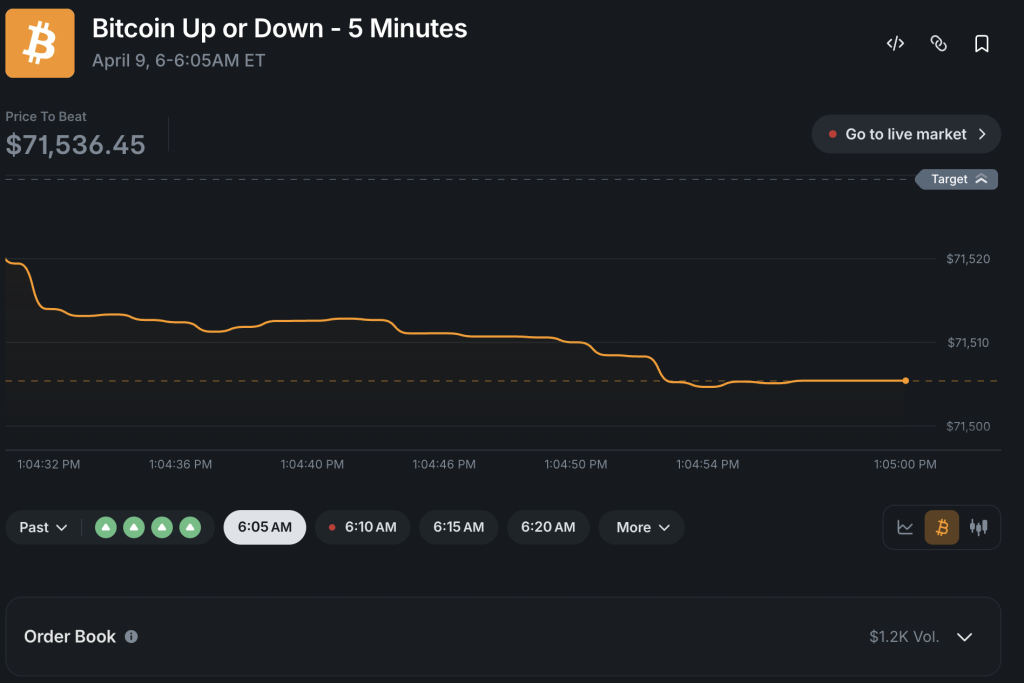
$153 million in daily volume. 4 billion dollars in total. $200 million in the first week alone. Polymarket’s 5-Minute Prediction Markets have grown from an experimental product to one of the fastest trading venues in DeFi – and Chainlink oracles are the reason it all works.
The increase in volume, confirmed by on-chain data shared on crypto analytics channels, represents an increase of approximately 400% over previous baseline figures, with the 3x weekly growth rate still accelerating since the last reporting window.
Discover: Best Pre-Launch Token Sales
Why 5-Minute Prediction Markets Break from Standard Oracle Architecture
Standard Oracle infrastructure designed for hourly or daily market resolution can tolerate latency. A price transmission delayed by 30 seconds is noise when a contract settles in 48 hours.
In 5-minute prediction markets, that same 30-second delay makes the difference between a valid settlement and a manipulated settlement, which is exactly why Polymarket’s architecture required a fundamentally different Oracle setup.
Chainlink’s Data Streams integration, deployed on Polygon where Polymarket is based, provides time-stamped price reports at sub-second intervals.
Combined with Chainlink Automation managing on-chain settlement triggers, the system processes the full cycle, price confirmation, contract resolution, USDC payment, without human intervention and without the vector of manipulation introduced by centralized price feeds.
Oracles provide the official pricing information that triggers contract settlement, completely eliminating the need for a centralized authority.
The scale of what is currently going through this infrastructure is significant. More than 3,000 traders actively use Chainlink data feeds on integrated platforms, and Oracle’s Dashlink dashboard tracking demand shows a direct correlation between Polymarket’s increased volume and a decline in LINK exchange reserves – whales are withdrawing supply from exchanges as network usage hits new highs for predicting market settlements.
The adoption of USDC native collateral in these markets has further accelerated institutional participation by improving capital efficiency.
The appeal is obvious: a platform already monitored for insider trading in long-duration markets now offers a format in which information asymmetry has a shelf life of 5 minutes.
The risks are real and should not be buried. Short time frames amplify volatility, HFT-dominated order flow can crowd out retail trading, and oracle delays, however rare, have outsized consequences when resolution windows are measured in minutes.
But the volume data doesn’t lie: the format captures demand that didn’t have an instrument before.
Closing of the Convergence hackathon – Liquid Chain wins the grand prize on CCIP
Liquid Chain has built a unified liquidity layer that pools capital across multiple Layer 2 networks using Chainlink’s Cross-Chain Interoperability Protocol (CCIP) as the messaging backbone.
The main problem it solves is real and costly: assets stuck on individual L2s require manual bridging, creating slippage, delays, and trust assumptions that institutional allocators won’t accept.
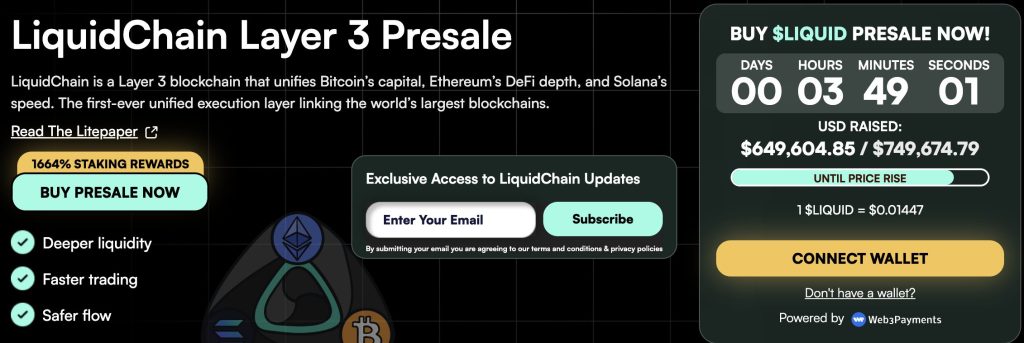
Liquid Chain’s architecture allows users to move assets seamlessly between chains without manual bridging interactions, with CCIP handling the verification and messaging layer beneath the surface.
The project presented its DeFi Layer-3 build as a credible answer to the fragmentation problem, and the Convergence judges agreed.
Other notable submissions to the hackathon focused on real-world asset tokenization and DeFi automation – a consistent signal that Chainlink’s developer community is moving toward institutional-grade infrastructure rather than consumer speculation. The CCIP adoption rate implied by the hackathon submissions validates Chainlink’s cross-chain positioning exactly when the tamper-proof Oracle settlement is breaking records on Polymarket.
Learn about LiquidChain’s current presale and allocation terms here.
The post Polymarket Just Hit $4 Billion in Volume in 5 Minute Markets: Is Chainlink the Infrastructure Behind the Next DeFi Explosion? appeared first on Cryptonews.


