



Rio upgrade has been successfully deployed in the Polygon POS AMOY TESTNET, marking a critical step towards a massive scaling of network capacity.
Polygon has deployed the Rio upgrade, a basic stage in its Gigagas roadmap which reshapes the design of the network. The upgrade aims to increase Mainnet’s capacity to 5,000 transactions per second, a leap accent compared to current levels.
The upgrade was confirmed by the Polygon team on X, saying:
“Rio upgrade is live on Polygon POS AMOY TESTNET.”
At the center of the upgrade is a new system called elected block producers (Veblop).
This model transfers more control to the validators, who will now play a stronger role to decide how the blocks are produced. Polygon says that change will improve fairness and efficiency while strengthening decentralization.
The other modifications include checking blocks without a state, which reduces the costs for validators by reducing the burden of data from the execution of a node.
The upgrade also eliminates the reorganizations of the blocks, a movement intended to ensure greater stability and to stop the unfair reshuffle of the production of blocks.
The update is not only technical. He arrives at a time when the native token of Polygon, Rio / USDT, shows signs of recovery. After weeks of lower prices and side exchanges, the token pushed over $ 0.31 this week.
Together, the redesign of the network and the rebound of the token mark a notable moment for the polygon. Rio upgrade indicates where the project is heading: towards a higher speed, lower costs and a structure designed for wider use in payments and tokenization of assets.
Discover: Crypto following 1000x: 10+ Crypto tokens which can strike 1000x in 2025
Rio prices prediction: Can Rio maintain its rally to the resistance zone from $ 0.34 to $ 0.35?
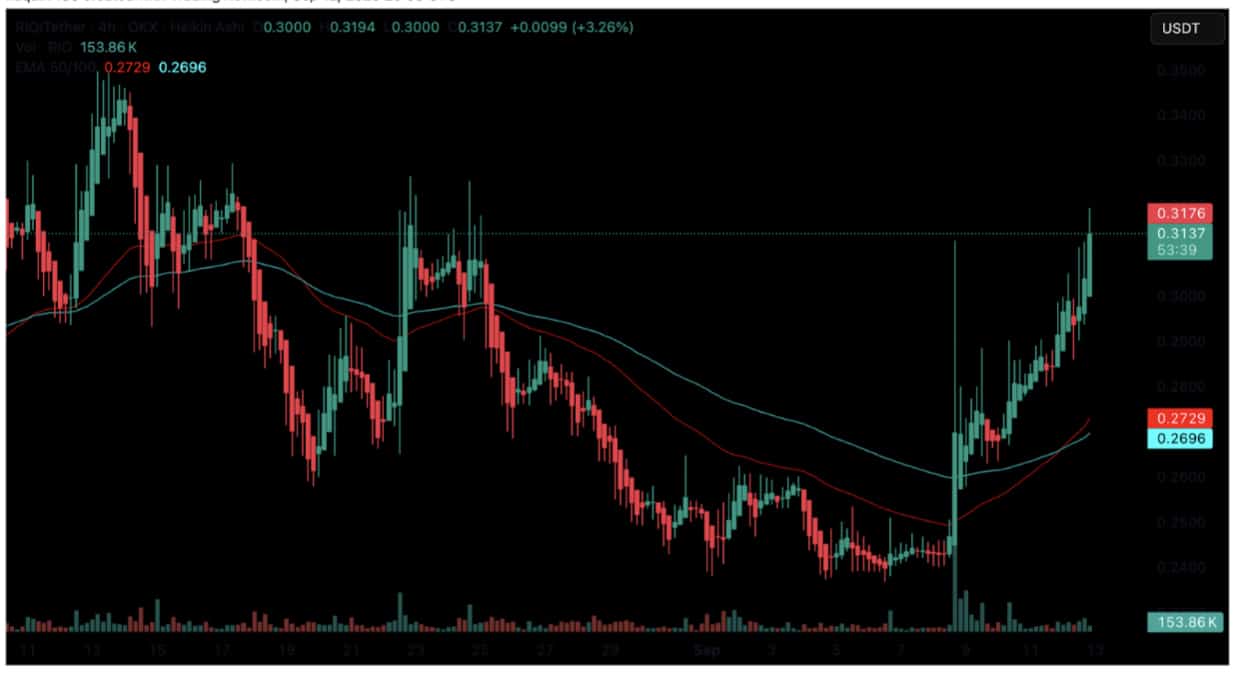
After several weeks of pressure, Rio underwent a sudden recovery, revolving around a drop in August between $ 0.34 and $ 0.23. The turning point occurred on September 9 when the trading volume increased sharply, and the buyers took control and further raised the token.
Rio was led to the EMA from 50 days to $ 0.2729 and the EMA from 100 days to $ 0.2696, with the last fence at $ 0.3137, which was + 3.26% higher than its previous closure.
(Source – RIO USDT. Tradingview))
This inversion indicates a Haussier realignment, which is generally followed by more powerful rallies.
The momentum is obvious in the graph. The increase in low-high green candles and confidence confidence, and the decisive movement above the $ 0.30 area has changed the mood.
The following key test is at $ 0.3176. A clear break in this level could open the road to $ 0.34, the last view in mid-August.
The support is at the current level of $ 0.28, and additional protection is at the EMA cluster of $ 0.27.
The structure resembles a conventional reversal: a long downward trend, followed by an accumulation, then of an break supported by an increase in volume. This volume profile suggests that retail and institutional money is involved.
Analysts indicate that the short -term emphasis is for a range of 0.3176 to $ 0.32. A higher sustained thrust could stretch the gains around $ 0.34 to $ 0.35, a psychological barrier. But if the token does not defend $ 0.30, the profits can remove it from $ 0.28.
Overall, the perspectives have tilted increased, although volatility is probably because Rio works through these resistance levels.
Discover: Crypto following 1000x: 10+ Crypto tokens which can strike 1000x in 2025
How will Rio upgrade make faster and cheaper transactions?
The upgrading of Rio du Polygone is yet another evolution towards scaling and competition remaining by the network.
The update aims to increase flow and reduce the times of transactions, and make transactions faster and less expensive for users and developers.
Another of the biggest changes is the increased role in validators. By assigning them a higher responsibility, Polygon wishes to improve the decentralization of the system and maintain a low cost system.
The changes help with its global objective to establish the platform that will help it manage global payments and the tokenization of active world.
Rio upgrade is an improvement in a series of important upgrades the previous year. In September 2024, Polygon changed the name of his native Pol token, which was used throughout the ecosystem.
Then, in June 2025, the Bhilai Hard Fork published the first stage of the Gigagas roadmap, increasing the flow to 1,000 transactions per second and improving the stability of gas costs.
A month later, Heimdall V2 reduced the purpose of the transactions to around five seconds and erased the obsolete code. Together, these updates show a constant thrust to strengthen the technical foundations of Polygon.
With Rio Now Live, the network continues to build towards higher efficiency, stability and decentralization, aimed at keeping the pace of the requirements of a blockchain evolution market.
Discover: 20+ Next Crypto to explode in 2025
Join the 99Bitcoins News Discord here for the latest market updates
The post-io upgrade is put online on Polygon Testnet: Pol price prediction for September 2025 appeared first on 99Bitcoins.


