




Ripple landed at No. 16 on CNBC’s Disruptor 50 2026 list, placing the San Francisco-based payments infrastructure company in the top 20 in a ranking that historically leans toward enterprise software, AI and biotechnology, sectors where institutional supply cycles, not hot money, drive valuation.
The CNBC editorial team placed Ripple in the “New Money” topic category, specifically citing its role in modernizing cross-border payments and institutional crypto infrastructure across payment corridors now touching more than 70 countries via RippleNet and associated services.
Ripple is #16 in 2026 @CNBC Disruptor 50, representing the role crypto infrastructure plays in bringing blockchain to real-world finance.
The age of infrastructure has arrived. 🚀
– Ripple (@ripple) May 19, 2026
This is not just a media reward. It’s a sign that traditional financial research processes, the ones that institutional procurement officers and sponsors actually monitor, have officially reclassified Ripple from a crypto-native payments experience to a systemically important infrastructure provider.
We suspect that the CNBC selection committee’s reasoning reflects not a forward-looking bet on blockchain adoption, but a retrospective recognition of the adoption that has already been occurring quietly in bank back offices and in central bank pilot programs.
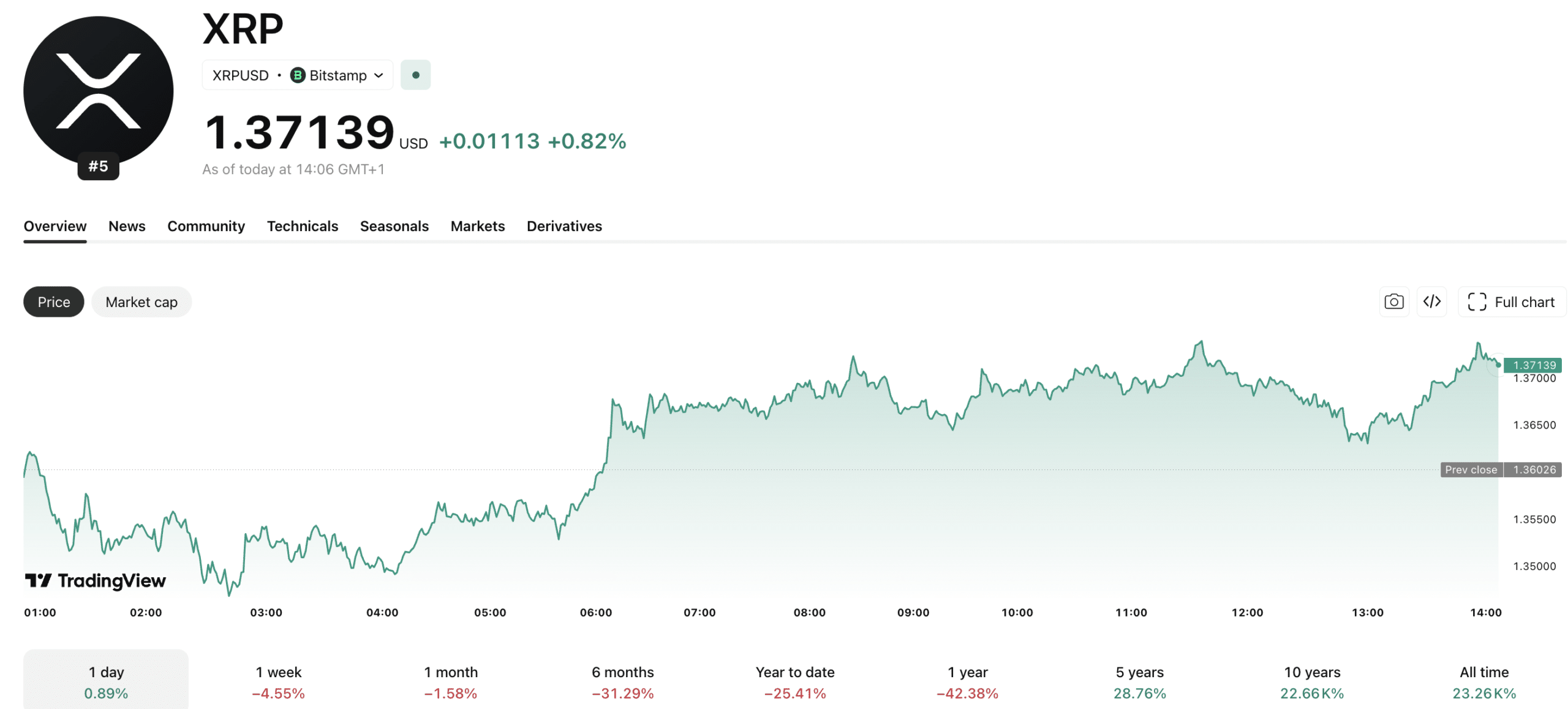
(SOURCE: TradingView)
CNBC Disruptor 50: What the selection process really signals for Ripple and institutional crypto as a whole
CNBC’s Disruptor 50 is compiled annually through a nomination process that evaluates companies based on revenue trajectory, market disruption potential and evidence of institutional traction, rather than brand recognition. Companies are evaluated on funding rounds, regulatory posture and the integration of their technology into industry workflows.
Ripple’s inclusion at 16th under the theme of payments modernization suggests that it has achieved significant institutional integration, marking a shift from its 2022 narrative focused on legal battles with the SEC. The Disruptor 50 generally highlights companies whose products are redefining purchasing decisions rather than those involved in legal disputes.
Ripple’s post-SEC compliance efforts, including obtaining regulatory licenses in Singapore, Dubai and other regions, likely played a crucial role in its selection, as institutional buyers are unlikely to adopt unlicensed payment solutions.
DISCOVER: Best Meme Coins to Buy in 2026
RippleNet and XRP Ledger: How Cross-Border Settlement Infrastructure Really Works
Daniel Keller, CTO of Eminence, explains why he remains optimistic #XRPL And $XRP.
Keller became bullish in 2020 due to the speed, low cost, and real-world utility of XRPL.
His view became cautious during the 2022 bear market as he questioned whether strong technology alone would guarantee… pic.twitter.com/xoydHTbZQ2
– TheCryptoBasic (@thecryptobasic) May 20, 2026
RippleNet connects financial institutions, such as banks and payment service providers, through a standardized messaging and settlement layer, enabling efficient routing of transactions. By using the XRP Ledger as a liquidity bridge, RippleNet minimizes the need for pre-funded nostro and vostro accounts.
In the on-demand liquidity setup, a issuing institution converts local fiat currency to XRP, transmits it via the XRP ledger (in approximately 3-5 seconds), and the receiving institution converts it back to fiat currency.
This setup significantly reduces costs by freeing up capital that would otherwise be tied up in corresponding accounts, resulting in savings of 40-70% compared to traditional SWIFT transfers, which often involve multi-day settlement times and high fees. The XRP Ledger’s low transaction costs and ISO 20022 compatibility make it suitable for existing financial messaging systems.
A notable proof of concept occurred on May 6, 2026, when JPMorgan, Mastercard, Ripple, and Ondo Finance executed a cross-border redemption of U.S. Treasuries tokenized on the XRP Ledger in approximately 4.2 seconds, facilitating fiat settlement through JPMorgan’s Kinexys platform.
However, details on the volume of on-demand liquidity transactions remain unclear, raising questions about the relative scale of settlements bridged by XRP compared to RippleNet’s other options.
EXPLORE: Top Crypto Signals Group Just Added Online Poker Channel
following
Disclaimer: Coinspeaker is committed to providing unbiased and transparent reporting. This article is intended to provide accurate and current information, but should not be considered financial or investment advice. Because market conditions can change quickly, we encourage you to verify the information for yourself and consult a professional before making any decisions based on this content.

Neil is a professional cryptocurrency content writer with years of experience. He has written for various cryptocurrency websites to report on the latest news and has been hired by all kinds of cryptocurrency projects, to create content that would increase their visibility and attract more potential investors.
Neil Mathew on LinkedIn


