



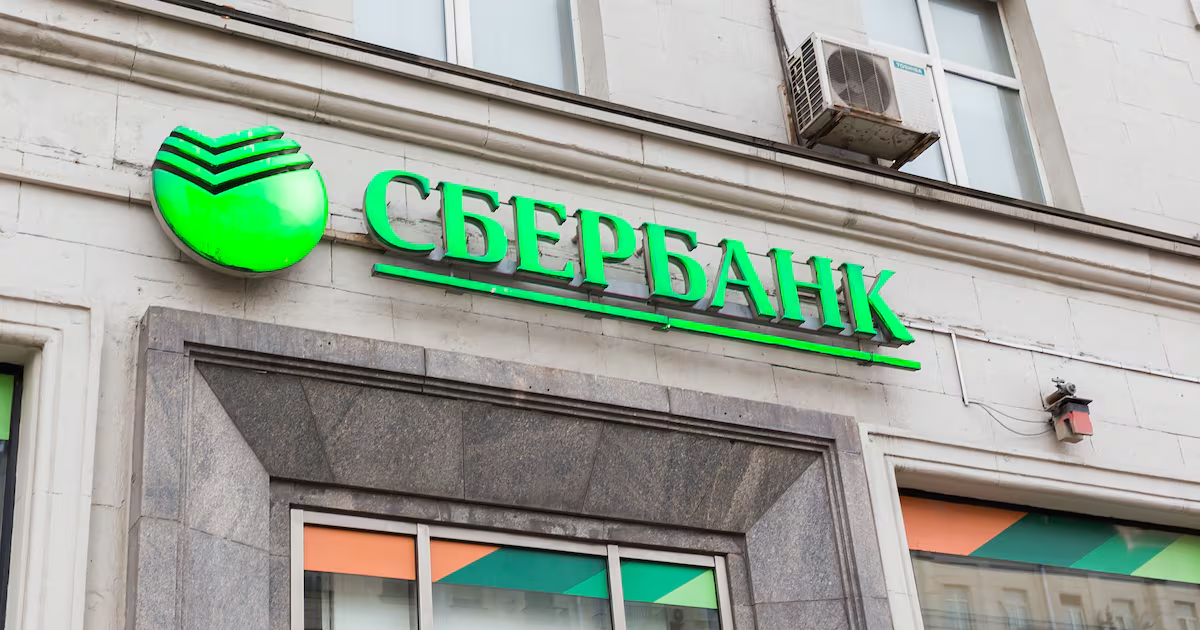
- Sberbank is one of the five largest companies in Russia.
- Executive: decentralized finance and traditional financial services will “converge”.
- The bank wants to work on Ethereum blockchain solutions.
Sberbank, Russia’s largest bank, says it is testing a range of DeFi products as its customers show greater willingness to trade and hold cryptocurrencies.
Speaking to Russian media RBCAnatoly Popov, deputy chairman of the board of directors of Sberbank, said the company “will develop digital asset offerings in collaboration with regulators.”
“Sberbank is already testing various DeFi products,” Popov said. “We are confident that traditional banking and DeFi will converge soon.”
Popov did not specify any DeFi protocols.
Although they remain cautious, Russian banks are increasingly optimistic about crypto adoption plans, spurred by Moscow’s push to regulate the sector in 2026.
Sberbank’s market capitalization is around $83 billion and the bank says it has around 109 million retail customers and more than 3 million corporate clients.
Banks are cautiously moving into crypto
Earlier this month, VTB, one of Sberbank’s biggest rivals, also said its own customers wanted to buy “real” crypto rather than trade derivatives.
This year, several major Russian companies have launched a wide range of crypto-themed funds, bonds and indices that track the price of major cryptocurrencies like Bitcoin and Ethereum. They have also launched funds that follow the movement of the famous US-based crypto exchange-traded funds.
But banks are still waiting for the green light to allow their customers to buy and sell coins on their own banking apps.
“Cryptocurrencies are popular among Russians,” Popov said. “The central bank estimates that by March 2025, the volume of cryptocurrency in Russian wallets will reach $10.5 billion.”
He said Sberbank “plans to actively engage in this market, but only once clear regulations are in place and it becomes economically feasible.”
Popov added that Sberbank customers are “very interested in convenient solutions for accessing cryptocurrencies” and “consciously looking for ways to invest in cryptocurrencies.”
Central bank refusal
The central bank’s reluctance to approve crypto has been a major sticking point for Russian banks and blockchain companies.
While the Bank of Russia is interested in blockchain technology, its governor Elvira Nabioullina has spoken out against “private cryptocurrencies” like Bitcoin.
Nabiullina has previously called for a sweeping ban on crypto and the promotion of private blockchain-based solutions like the digital ruble, a blockchain-based version of Russian fiat currency.
However, the year 2025 was marked by many changes for the Bank of Russia. As Russia’s Bitcoin mining industry continues to grow and more traders use crypto as a sanctions-proof cross-border settlement tool, the central bank’s stance has softened.
Evidence of this can be found in Popov’s interview with RBC.
“We are not limited to private networks,” he said. “Sberbank is also working on projects that involve the use of public blockchains for specific purposes. For example, we are looking to tokenize assets or create connections with decentralized finance platforms.”
He said the bank wants to work on “networks with developed infrastructure and robust smart contract tools, such as Ethereum.”
Networks like Ethereum “offer flexible integration options, ensure transparency and facilitate access to international markets,” he said.
“Tokenized assets are actively being tested around the world,” concluded Popov. “And Russia is now also moving in this direction. »
Tim Alper is a news correspondent at DL News. Do you have any advice? Send him an email to tdalper@dlnews.com.


