



Binance has unveiled a major overhaul of its token listing process, aimed at improving transparency, strengthening oversight and eliminating fraudulent intermediaries that have plagued the exchange’s listing ecosystem.
The world’s largest cryptocurrency exchange has announced that third-party “transaction brokers” are strictly prohibited from facilitating listings.
The company also released a blacklist of individuals and companies that allegedly made false claims, including BitABC, Central Research, May/Dannie, Andrew Lee, Suki Yang, Fiona Lee and Kenny Z, signaling that legal action will be taken against those who engage in such activities.
New listing standards aim to improve visibility and quality on Binance
According to Binance, the new listing criteria cover the Alpha, futures and spot markets and are designed to create a more structured and transparent framework for projects seeking exposure on the platform.
Binance’s Alpha platform targets early-stage tokens, providing distribution opportunities through Pre-TGE, Prime Sale, TGE, Airdrops and Booster Programs, helping projects gain momentum before their full market launch.
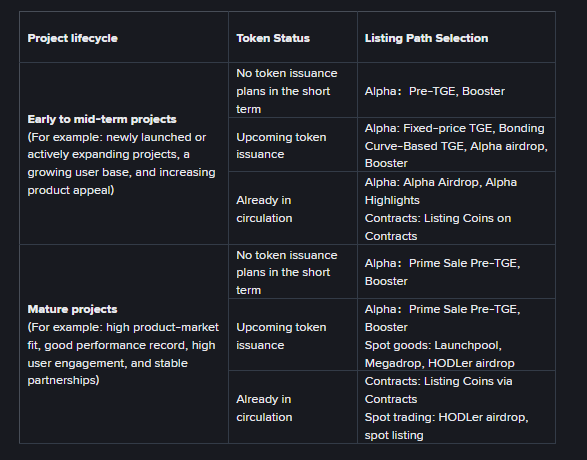
Binance’s contract platform allows users to access derivatives to hedge positions, establish long or short trades, or manage liquidity, while the spot platform remains the largest venue for direct trading and long-term holding of high-quality crypto assets.
The exchange also provides mechanisms like Launchpool, Megadrop, and HODLer airdrops to increase visibility for new projects, especially those that have demonstrated progress, strong teams, and active communities.
Binance is currently seeing $11.13 billion in 24-hour trading volume, reflecting a 28.2% decline over the same period. The exchange supports 441 coins listed across 1,638 trading pairs.
Binance revises listing process after speculative token criticism
The new standards address several challenges that Binance has faced over the past two years.
The exchange previously announced the tokens’ listing just hours before trading began, a practice that often caused price spikes on decentralized exchanges followed by rapid sell-offs on Binance itself, creating volatility that hurt late entrants.
Binance has also been criticized for listing speculative or low-quality projects that have failed to generate long-term value, contributing to market losses and investor distrust.
Additionally, third-party intermediaries claiming to guarantee registrations had become a major source of scams, misleading project teams and creating confusion around the legitimate application process.
These changes follow long-standing concerns expressed by Binance founder Changpeng Zhao, who in February 2025 called the listing process flawed.
CZ criticized Binance’s listing process, calling it “a little broken.”#ChangpengZhao #Binance #TSTMemecoinhttps://t.co/y3o2rT6RPJ
– Cryptonews.com (@cryptonews) February 10, 2025
 CZ criticized Binance’s listing process, calling it “a little broken.”
Zhao noted that the short interval between listing announcements and actual transactions created opportunities for rapid price manipulation and undermined confidence in the process.
Binance has since decided to introduce more structured due diligence, a community co-governance vote for listing and delisting tokens, as well as a monitoring zone for projects that do not meet ongoing reporting or activity requirements.
Community members can vote on whether projects should remain listed, adding a level of public oversight.
Crypto founders worried about Binance listing requirements
This overhaul also comes against a backdrop of high-profile controversies surrounding listing practices.
In October, CJ Hetherington, founder of prediction market startup Limitless, claimed that Binance demanded 8% of his project’s token supply plus $2 million in additional payments to secure a listing and alleged that the exchange engaged in “dumping” of tokens after the listing.
– Cryptonews.com (@cryptonews) October 15, 2025
 CZ doesn’t deserve a presidential pardon – and Binance users’ anger over last week’s crash proves it
Binance initially responded with threats of legal action, calling Hetherington’s posts “false and defamatory”, although the company later admitted to some details regarding the token allocation.
Binance maintains that it does not directly profit from listing fees, saying that allocated tokens are used for marketing, airdrops, and other initiatives that benefit users, rather than for the exchange itself.
Despite the controversies, many crypto founders still view a listing on Binance as highly desirable, given the exposure and liquidity offered by the platform, although some have criticized the process as “predatory” or too complex.
The article Binance Cleans House: New Listing Criteria Exposes Blacklisted ‘Transaction Brokers’ appeared first on Cryptonews.


