



In SEC crypto news today, the U.S. Securities and Exchange Commission opened a 60-day comment period to reconsider its regulation of new exchange-traded funds, a category it explicitly defines as including crypto assets, event-driven contract products, and complex leveraged strategies.
This decision, formalized on June 30, 2026 under number 33-11426, indicates that the agency is in the process of putting together a formal regulatory filing before rewriting the rules that govern how unconventional ETFs reach retail investors.
The SEC announced today that it is seeking public comment on “new” ETFs (triggered by the multitude of prediction market ETFs) in an effort to develop a framework for what should be compatible with ETFs, making approvals standardized (thus fewer backlogs), and to limit issuer overreach. scoop via… pic.twitter.com/DuEaH4hfLr
– Éric Balchunas (@EricBalchunas) June 30, 2026
Timing matters. The U.S. ETF market has grown from $4 trillion in 2019 to about $12 trillion in 2025, fueled in part by Rule 6c-11, the 2019 SEC rule that allows most ETFs to be listed on exchanges without seeking case-by-case exemptive orders from the SEC.
This streamlined process boosted the launch of a plain vanilla fund. The SEC is now questioning whether this same framework is adequate for products with much more complex risk profiles.
DISCOVER: The best Meme Coin ICOs to invest in 2026
SEC Crypto News: What the Regulator is Currently Looking at
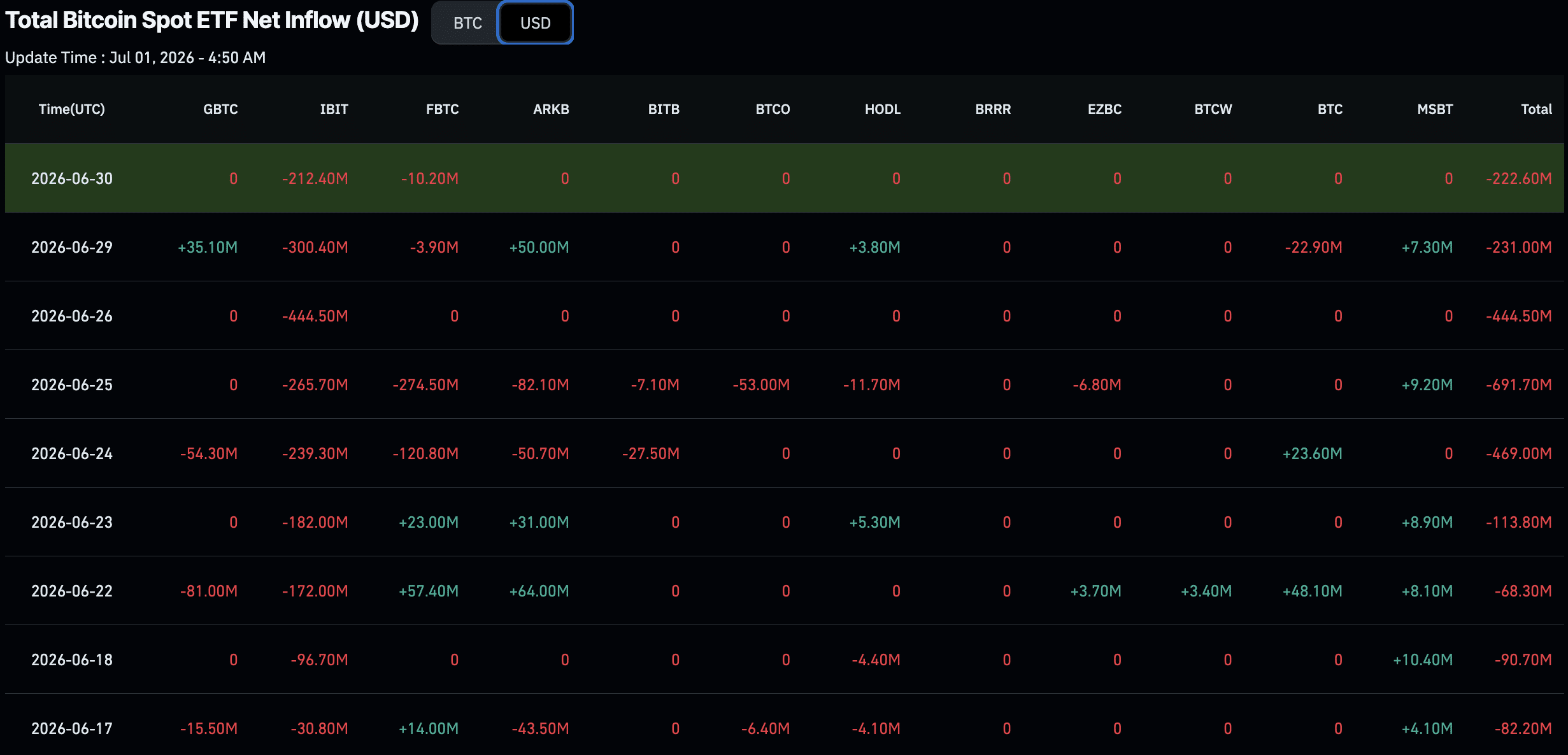
(SOURCE: CoinGlass)
The request for comment asks 27 questions in three main areas. First, that funds holding non-security assets, such as commodity-classified Bitcoin or other cryptographic tokens, are still considered investment companies under the Investment Company Act of 1940.
The SEC’s own filing directly states: “Market participants have raised questions about whether new ETFs whose primary investment strategy is to invest in assets that are not securities under the Investment Company Act are investment companies.”
Second, Rule 6c-11 still works well for new securities, particularly with respect to arbitrage mechanisms and disclosure requirements that keep an ETF’s market price close to the value of its underlying asset.
Third, whether the current 60-75 day automatic effective window gives SEC staff enough latitude to review first-of-kind products, or whether new funds require a dedicated, slower approval pathway.
SEC Chairman Paul Atkins called the review pro-innovation rather than restrictive. “Innovation in exchange-traded funds depends on a consistent, transparent and effective regulatory framework,” Atkins said. “The committee’s request for comment seeks public input on how the U.S. ETF market can continue to grow and innovate while effectively serving investors.”
EXCLUSIVE: Earn $10 USDC via Binance Signup
What this means for Crypto ETF products
THE SEC IS RETHINKING HOW IT REGULATES THE ENTIRE $16 TRILLION ETF INDUSTRY, AND IT STARTED WITH AN ADMISSION THAT MOST INVESTORS WILL FIND STRANGE
The SEC does not actually approve or reject ETFs.
Under current rules, once a fund is effective, the agency essentially has a… pic.twitter.com/uBJKUGQpSE
– WOLF (@WOLF_Financial) June 30, 2026
As a follow-up to this SEC crypto news, existing Bitcoin and Ether spot ETFs approved under the SEC’s 2025 Standards continue to trade as normal, with approval times reduced from 240 days to approximately 75 days for eligible digital assets.
However, approximately 24 event contract ETF filings have been suspended in May 2026 as the SEC evaluates the implications of new, untested products such as staking yield funds and altcoin baskets. Morgan Stanley’s filings for Ethereum and Solana staking ETFs illustrate the scrutiny these new products face.
TD Cowen’s Jaret Seiberg emphasized that the review process is strategic and aims to build a case for potential future policy changes that could expand ETF offerings to include a broader range of assets. The ETF rules overhaul will follow a defined path, including a 60-day comment period and a proposed rule set.
For crypto investors, the immediate outlook indicates no disruption to existing Bitcoin or Ether positions, while new launches could see slowdowns and increased disclosure requirements. Ultimately, a clear framework for altcoin ETFs could remove the regulatory ambiguity that has long hampered product development.
EXPLORE: Best Crypto Presales with Asymmetric Upside Potential in Today’s Market
The article SEC Opens 60-Day Comment Period to Reshape New ETF Rules appeared first on 99Bitcoins.


