



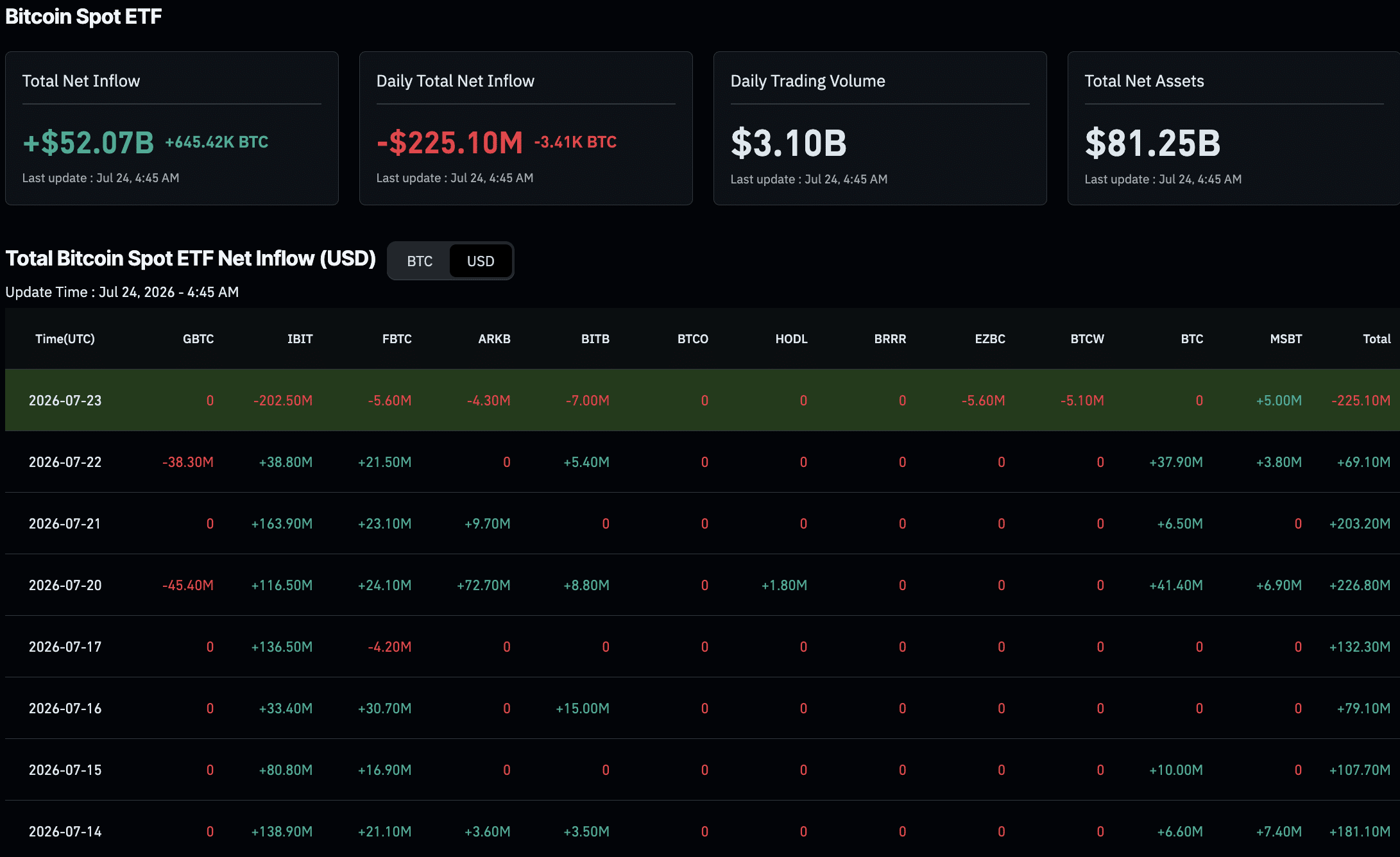
In today’s Bitcoin news, US spot BTC ETF funds saw nearly $1 billion in net inflows over seven consecutive sessions through July 22, 2026 – their longest positive period in 11 weeks, with BlackRock IBIT capturing $319.16 million of the $499.05 million added this week alone.
However, this streak has already ended, as yesterday’s session closed with -$225 million in outflows, although Bitcoin remained stable above $65,000 despite ETF selling pressure.
Bitcoin climbed above $66,000 during the two strongest sessions of the streak, July 20 and 21, according to 247 Wall St. The catalyst was the news that President Trump had agreed to ethics rules that delayed the CLARITY Act.
This bipartisan digital asset legislation, which would establish clearer regulatory boundaries for crypto markets, appears to have sparked a wave of institutional demand.
Bitcoin ETF News: Seven days of inflows interrupted by an outflow of -$225 million
(SOURCE: CoinGlass)
The last outing day was July 13, when investors withdrew $424.66 million, the largest single-day withdrawal of the month. Since then, money has returned every session, but not consistently.
Flows on July 14 reached $181.08 million, then fell to $107.80 million on July 15, $79.15 million on July 16, and returned to $132.30 million on July 17, according to CoinGlass data.
The two dominant sessions came with headlines from the CLARITY Act. July 20 recorded $226.92 million and July 21 saw another $203.14 million as Bitcoin price surpassed $66,000.
By July 22, daily inflows had declined to $68.99 million, the lowest session in the entire streak. This deceleration trend was telling, as yesterday capital outflows reached -$225 million, ending the streak of seven consecutive days.
The last time institutional demand for Bitcoin through ETF vehicles maintained this type of consistency across multiple days was in early October 2025, when Bitcoin was trading near its all-time high of around $126,000.
Why IBIT continues to win even though it is not the cheapest option
BREAKING: Bitcoin ETFs attracted +$900 million in inflows last week, the largest weekly inflow since early May.
This marks a sharp acceleration from the previous week’s inflows of +$197 million.
The largest Bitcoin ETF, $IBIT, led the rise, attracting +$193 million last week,… pic.twitter.com/tr8lo363oX
– Kobeissi Letter (@KobeissiLetter) July 22, 2026
The pricing structure alone does not explain IBIT’s dominance. Although Fidelity FBTC charges no management fees and has $11.38 billion in assets under management, IBIT leads with $48.86 billion in assets under management. Over ten years, the 0.25% annual fee for IBIT represents a significant amount for long-term investors.
247 Wall St. attributes IBIT’s success to its distribution advantages. BlackRock’s products are familiar to pension managers and licensed advisors, making purchasing IBIT a seamless experience with minimal compliance hurdles, making fees less significant.
Trading volume also highlights this concentration: on July 22, IBIT accounted for nearly 79% of the $1.11 billion in total trading across the 13 spot Bitcoin ETFs. IBIT holds 3.70% of all Bitcoin, while the other twelve ETFs combined hold only 2.38%, indicating significant institutional activity in IBIT during this period.
DISCOVER: The Next 1000x Crypto Gem Ahead of Its Listing on Binance
Bitcoin ETF News: Grayscale GBTC, the fund that still trails the entire complex
In other Bitcoin ETF news, Grayscale GBTC, the Grayscale Bitcoin Trust that transitioned from a closed-end fund to a cash ETF, remains the largest structural barrier to the ETF complex’s net position. Since converting to ETF format, GBTC has lost $27.42 billion in cumulative outflows. On July 22 alone, another $38.30 million left the fund.
The difference in fees is the root cause. Grayscale charges 1.50% per year. IBIT charges 0.25%. For an investor holding $100,000 for five years, that 1.25 percentage point difference amounts to about $6,500 in additional fees, before factoring in any performance differences.
The cumulative effect is that GBTC’s cash outflows have exceeded the actual demand visible in IBIT and, to a lesser extent, other competitors.
Total net inflows into the 13 Bitcoin ETF funds are $51.85 billion since launch, but that figure is what remains after subtracting $27.42 billion from GBTC. Without the GBTC drag, the ETF complex numbers would look considerably stronger.
$BTC — If we somehow deviate and get 65.5k back on 4HR TF, we’ll quickly see 70k!
Otherwise, the chop continues up to 64K.
I am optimistic about the upward movement due to the relative strength of our orange coin despite SPY’s weakness yesterday.
70K+ $BTC is scheduled in the next… pic.twitter.com/Ug9eGaGPUX
—Friedrich
(@FriedrichBtc) July 24, 2026
 (@FriedrichBtc) July 24, 2026
Trade BTC on ByBit and Join 99Bitcoin’s Exclusive $1,000 USDT Airdrop
The Catalyst of the CLARITY Act and What It Really Did
The CLARITY Act, or the Digital Asset Market Clarity Act, had been blocked due to ethics disputes. News on July 20 of President Trump’s agreement to ethics rules sparked large inflows of capital into the market.
Regulatory clarity reduces the risks of non-compliance, potentially allowing institutional investors such as pension funds and insurance companies to hold Bitcoin ETFs more freely.
Entry days of $226.92 million and $203.14 million on July 20 and 21 indicate that institutions were anticipating this shift, although yesterday’s large outflows ended any bullish momentum built over a seven-day entry streak.
However, if procedural delays recur, the momentum could continue to reverse, as shown by the $68.99 million inflow reduction on July 22, followed by yesterday’s outflow, both lacking new regulatory support.
EXPLORE: Best Crypto Presales with Asymmetric Upside Potential in Today’s Market
The article Seven Straight Days of Bitcoin ETF Inflows Recover Just 15% of June Losses appeared first on 99Bitcoins.


