



Bitcoin (BTC) is trading at around $65,000 on June 17, down around -2.5% over the past 24 hours, as the Federal Open Market Committee (FOMC) convenes for its first meeting under new Federal Reserve Chairman Kevin Warsh.
The rate decision itself was already a foregone conclusion, and the real market event focused entirely on whether Warsh, as expected, would refuse to submit his personal point projection.
(SOURCE: CME Group)
This is not just a procedural quirk from an idiosyncratic new president. This is a potential regime change in how the world’s most systemically important central bank communicates.
And the structural consequences on crypto markets, Treasury pricing, and Bitcoin’s long-term value proposition are distinct enough to warrant separating short-term noise from lasting signal.
Mechanics of Point Plotting: Why Removing the Anchor Creates Immediate Turbulence
Since Ben Bernanke introduced the dot plot in 2012, Wall Street has relied on each policymaker’s rate projections to influence Treasury yields, corporate loan spreads and IPO valuations, with SpaceX cited as a notable example.
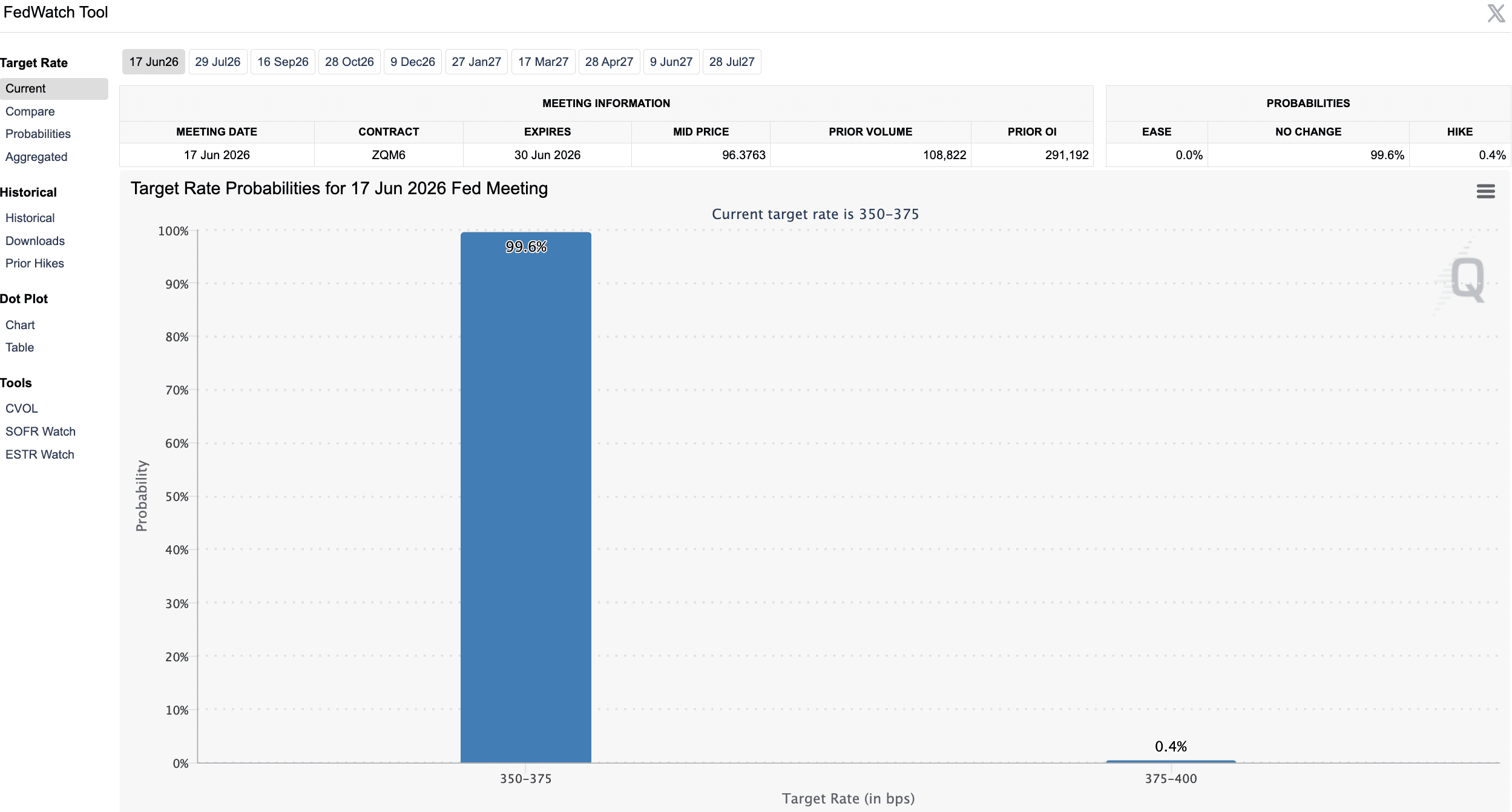
As of June 17, probabilistic data indicated a 98.2% probability of maintaining the current rate of 3.50 to 3.75%, meaning the decision itself has little informational weight. Instead, the dot plot and statements from policymakers, particularly Warsh, are crucial to market expectations.
If Warsh withholds his projection, it could lead to increased Treasury volatility, higher Fear Index (VIX) values, and decreased liquidity of risk assets, which would negatively impact Bitcoin amid macro uncertainty.
Analysts suggest that Warsh’s reduction in forecasts could increase market volatility and put pressure on Bitcoin if planned rate hikes materialize. Warsh’s previous comments indicate that this meeting may mark a shift away from traditional forward-looking guidance rather than a one-off event.
DISCOVER: Best Meme Coins to Buy in 2026
Long-term Bitcoin thesis: fiat opacity as a structural tailwind
$BTC failed to reclaim the $67,000-$68,000 zone.
Now the key level to maintain is $64,000-$65,000.
If Bitcoin loses this, it will eventually give back most of its short-term gains. pic.twitter.com/uI6P5k8oyD
— Ted (@TedPillows) June 17, 2026
The longer-term scenario goes in the opposite direction. Analysts at Galaxy Digital and Ark Invest characterized Warsh’s elimination of the dot plot as something that effectively erodes the credibility of the traditional fiduciary transparency architecture, the “centrally planned” expectation management apparatus.
TradingKey’s analysis has supported institutional confidence in pricing dollar-denominated assets since the post-2008 recovery. When this architecture becomes visibly less readable, Bitcoin’s transparent, algorithmically set supply schedule gains relative appeal precisely because it cannot be revised at a press conference.
The structural argument is not that Warsh’s policies are bad; is that any reduction in the predictability of the fiduciary system modifies the asymmetry. Each subsequent release of the CPI, employment report, or PCE becomes a larger market event without a roadmap from the Fed to anchor the interpretation.
This regime of higher macroeconomic sensitivity and greater one-time volatility in rate expectations constitutes, historically, an environment in which scarce rules-based assets attract additional defensive allocation.
The two paths for Bitcoin after the FOMC
The most important news conference in finance takes place today at 2:30 p.m. ET.
Kevin Warsh. New Chairman of the Fed. First meeting.
Everyone expects rates to stay at 3.50%.
But the rate decision is not the story.
The story is whether Warsh kills the dot plot today.
Dot plotting is how the… pic.twitter.com/wzLuJxeaVB
– Kyle Chassé 🐸 (@Kylechasse) June 17, 2026
The condition for confirmation of the upward trajectory is a clear abstention from Warsh, no points submitted, neutral statement language and a press conference that avoids hawkish rate trajectory signals.
In this scenario, near-term volatility is elevated but contained, and the Bitcoin structural narrative outlined by Galaxy Digital and Ark Invest begins to build up as a mid-term positioning thesis.
The disabling condition is a hawkish residual signal, whether via the remaining participants’ points clustering toward an early 2027 timetable, explicit pro-tightening language in the declaration, or a Warsh press conference that reads restrictive.
Kitco warned that a hawkish point pattern pushing cuts through 2027 would increase real yields, support the dollar and put direct pressure on risk assets, including crypto.
We suspect that the most likely short-term outcome is controlled ambiguity rather than outright hawkishness, but the distribution of outcomes is wide enough that the on-chain capitulation dynamic of long-term holders could amplify any downward moves in the event of a negative surprise.
EXPLORE: The next crypto will explode in the second quarter
following
Disclaimer: Coinspeaker is committed to providing unbiased and transparent reporting. This article is intended to provide accurate and current information, but should not be considered financial or investment advice. Because market conditions can change quickly, we encourage you to verify the information for yourself and consult a professional before making any decisions based on this content.

Daniel Frances is a technical writer and Web3 educator specializing in macroeconomics and DeFi mechanics. Hailing from crypto since 2017, Daniel leverages his experience in on-chain analytics to write evidence-based reports and in-depth guides. He holds certifications from the Blockchain Council and is dedicated to providing “insight gain” that overcomes market hype to find real utility for blockchain.


