



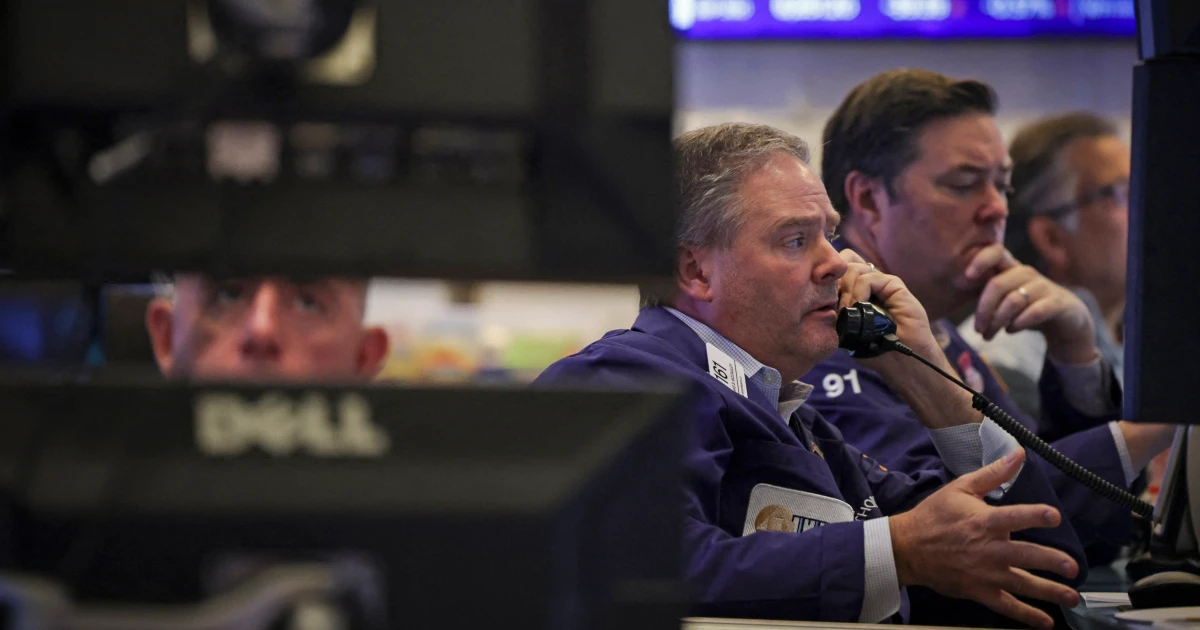
The global stock market rally hit a wall on Tuesday, dragged down by artificial intelligence and technology companies.
The S&P 500 fell 1.2% and the Nasdaq fell 2%. The Russell 2000 index, which tracks smaller companies, fell 1.4%.
Gold, a traditional safe haven for investors when markets are volatile or uncertain, fell about 1.6%.
Within the S&P 500, technology was the worst performing sector.
The world’s largest publicly traded company, Nvidia, fell almost 4%. With a market value of over $4.85 trillion, Nvidia lost $200 billion in market value.
Crypto also suffered heavy losses, with bitcoin dipping below $100,000 for the first time since June. The digital currency fell more than 7% as investors fled riskier assets like digital currencies.
International markets followed a similar trajectory, with benchmark indices in Germany and France both falling almost 1% on Tuesday. Asia-Pacific markets also fell, with stock indexes in Australia and Hong Kong falling about 1% during Tuesday’s trading. Stocks in Japan fell almost 1.8%.
Profits from defense darling Palantir appear to have helped spark nervousness among traders. The company’s shares, which have soared more than 160% this year, fell more than 8% despite quarterly results that beat Wall Street’s earnings and revenue expectations.
Michael Burry, an investor known for “The Big Short” and who rose to prominence with a bet against the U.S. housing market in 2008, also revealed large bets against Nvidia and Palantir on Monday evening.
Comments made overnight by the CEOs of two major investment banks also caught the attention of traders.
David Solomon of Goldman Sachs and Ted Pick of Morgan Stanley warned that stocks could be on the verge of a pullback.
“We should welcome the possibility that there will be declines, 10 to 15 percent, that are not caused by some kind of macroeconomic cliff effect,” Pick said at the Hong Kong summit of global financial leaders.

Salomon, speaking at the same conference, said that “there are things that will change sentiment and create declines, or change perspective on the growth trajectory, and none of us are smart enough to see them until they actually happen.”
But fears about AI’s stratospheric valuations have been the focus of discussion on Wall Street for most of the year. As the value of these stocks continues to rise, they increasingly represent the value and momentum of key indexes like the S&P 500.
“AI-related stocks have accounted for 75% of S&P 500 returns, 80% of earnings growth, and 90% of capital spending growth since ChatGPT launched in November 2022,” according to a recent analysis from JP Morgan Asset Management.
“The Magnificent 7 represent more than 30% of the S&P 500 – a level of concentration exceeding even that of the dot-com bubble,” Erwan Jacob, macro analyst at LSEG, wrote in a note on Tuesday. The “Magnificent 7” are Apple, Amazon, Alphabet, Microsoft, Nvidia, Meta Platforms and Tesla.
“It remains unclear whether such expenditures will be financed by corresponding revenues,” Jacob noted.
Yet this year, the S&P 500 is up more than 15% overall, while the Nasdaq Composite, which more closely tracks the biggest tech companies, remains in the green by 20%.
Still, experts say a downturn isn’t always cause for concern.
“On average, the (S&P 500) experiences three declines between 5% and 10% each year,” wrote Jeff Buchbinder, chief market strategist at LPL Financial, during a short sale in August 2024. “Corrections of 10% to 20% are also quite common, occurring on average once a year. »
At the same time, the dollar index, which measures the strength of the U.S. dollar against a basket of foreign currencies such as the yen, pound sterling and euro, was up slightly, hitting its best level in about three months.


