





The U.S. Senate Banking Committee has unveiled draft text of the CLARITY Act ahead of a scheduled hearing, releasing a 309-page bill that represents the most comprehensive attempt to date to establish a federal regulatory framework for digital assets. The legislation covers significant ground in stablecoins, decentralized finance and the broader crypto ecosystem – and the timeline for its advancement is moving faster than most participants anticipated.
The most immediately debated provision directly targets stablecoins. The bill prohibits issuers from paying interest or yields simply for holding stablecoins. For yield-generating stablecoin products that have seen significant growth on both centralized and decentralized platforms, the implications are structural rather than cosmetic.
The Senate Banking Committee is expected to vote on the CLARITY Act during a markup session on May 14, 2026, two days from now. If the bill passes this threshold with sufficient support, a full Senate vote could follow by summer 2026, putting the United States closer to a comprehensive digital asset regulatory framework than at any other time in the industry’s history.
The stakes extend well beyond stablecoins. What the CLARITY Act establishes about who regulates what, which protocols are considered sufficiently decentralized, and which activities require registration will define the operating environment for the entire crypto industry in the world’s largest financial market.
Four advantages. Four verdicts. A framework that changes everything
Lead investor Fred Krueger broke down the implications of the CLARITY Act into the four categories that matter most to crypto participants — and his assessment is more constructive than the 309-page length and regulatory complexity suggest.
For Bitcoin, Krueger’s verdict is unambiguous. Explicit protection of self-custody removes one of the lingering regulatory threats to Bitcoin holders, while a clear legal framework for lending, investing, and other financial products built around Bitcoin opens the door to large-scale bank participation. His characterization: very optimistic.
For DeFi, the picture is conditionally positive. Truly decentralized protocols remain intact under the Clarity Act. The burden of compliance falls primarily on front-ends, who will need to implement more aggressive geo-blocking, suspicious activity reporting, and potentially KYC requirements. For protocols capable of demonstrating true decentralization, the path forward is clearer than many feared.
For stablecoins, the yield restriction is the determining limitation. Banks appear to be the structural winners: they can issue stable coins within a clear framework while yield alternatives face heavy restrictions. Bullish for the category, but with a clear hierarchy as to who benefits the most.
For crypto and Bitcoin companies, Krueger is again adamant. US companies building truly decentralized protocols are protected. Importantly, products can start with more centralized architectures and gradually decentralize to achieve compliance – an arrangement that provides builders with a realistic path forward rather than an impossible starting condition.
The implementation timeline Krueger identified is summer 2027, giving the industry about a year after potential adoption to adapt.
CLARITY Act Comes as Crypto Market Tests Critical Zone
The total crypto market cap is trading around $2.66 trillion as the market attempts to stabilize after months of volatility and macro uncertainty. The timing is remarkable. The Senate Banking Committee’s release of the CLARITY bill introduces the strongest regulatory framework proposal the industry has seen in years, just as the crypto market structure begins to show signs of recovery.
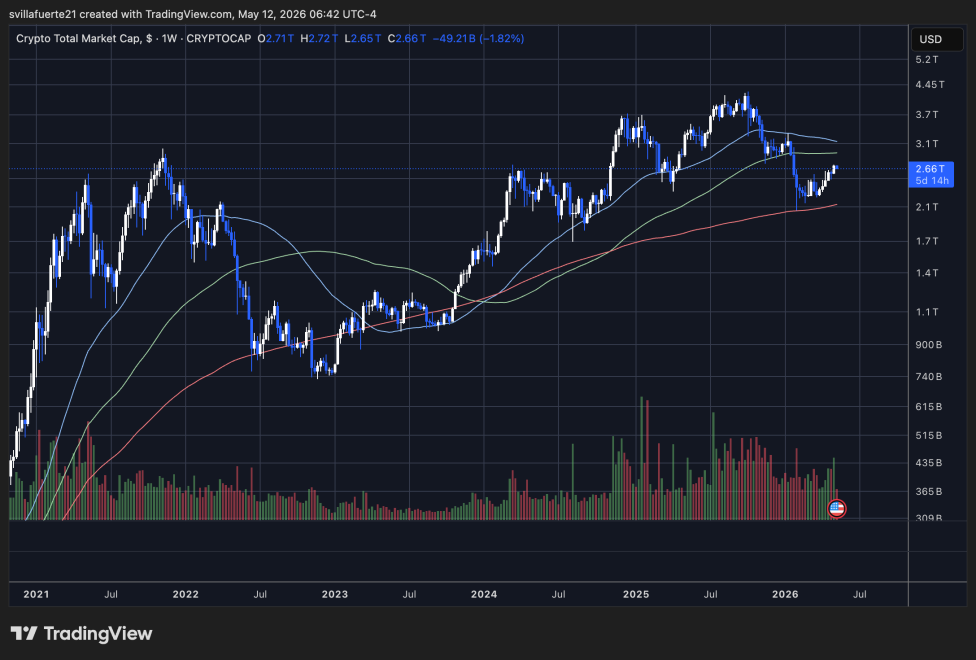
Technically, the chart shows the market recovering a significant area after the February capitulation that briefly pushed the total valuation near the $2.1 trillion zone. Since then, buyers have managed to recoup a significant portion of the decline, bringing the market back above the 50- and 100-week moving averages. These moving averages are now starting to flatten, reflecting the transition from aggressive bearish momentum into a broader consolidation phase.
The key level remains the $2.7 trillion region. This area served as support during several phases of the 2024 rally before becoming resistance during the correction. The market is now testing this same area from below, while volume remains relatively controlled compared to the panic spikes seen earlier in the year.
If the market holds above the major moving averages and decisively breaks through resistance, the structure would start to resemble a continuation phase rather than a temporary relief rally. Much of this confidence may now depend on how the CLARITY Act defines the future operating environment for crypto.
Featured image from ChatGPT, chart from TradingView.com
Editorial process as Bitcoinist focuses on providing thoroughly researched, accurate and unbiased content. We follow strict sourcing standards and every page undergoes careful review by our team of top technology experts and seasoned editors. This process ensures the integrity, relevance and value of our content to our readers.


