




President Donald Trump has strongly stated his position, warning major US banks that his administration will not tolerate interference with his “crypto agenda.” In a fiery article on Truth Social Tuesday evening, he explicitly called for passage of the Clarity Act. This stalled bill could significantly reshape how digital assets are regulated in the United States.
While banks claim they are protecting the financial system, the administration is creating a “The People Against the Banks” narrative, portraying the legislation as essential to keeping crypto innovation and capital within U.S. borders. The stakes are high: the outcome of this legislative battle will determine not only who regulates your assets, but also whether you can earn interest on them.
BREAKING: Trump says ‘PASS THE CLARITY ACT ASAP’ – warns banks ‘SHOULD NOT HOLD THE CLARITY ACT HOSTAGE’
“The United States must put the market structure in place, as soon as possible. »
– Diane (@InvestWithD) March 3, 2026
 BREAKING: Trump says ‘PASS THE CLARITY ACT ASAP’ – warns banks ‘SHOULD NOT HOLD THE CLARITY ACT HOSTAGE’


 …
… DISCOVER: The next 1000x gem? Check out our top presale picks before they list
What the Clarity Law Really Changes
The heart of this battle is a massive shift in power known as the Clarity Act. Currently, the fight between the Securities and Exchange Commission (SEC) and the Commodity Futures Trading Commission (CFTC) leaves investors uncertain about the rules. The Clarity Act proposes to remove much of the SEC’s power and give “exclusive jurisdiction” to the CFTC.
By classifying most cryptocurrencies as “digital products” rather than securities, the bill aims to end the era of “regulation by enforcement.”
This isn’t just a label change. It provides a legal avenue for the CFTC’s exclusive authority over cash markets. This means that exchanges would finally know exactly what rules to follow without constantly fearing sudden lawsuits, creating a clearly defined path for digital asset innovation.
DISCOVER: 5 High-Risk, High-Reward Cryptos
Why Wall Street Is Fighting This (And Why It’s Surprising)
If clear rules are good for business, why do banks oppose them? The answer lies in competition. The Clarity Act’s main sticking point concerns banking regulations regarding stablecoins (dollar-pegged crypto tokens).
Banks are terrified of provisions that would allow crypto exchanges to pay yield (interest) to users holding stablecoins. If you could earn a 5% return on your digital dollars on an exchange, why would you keep your money in a traditional bank account paying 0.01%? Banks call this “deposit flight” and they are pushing to stop it to protect their balance sheets.
We have seen this tension building for months. While traditional financial leaders like the CEO of Goldman Sachs have called for clear rules on crypto, they want a system that keeps banks at the center of the financial universe. They want to participate in the crypto-economy, but they don’t want the crypto-economy to replace them.
DISCOVER: The Best Crypto Presales to Watch Now
Bitcoin Price Rises as Trump Pushes for Clarity Act
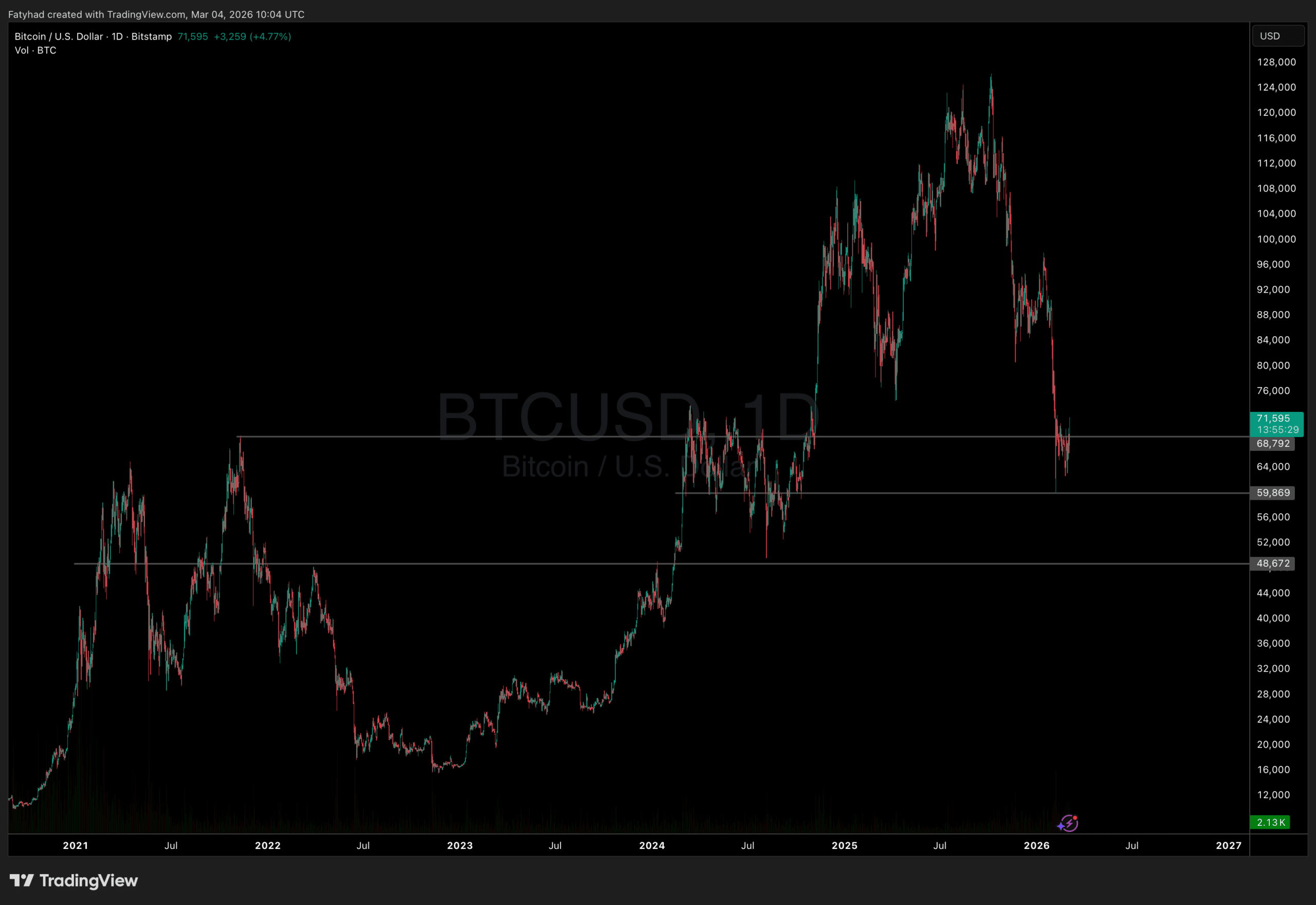
Bitcoin is trading near $71,500 after bouncing from the $60,000 support zone to $62,000, matching a prior consolidation range from mid-2024. The rebound follows a strong rejection from the cycle high of $120,000 to $125,000, confirming a long correction phase.
Structurally, BTC is attempting to reclaim the $68,700 level, now acting as short-term resistance turned into support. Holding above this zone would open the way to $80,000 and potentially $90,000. However, if the price fails to maintain its momentum, the price of rice could decline towards $59,800. The broader trend remains bullish over multiple years, but the medium-term structure depends on defending the $60,000 floor.
DISCOVER: Secure Your New Assets: The Best Hardware Wallets Reviewed
The Trump Factor: The Politics Behind the Clarity Act
The push for the Clarity Act isn’t just about politics; it’s personal. Trump’s crypto agenda is closely tied to the administration’s broader goals: and arguably personal interests.
With the Trump family’s involvement in projects like World Liberty Financial (WLFI), the administration has a stake in the game. A regulatory environment controlled by a more crypto-friendly CFTC directly benefits DeFi projects. This alignment also becomes clearer with personnel changes. We recently saw a Chainlink executive join the SEC Crypto Task Force, reporting that the administration is systematically replacing “anti-crypto” bureaucrats with industry natives.
We’re watching to see if the Senate Banking Committee gives in to the president’s pressure. The banks have the means to lobby, but the White House has the power to intimidate and the mandate to reform the system.
The clock is ticking. As Treasury pushes for a resolution by spring, the Clarity Act is the final piece of the puzzle. We are closely monitoring the Senate increase: if concerns related to “deposit leak” are resolved, we can expect this bill to move forward quickly.
Follow 99Bitcoins on X for the latest market updates and subscribe on YouTube for daily market analysis from experts.
Key takeaways
- The Clarity Act proposes to shift crypto oversight from the SEC to the CFTC, treating most tokens as commodities rather than securities.
- Banks oppose the bill because they fear users will move money from low-interest bank accounts to high-yielding stable accounts (deposit flight).
- For retail investors, the law could mean lower fees and more token listings, but potentially fewer disclosure protections than those offered by the SEC.
After Trump against the banks: does the Clarity Act change the situation? appeared first on 99Bitcoins.


