



Uniswap (UNI) has opened community voting on a proposal that could introduce the protocol’s first UNI-backed burn mechanism. The initiative spans three governance votes.
They include enabling protocol fees on Robinhood Chain, deploying v4 and bridging infrastructure on all other chains.
If Uniswap members approve the proposals, the protocol will begin depositing fees into TokenJar accounts. At press time, the vote in favor of the proposal stood at 74%.
Once there, users can acquire enough UNI to burn it completely and in turn recover their UNI from the TokenJar account.
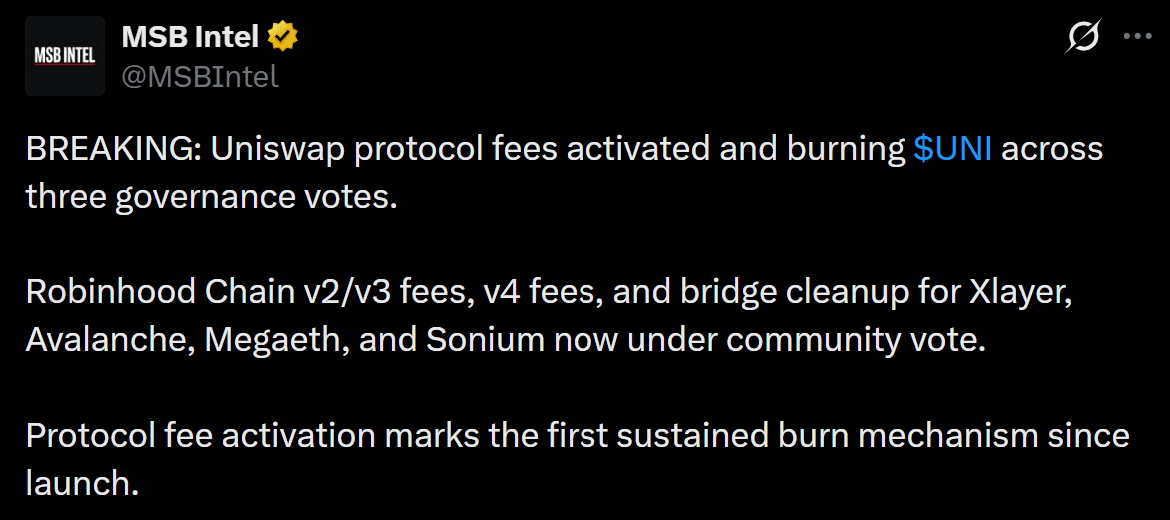
The proposal will link the provision of UNI to actual use of the protocol rather than simply providing incentives through governance.
Protocol Revenue Strengthens UNI’s Value Capture
This potential change becomes more significant when compared to Uniswap’s growing protocol revenue. Each increase in commercial activity would generate additional fees, creating more opportunities to remove UNI from circulation through the proposed burning mechanism.
Currently, according to data from DefiLlama, Uniswap generates around $5 million in fees per day. Additionally, its annual protocol revenue is almost $50 million.
As v4 and Robinhood Chain deployments attract more trading volumes, fee generation could continue to grow.
Despite this, the forecast consumption rate remains modest relative to UNI’s total supply. Nevertheless, the mechanism introduces a lasting link between protocol usage and token scarcity.
If network activity continues to grow, UNI’s long-term value may increasingly reflect demand for organic protocols rather than governance incentives alone.
Robinhood Chain tests Uniswap’s growth strategy
Whether the burning mechanism will produce meaningful results now depends on user adoption rather than governance alone. Robinhood Chain quickly became an early test of this thesis after surpassing $1 billion in cumulative swap volume within days of its launch.
This momentum suggests that Uniswap’s ecosystem is reaching users beyond its traditional base. The increase in cross-wallet interactions and swap activity further indicates that participation goes beyond speculative interest.
However, lasting success will depend on retaining these users over time. If daily trading and liquidity continue to grow, Robinhood Chain could become an increasingly important contributor to Uniswap’s long-term protocol growth.
Final summary
- Uniswap could tie long-term token value to protocol usage via its proposed fee-funded burn mechanism.
- The adoption of Uniswap on Robinhood Chain will determine whether sustained burns significantly strengthen token scarcity.


