



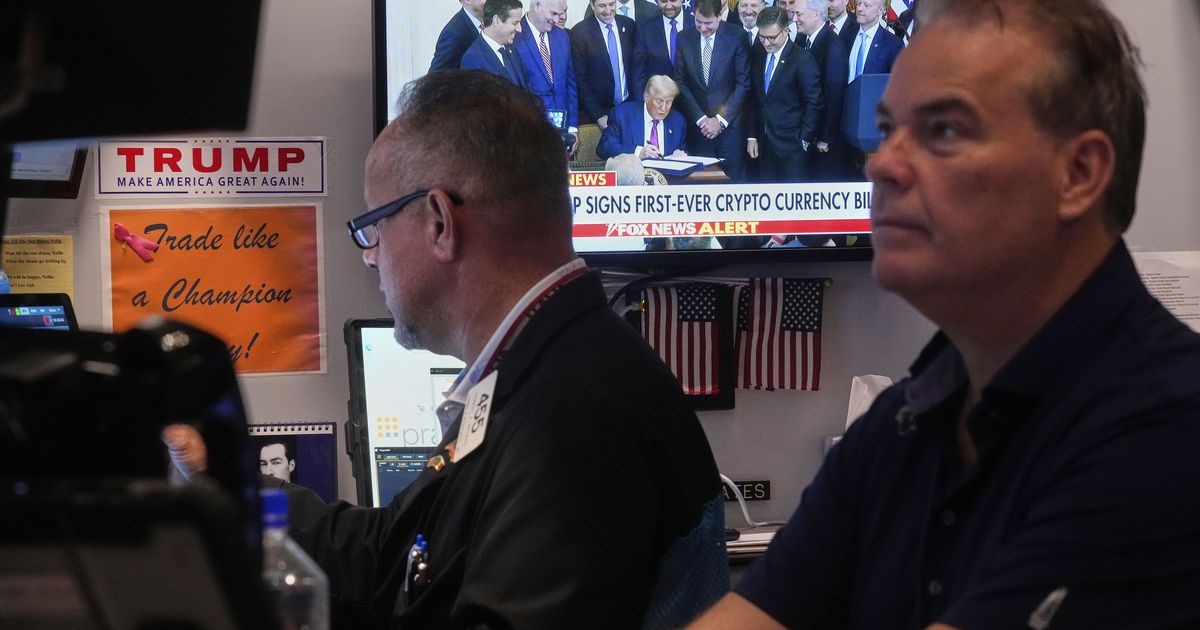
Stablecoins play an increasing role in the global financial system. The Genius Act of 2025, signed by President Donald Trump on July 18, marks significant development, establishing a complete and binding legal framework for cryptographic assets. This historic stage positions the United States at the forefront of regulatory innovation in this sector. It also raises important issues on global financial stability, geopolitical dynamics and conflicts of potential interests.
Stablecoins represent a specific category of cryptocurrency. Their value is fixed to a particular asset, most often a traditional currency such as the US dollar. The act of engineering now incorporates stablescoins into the American financial system. In order to comply with regulatory requirements, stablecoins must be fully supported by liquid assets in US dollars, mainly in the form of short -term treasury bills. The new rules establish a clear legal framework for stablecoins in their largest market, but also present significant risks.
Potential risks for Europe
The rapid growth of the stalls fixed to the US dollar, as well as the associated change in assets and financial transactions, could weaken the monetary sovereignty of the euro zone and the hamstrings of its monetary policy. The obligation to support the stablescoins 1: 1 creates strong incentives to buy short -term US treasury bills, despite increasing concerns concerning the sustainability of American debt. This could result in an increase in demand for American securities and a decrease in the demand for European bonds. This would increase interest rates for highly indebted euros states.
The greatest risk, however, lies in the opacity of many stablecoin transmitters. Although they say that their products are supported by traditional assets such as cash bills, the complex structure of their capital and their reserve creates considerable potential for a sudden crisis of confidence. This could quickly lead to the panic of the market, which makes it impossible to convert them into traditional assets. This would have overflow effects in the European financial sector.
The potential conflict of interest resulting from personal participation in cryptography raises particular concerns. According to the media, companies belonging to the Trump family have made substantial benefits in this sector. Given the need to sell more American debts – with which stablecoins could be useful – it is in the interest of Trump to see that the market develops as quickly as possible. However, this raises questions about the effectiveness of surveillance in the United States, as well as the probability of public intervention in the event of a crisis.
More reasons to introduce a digital euro
The act of engineering marks a radical difference in the EU approach to regulate digital currencies. It focuses on the rapid development of private currencies fixed to the dollar. On the other hand, the main initiative of the EU is the digital euro, a digital currency of the central bank which will be issued by the European Central Bank. The United States is currently banning the development of central bank digital currencies on the patterns paradoxically that this form of money, when published by a central bank is too risky.
While the engineering law focuses on the use of stablescoins to strengthen the influence of the dollar and create incentives to buy American obligations, the EU continues a more prudent, complete and balanced approach. Its Mica (markets in crypto-active) regulations favors financial stability and consumer protection within the cryptocurrency ecosystem. The divergence between these regulatory approaches has the potential to generate conflicts.
In any case, the advent of the Engineering Act underlines the need for a secure digital euro which preserves monetary sovereignty in the digital ecosystem and allows innovation of the private sector, including stalins based on it. Europe must also monitor developments in the United States and identify potential risks. Excessively rapid growth or turbulence would have a threat to Europe’s financial stability.


