




This long-term technical progress is reflected in real-world adoption, as stablecoin transfer volume on Ethereum surpassed $8 trillion in Q4 2025, alongside a record number of transactions and active addresses. Together, the data suggests that Ethereum is evolving from a primarily speculative platform to a global settlement layer for real-world payments, stablecoins, and tokenized assets.
Ethereum Claims Trilemma Breakthrough
Vitalik Buterin claims that Ethereum has effectively crossed a historic threshold in solving what has long been considered one of the world’s most difficult problems. blockchain design: the blockchain trilemma. In an article which was shared on X this weekend, the Ethereum co-founder argued that recent and upcoming upgrades mean Ethereum can now simultaneously support decentralization, security and scalability in a way that is no longer theoretical, but already partially experienced in production.
According to Buterin, two major technical developments are at the heart of this change: peer data availability sampling, known as PeerDAS, and zero-knowledge Ethereum virtual machines, or ZK-EVM. Together, he said, these technologies transform Ethereum into “a fundamentally new and more powerful type of decentralized network.”
PeerDAS was introduced as part of the Fusaka Upgrade in December, and this allows Ethereum to handle much larger amounts of data by allowing nodes to check data availability without needing to download everything. This approach significantly improves scalability while preserve decentralizationand Buterin explained that this component of the vision is already live on the Ethereum mainnet.
ZK-EVMs are the second half of the equation. These systems allow Ethereum blocks and transactions to be validated using zero-knowledge proofs while remaining compatible with the existing Ethereum virtual machine. While ZK-EVMs have been in development for several years and are now considered ready to go, Buterin stressed that they are still in the “alpha stage” from a security perspective. Hardening and testing are required before it can be considered the primary network validation mechanism. He shared a roughly four-year roadmap during which ZK-EVMs will gradually play a larger role in Ethereum’s core infrastructure.

Buterin described a phased rollout beginning in 2026, when Ethereum is expected to see gas Limit increases driven by changes such as balance adjustments and execution layer upgrades. 2026 could also mark the first real opportunity for users to run ZK-EVM-based nodes. Between 2026 and 2028, Ethereum developers plan to introduce gas repricing, changes to the state structure, and adjustments that will make higher throughput more secure. By the end of the 2020s, Buterin expects ZK-EVMs to become the dominant means of block validation, opening up much larger gas limits and sustainable scalability gains.
Buterin said it took about a decade of focused development to achieve what he now sees as a resolution of the trilemma. He traced the origins of this work back to his first writings on data availability in 2017 and described the effort as a ten-year journey that is only now bearing fruit.
Stablecoin Activity on Ethereum Reaches New High
Ethereum is also seeing success in other areas. Stable coin transfer volume on Ethereum reached a new all-time high in the fourth quarter of 2025 after surpassing $8 trillion, according to data released by Token terminal.
This milestone represents almost double the transfer volume recorded in the second quarter, which amounted to just over $4 trillion. Analysts say this increase proves that there is a shift away from on-chain speculative activities towards real-world use, particularly in payments, remittances and cash flow.
Stablecoin issuance in progress Ethereum also grew significantly during the year 2025. According to Blockworks figurinestotal emissions rose about 43% over the year, from $127 billion to $181 billion in December. An analyst published under the name “BMNR Bullz” on tokenization.
The increase in stablecoin activity has coincided with record levels of network usage. Data from Etherscan Shows that daily Ethereum transactions peaked at around 2.23 million in late December, an increase of around 48% from the same period a year earlier. At the same time, Token Terminal reported that monthly active addresses on Ethereum reached an all-time high of 10.4 million in December, while the number of unique daily active addresses acting as senders or recipients surpassed one million.
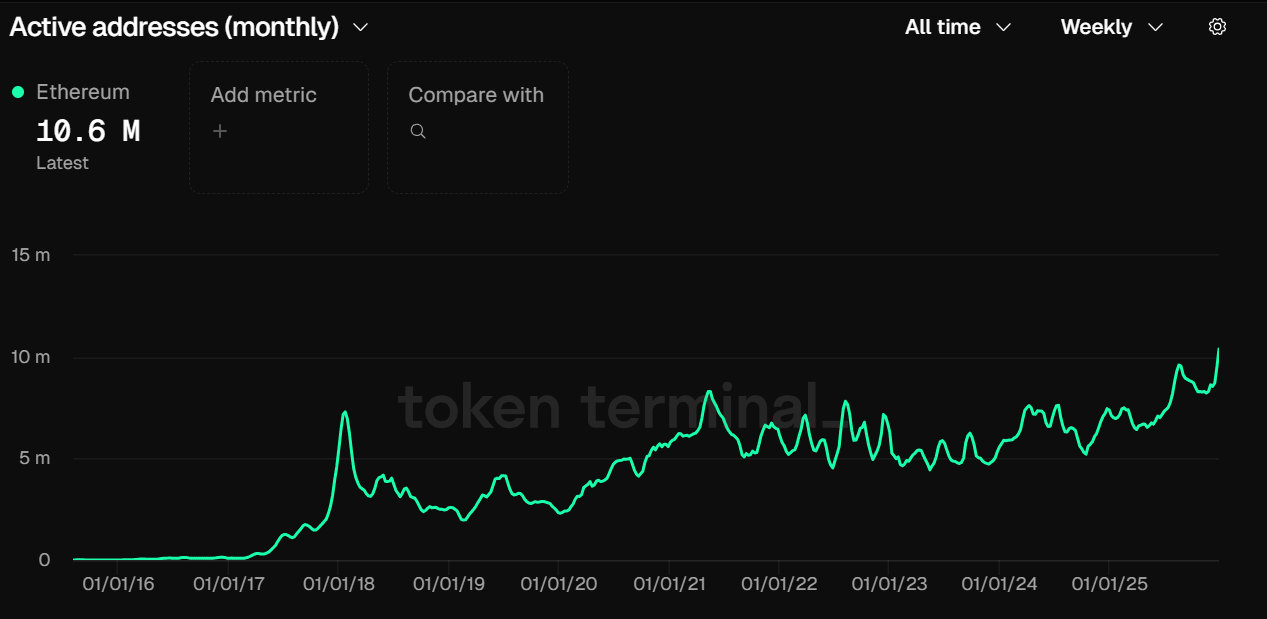
Ethereum monthly active addresses (Source: Token terminal)
Ethereum also dominates the tokenization of real-world assets walk. According to data from RWA.xyz, the network accounts for approximately 65% of the total on-chain RWA value, which equates to approximately $19 billion. When layer 2 Ethereum networks and other EVM-enabled chains are included, this share rises to over 70%.


