



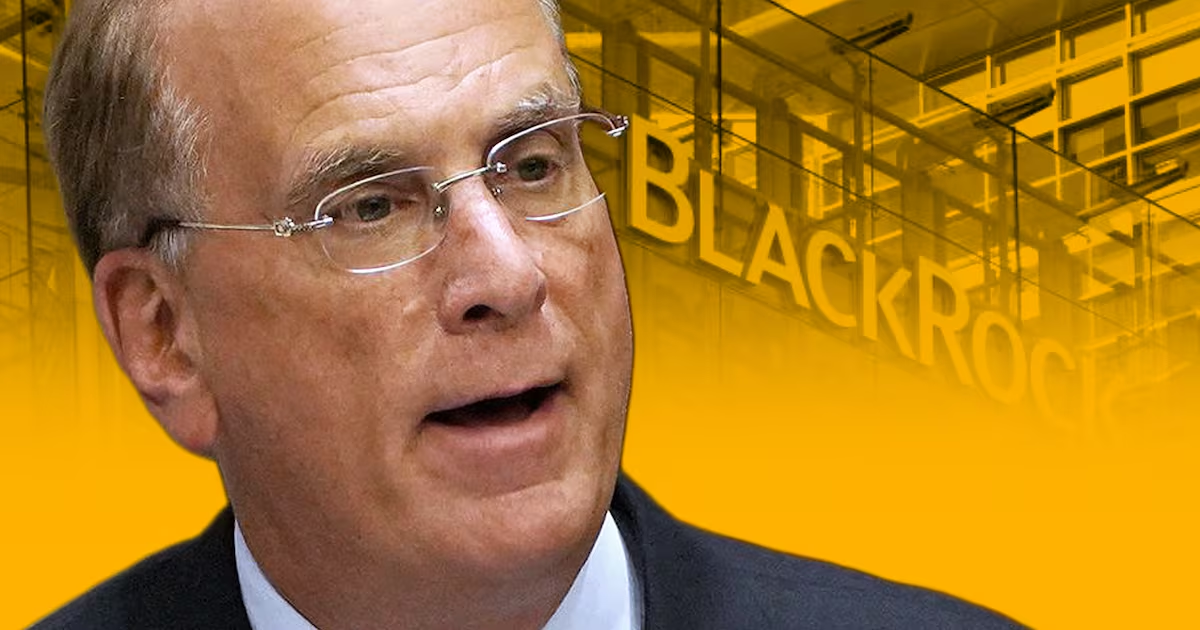
- Larry Fink is optimistic about tokenization.
- The trend is expected to accelerate in 2026.
- A lack of infrastructure and regulations could slow down this development.
Updating the financial system to run on blockchain technology is “necessary” and promises to reduce fees and improve accessibility for investors.
Such is the case with BlackRock CEO Larry Fink, who spoke Wednesday at a World Economic Forum panel in Davos, Switzerland, alongside Citadel CEO Ken Griffin and European Central Bank President Christine Lagarde.
Tokenization is the process of converting ownership rights to assets such as real estate, stocks or bonds into digital tokens on a blockchain. Supporters argue it would speed up funding, reduce costs and provide more accountability.
“We would reduce fees, we would do more democratization,” Fink said. “(If) we had a common blockchain, we could reduce corruption.”
For Wall Street titans like BlackRock, tokenization presents a huge opportunity.
Most of the underlying software that runs the global financial system is between 40 and 60 years old. This is why it is often slow and clumsy, and dependent on expensive intermediaries.
Updating it to a blockchain-based system could bring a lot of money to those pioneering the change.
BlackRock is not alone in being optimistic about blockchains.
“Blockchain is the future of traditional banking,” UBS CEO Sergio Ermotti said at the World Economic Forum earlier this week. “You will see a convergence.”
Ripple and Boston Consulting Group predict that blockchain tokenization will become a $19 trillion industry by 2033, while asset manager Grayscale predicts a thousand-fold increase in tokenized assets, bringing their combined value to $35 trillion by 2030.
Modest progress
Despite all the hype around tokenization, progress so far has been modest.
Investors have invested more than $22 billion in tokenized assets, but adoption has been limited to a few key areas. U.S. Treasury bonds are the largest tokenized asset, worth about $9.3 billion, while commodities, like tokenized gold receipts, make up almost $4 billion.
This year could be the year where the trend deepens and accelerates.
“In 2026, the market for tokenized assets will become broader, deeper and significantly more institutional,” said Philipp Pieper, co-founder of tokenization platform Swarm Markets. DL News.
Tokenization has already achieved a big victory. On Monday, the New York Stock Exchange announced the launch of a tokenized securities trading platform with stable funding, instant settlement and 24/7 trading.
According to Fink, another big advantage of tokenization is security.
Blockchains, unlike today’s centralized financial system, can be decentralized, meaning no single entity has control over who can send funds or has privileged access to data.
In other words, everyone who uses the blockchain follows the same hard-coded rules. This creates a level playing field that attracts both investors and asset managers.
“We may have more dependencies on a single blockchain, which we could all talk about,” Fink said. “But that being said, activities are probably being processed and more secure than ever.”
Are you moving too fast?
For Fink, however, tokenization could progress more quickly in the United States.
“It is ironic to see two emerging countries leading the world in tokenization and digitalization of their currencies, namely Brazil and India,” he said.
The infrastructure needed to make tokenization work at scale may not yet have caught up.
“Tokenized assets exist and can be traded, but they lack the depth, distribution and reliability of data required by institutional capital,” said Laurens Fraussen, research analyst at Kaiko, in a January 20 report.
Then there is the Clarity Act, a sweeping crypto market structure bill passed by the US Senate.
This will likely reduce uncertainty around tokenized assets, and many experts expect it to accelerate their adoption as more institutions gain confidence to issue and trade them.
The bill was previously expected to pass before the end of 2025. It faced more delays last week after Coinbase CEO Brian Armstrong said his exchange would not support it.
Armstrong argued that certain provisions allow for a “de facto ban on tokenized stocks” and would give the government unrestricted access to crypto users’ financial records.
“We would rather have no bill than a bad bill,” Armstrong said in a Jan. 14 social media post.
Tim Craig is DL News’ DeFi correspondent based in Edinburgh. Contact us with advice at tim@dlnews.com.


