




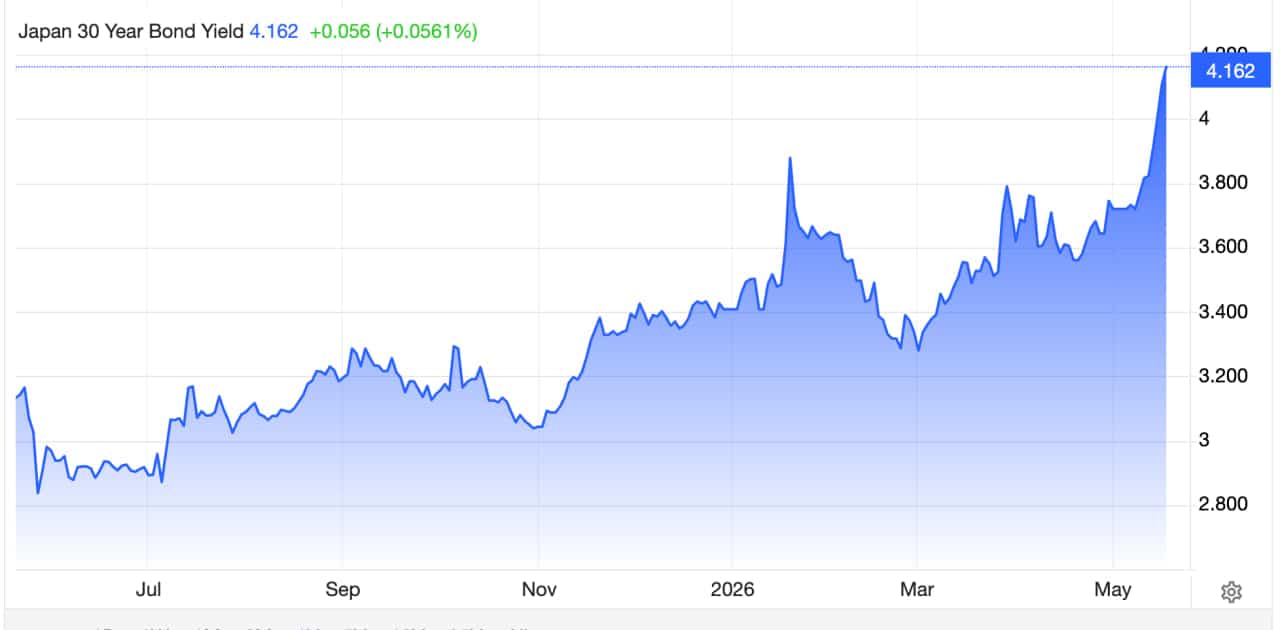
The yield on 30-year Japanese government bonds rose above 4% for the first time since the instrument’s inception in 1999, reaching around 4.2% in May 2026, as the Bank of Japan’s sustained rate normalization program continues to end decades-long yen carry trades that had quietly funded risky assets like XRP in global markets.
Japanese institutional investors sold nearly $29.6 billion of U.S. debt during the first quarter of 2026, the largest quarterly sell-off since 2022, contributing to a 30-year U.S. Treasury yield that topped 5% that same week, simultaneously compressing liquidity conditions for mortgages, corporate credit and sovereign debt.
Source: TE
Analyst Catalina Castro, writing to a wide audience, described the dynamic with sharp arithmetic: Japan is selling U.S. bonds, U.S. yields continue to rise, mortgages are rising, credit is getting more expensive, and pressure is building throughout the U.S. financial system.
This is not simply a correction in Japanese domestic bonds. This is a structural stress event in the global liquidity transmission chain – one that reveals a fundamental inefficiency that Ripple and XRP were designed, architecturally, to address.
We believe the JGB crisis will prove to be the most significant stress test Ripple’s settlement infrastructure has ever encountered in the real world, not because XRP can absorb a distressed $9 trillion bond market, but because the specific mechanism by which yield spikes drain institutional liquidity is precisely the mechanism that on-demand bridging settlement is intended to relieve.
DISCOVER: Best Meme Coins to Buy in 2026
XRP and Ripple Payments: How the On-Demand Liquidity Mechanism Actually Works
The mechanism works as follows: a Japanese urban bank or regional insurer holding yen-denominated liabilities and needing to settle a cross-border bond in dollars would, in the conventional correspondent banking model, use pre-funded nostro accounts, unused foreign currency reserves with correspondent institutions overseas, earning nothing while bond yields climb and opportunity costs rise.
Ripple’s payments platform, formerly known as On-Demand Liquidity and reintroduced in late 2024 as part of a broader institutional infrastructure initiative, eliminates this pre-funding requirement by routing the transaction through XRP as a bridge asset: the issuing institution converts the yen to the closing of the transaction.
⚠️ATENCIÓN⚠️
THE TERCER MERCADO DE BONOS MÁS GRANDE DEL MUNDO SE ESTÁ ROMPIENDO + RELACIÓN CON $XRP
🤯Japón aba de cruzar niveles que NO SE VEÍAN since the 90s and the CONSECUENCIAS can sacudir à TODOS LOS MERCADOS GLOBALES
💥The Japanese bono at 30 years superó el 4% por… pic.twitter.com/4yWBvtRnVT
– Catalina Castro (@techconcatalina) May 18, 2026
Castro described the theoretical result in straightforward terms: a bank sends its local currency, it is converted into
Ripple’s own pilot data supports this directional claim: its deployments have demonstrated cost savings of between 40% and 70% compared to SWIFT, with settlement occurring in minutes compared to the multi-day clearing windows required by correspondent banks.
The Japanese corridor is not a theoretical infrastructure; SBI Holdings, through its joint venture SBI Ripple Asia, has been integrating XRP-based settlement into domestic remittance and institutional payments flows for several years, giving Ripple a live institutional distribution network within the market most directly affected by the JGB dislocation.
following
Disclaimer: Coinspeaker is committed to providing unbiased and transparent reporting. This article is intended to provide accurate and current information, but should not be considered financial or investment advice. Because market conditions can change quickly, we encourage you to verify the information for yourself and consult a professional before making any decisions based on this content.

Daniel Frances is a technical writer and Web3 educator specializing in macroeconomics and DeFi mechanics. Hailing from crypto since 2017, Daniel leverages his experience in on-chain analytics to write evidence-based reports and in-depth guides. He holds certifications from the Blockchain Council and is dedicated to providing “insight gain” that overcomes market hype to find real utility for blockchain.


