




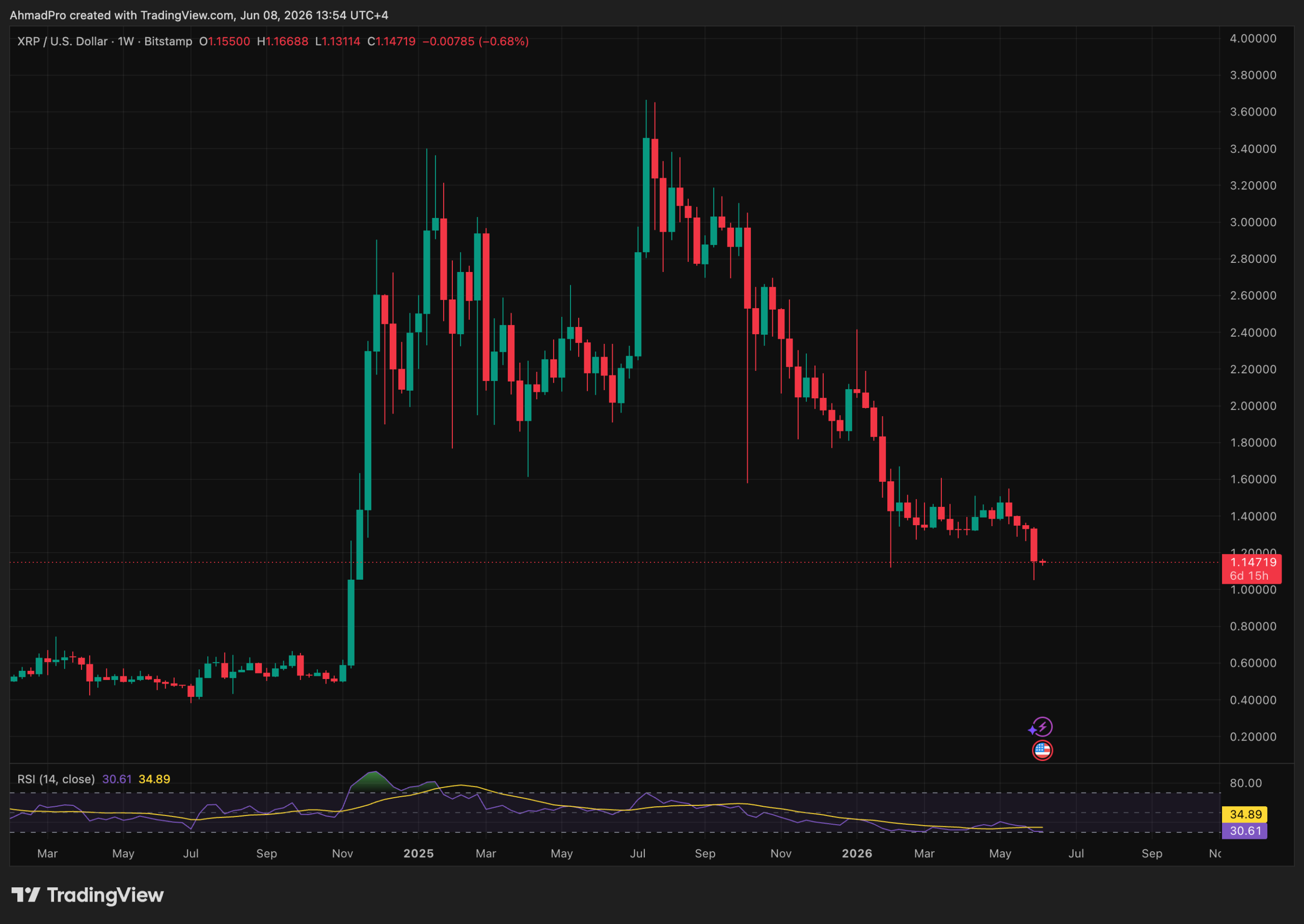
XRP printed $1.08 on June 5, 2026, its lowest level in 19 months, as stronger-than-expected U.S. jobs news showing 172,000 new positions reignited Federal Reserve rate fears and triggered a cascade that wiped out more than $1 billion in leveraged crypto long positions in 24 hours.
Bitcoin plunged to a weekend low of $59,100, and XRP was pulled down with it, extending a pullback that now stands around 69% from the July 2025 cycle high of $3.65. The token has since stabilized in the $1.12 to $1.16 range, recovering about 7% from Friday’s low.
The analytical question is not whether XRP crashed – it clearly did. The question is whether the divergence between this price action and competing institutional accumulation data represents a structural signal preceding a revaluation, or a lagging indicator of buyers who will eventually capitulate to the same selling pressure that pushed the XRP price to its current level. This distinction is considerably important to how the evidence below should be interpreted.
XRP ETF Inflow Divergence: What Institutional Flow Data Really Shows
Spot
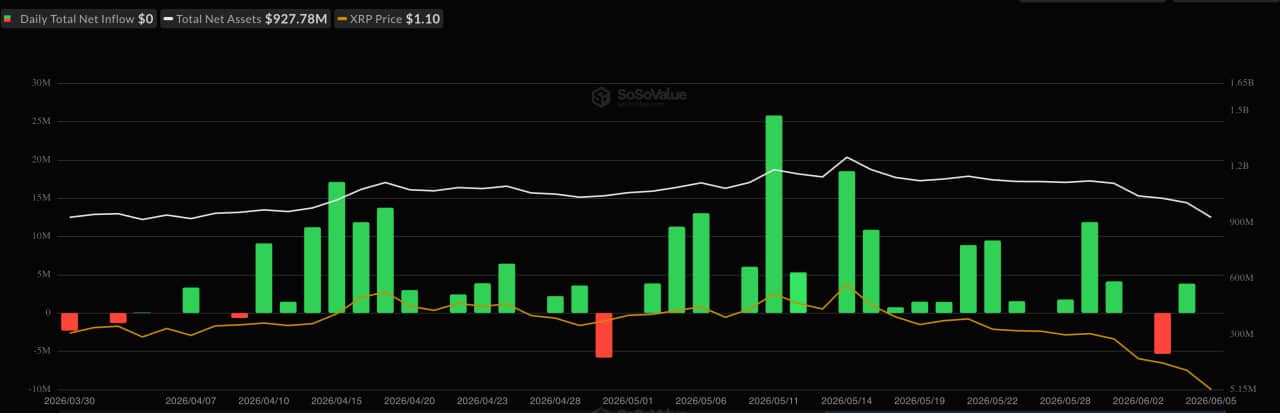
An additional $4.13 million entered XRP ETF products in early June, during the same week that the price of XRP hit a 19-month low, bringing cumulative XRP spot ETF inflows to $1.43 billion.
The mechanism works as follows: ETF inflows represent the activity of authorized participants, typically institutional and retail allocators, purchasing creation units directly from fund issuers, who in turn acquire spot XRP to support those units, thereby reducing the circulating exchange supply.
The discrepancy with comparable products is not accidental. During the same period, Bitcoin ETFs lost $4.4 billion over 13 consecutive trading days, and Ethereum ETFs lost $401 million over 17 days, meaning the institutional flow into XRP investment products was in the opposite direction as every other major crypto ETF category during a massive crypto liquidation event. Bitcoin ETF outflows only broke a 13-day streak on June 4 with an inflow of $3 million, a figure the source itself describes as insufficient to signal a reversal.
Source: XRP Etfs Feed / SoSoValue
However, it is necessary to point out the epistemic status of these data. ETF inflow figures confirm that capital has flowed into these products; they do not confirm that this capital represents a conviction that will persist even in the event of a further decline, nor do they establish a floor price on a specific timetable. Authorized participants can reverse their positions.
The XRP ETF’s record May figure is notable precisely because it occurred against a backdrop of deteriorating prices, but the same deteriorating environment makes the sustainability of these flows an open question rather than a settled one.
Forward-looking arguments regarding XRP ETF inflows rely largely on the CLARITY Act, which would definitively classify XRP as a commodity under U.S. federal law. The bill was approved by the Senate Banking Committee in May and was placed on the Senate legislative calendar on June 1.
Standard Chartered projects that passage of the CLARITY Act could trigger $4 billion to $8 billion in additional XRP ETF inflows by the end of the year, a figure representing approximately 30 to 60 times May’s record monthly total. This projection is conditional on the Senate’s schedule and its passage before the August recess, neither of which is guaranteed.
EXPLORE: The next crypto will explode in the second quarter
XRP News: What the XRP Price-Data Divergence Really Solves
If macroeconomic conditions stabilize, new US inflation data eases rate hold fears, and XRP ETF inflows maintain their May trajectory through June and July, the 9:1 skew between short and long positions becomes an accelerator of a short squeeze rather than a bearish indicator.
The CLARITY Act, which will be voted on by the Senate before the August recess, adds fuel. Standard Chartered’s projection of $4-8 billion inflows is starting to factor in ahead of adoption, taking XRP back towards $1.50-$1.60 in the near term and towards $2.00 or more if institutional inflows accelerate. The confirmation signal is a sustained daily close above $1.30, followed by a recovery of $1.40 in volume.
If Bitcoin stabilizes between $60,000 and $65,000 without decisively recovering to higher levels and the CLARITY Act remains on the Senate calendar with no scheduled floor vote, XRP consolidates near $1.10 to $1.25. The accumulation of whales continues quietly but finds no catalyst in the short term.
Source: XRPUSD / Tradingview
The installation builds without resolving. The confirming signal is that ETF inflow news remains positive week over week without acceleration, and XRP maintains $1.08 as an uninterrupted low.
If Bitcoin tests Polymarket’s implied $55,000 level, currently assigned a 64% probability, a new round of crypto liquidations will force even high-conviction XRP holders to reduce their exposure. XRP’s 0.87x correlation with Bitcoin’s recent movement implies a price near $1.05 to $55,000.
A test of $50,000, with a probability of 51%, pushes XRP below $1.00. Below that, structural support lies at $0.95, with the $0.75 to $0.85 area representing the all-time cycle lows. The confirmation signal is a daily close below $1.08 on high volume accompanied by a reversal in ETF entries.
The leading indicator in all 3 scenarios is not the XRP price itself. This is the weekly ETF flow figure. A sustained reversal from inflows to outflows indicates that the institutional accumulation thesis is breaking down. Continued inflows from further price weakness deepen the divergence and strengthen the potential bullish argument.
DISCOVER: Best Meme Coins to Buy in 2026
following
Disclaimer: Coinspeaker is committed to providing unbiased and transparent reporting. This article is intended to provide accurate and current information, but should not be considered financial or investment advice. Because market conditions can change quickly, we encourage you to verify the information for yourself and consult a professional before making any decisions based on this content.

Daniel Frances is a technical writer and Web3 educator specializing in macroeconomics and DeFi mechanics. Hailing from crypto since 2017, Daniel leverages his experience in on-chain analytics to write evidence-based reports and in-depth guides. He holds certifications from the Blockchain Council and is dedicated to providing “insight gain” that overcomes market hype to find real utility for blockchain.


