



XRP Ripple sits at $1.10, down -3% today. Seven straight weeks of net inflows into spot ETFs have pushed cumulative institutional demand to $1.35 billion, but the price has not broken out.
This gap between sustained buying and sideways price action is the central tension every XRP holder needs to understand right now as XRP moves closer and closer to $1.
The broader crypto market is recovering on Monday, helped in part by early diplomatic progress between the United States and Iran toward a 60-day peace framework.
This macro tailwind has lifted sentiment, but XRP’s own story is more structural than geopolitical. ETF supply is real, persistent and measurable. The question is whether it is a floor or a launch pad.
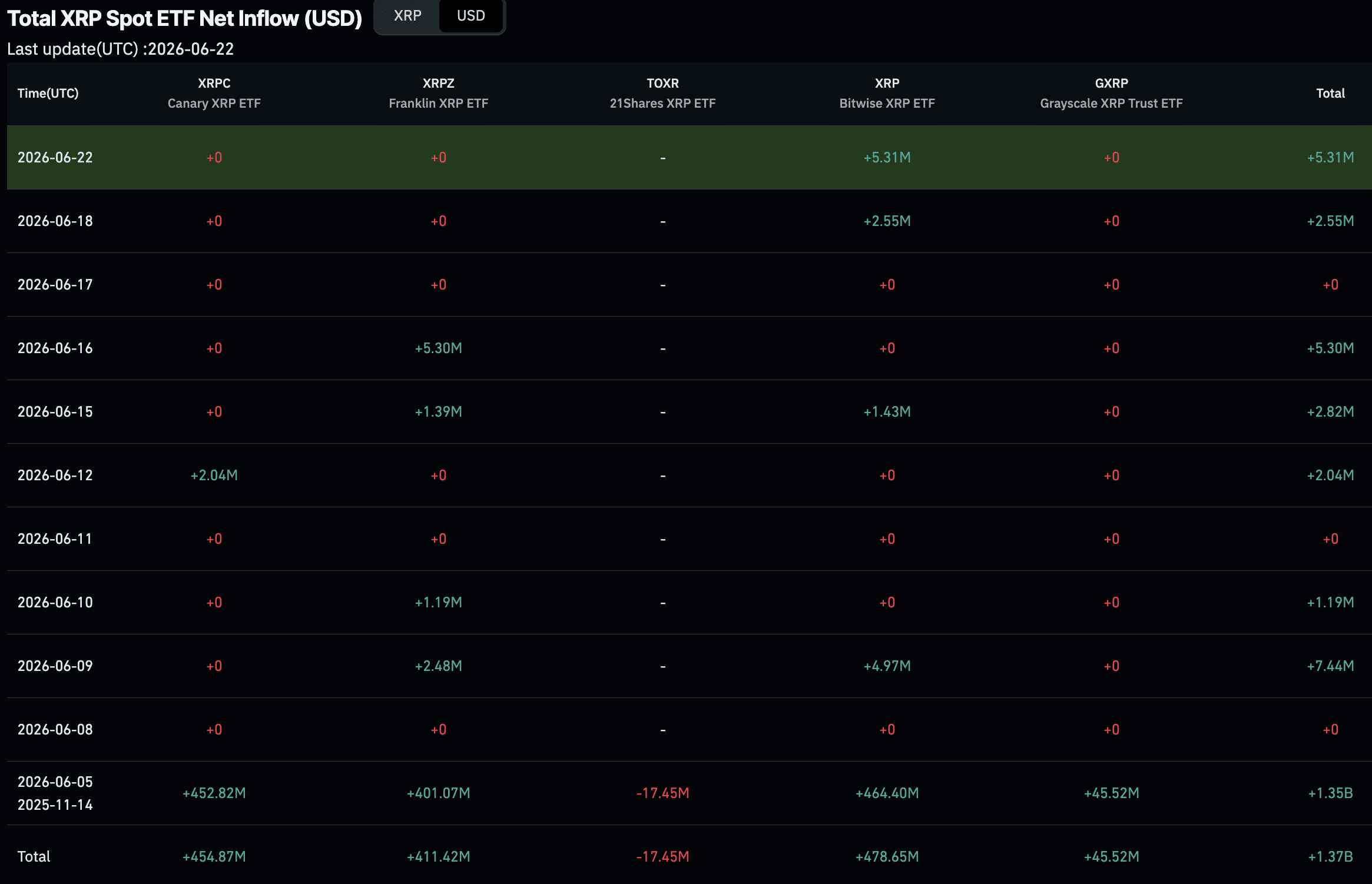
(SOURCE: CoinGlass)
XRP Ripple News: ETF Entry Sequence in Context
US Spot XRP ETFs launched in November 2025, providing investors with a regulated way to access XRP without holding it on a crypto exchange. This was reinforced on March 17, 2026, when the SEC and CFTC classified XRP as a digital commodity, similar to Bitcoin and Ethereum, easing previous legal issues for Ripple.
Since classification, ETF inflows have been steady, accumulating $1.45 billion in net demand over seven weeks, with average assets under management of $995 million. The latest weekly inflow was $11 million, which is significant considering most other crypto ETFs were experiencing outflows.
For the week ending June 12, XRP ETFs saw inflows of approximately $10.68 million, while Bitcoin, Ethereum, and Solana funds faced net outflows. This relative strength in a declining market is remarkable, even if the absolute numbers are modest.
Why price hasn’t followed the money
The uncomfortable truth of the inflow data reveals that $1.45 billion in cumulative ETF demand did not lead to a sustained increase in XRP prices, which peaked at $2.40 in January 2026 and has since fallen approximately 45%, settling in the $1.10 to $1.30 range.
Despite strong ETF inflows during this recession, institutions appear to be taking “shadow” positions rather than fully committing.
XRP exchange reserves have fallen to a seven-year low, indicating that much of the circulating supply has been shifted to ETF custody and long-term wallets, which is bullish in the long term but reduces active trading supply, thereby reducing volatility.
Additionally, the derivatives market is cautious, with open interest at $2.55 billion, 77% below July’s record, suggesting limited leverage bets on the price of XRP. Without significant support from derivatives, price breakouts are unlikely to maintain momentum.
GM CT!$XRP is approaching a long-term descending trendline that has already served as a key reaction zone on several occasions.
A successful defense could trigger a strong reversal, while a breakdown could open the door to lower levels.
pic.twitter.com/ipTxBBBrPc
– Crypto Corail (@Crypt0_Coral) June 23, 2026

DISCOVER: The best Meme Coin ICOs to invest in 2026
Macro headwinds do real work here
Anil Oncu, CEO of Bitpace, highlighted the key macro constraints: regulation, payments adoption and altcoin sentiment. He said signals of prolonged interest rate hikes from the Federal Reserve are affecting investor confidence and making it difficult to price risky assets.
This is particularly relevant for XRP Ripple, as much of the institutional demand for XRP ETFs comes from investors who treat the crypto as a high beta asset. When rate cuts seem unlikely, the opportunity cost of holding volatile assets increases and tight liquidity limits available speculative capital.
Geopolitical factors also introduce uncertainty. Although the U.S.-Iran peace framework provides temporary relief, ongoing tensions, particularly with Israel and Iran, keep the situation volatile.
This geopolitical risk does not directly affect the fundamentals of XRP, but influences traders’ overall risk appetite for altcoin investments.
EXCLUSIVE: Earn $10 USDC via Binance Signup
Bull, Base and Bear: Three Scenarios for XRP Ripple Price
Case of the bull: XRP Ripple reclaims the 50-day EMA above $1.25 during the daily close, triggering short covering among traders positioned for continued weakness. Momentum builds toward the 100-day $1.35 EMA, and a breakout of the descending trendline near $1.50 moves the technical structure from corrective to constructive. ETF inflows are accelerating, potentially driven by six additional XRP ETF filings from institutions still awaiting regulatory approval, and cumulative assets are well over $1 billion on a sustained basis.
Base case: XRP continues to trade in a range of $1.10-1.20, with ETF inflows providing a structural floor and macro headwinds limiting upside. The seven-week inflow streak continues, but weekly numbers remain moderate, in the $10 million to $30 million range. XRP is moving sideways as the market waits for a macroeconomic catalyst, a pivotal signal from the Fed, a legislative breakthrough on cryptocurrency custody rules, or a broader altcoin rotation triggered by the decline of Bitcoin’s dominance. No lasting breakout occurs in the short term.
Bear case: Macroeconomic conditions deteriorate, either the Fed signals further rate hikes or a geopolitical shock broadly hits risk appetite. OI futures continue to fade, retail participation remains absent, and XRP loses the $1.10 support level it currently holds. A retest of the technical floor of $1.10 to $1.11 becomes the immediate concern. If this level fails, the next structural support will be weaker, and the ETF inflow streak, which recently averaged just $11 million per week, will need to accelerate significantly to absorb the resulting selling pressure.
EXPLORE: Best Crypto Presales with Asymmetric Upside Potential in Today’s Market
Post XRP Ripple ETF Inflows Reached $1.35 Billion: Why Didn’t XRP Price Break Out? appeared first on 99Bitcoins.


