



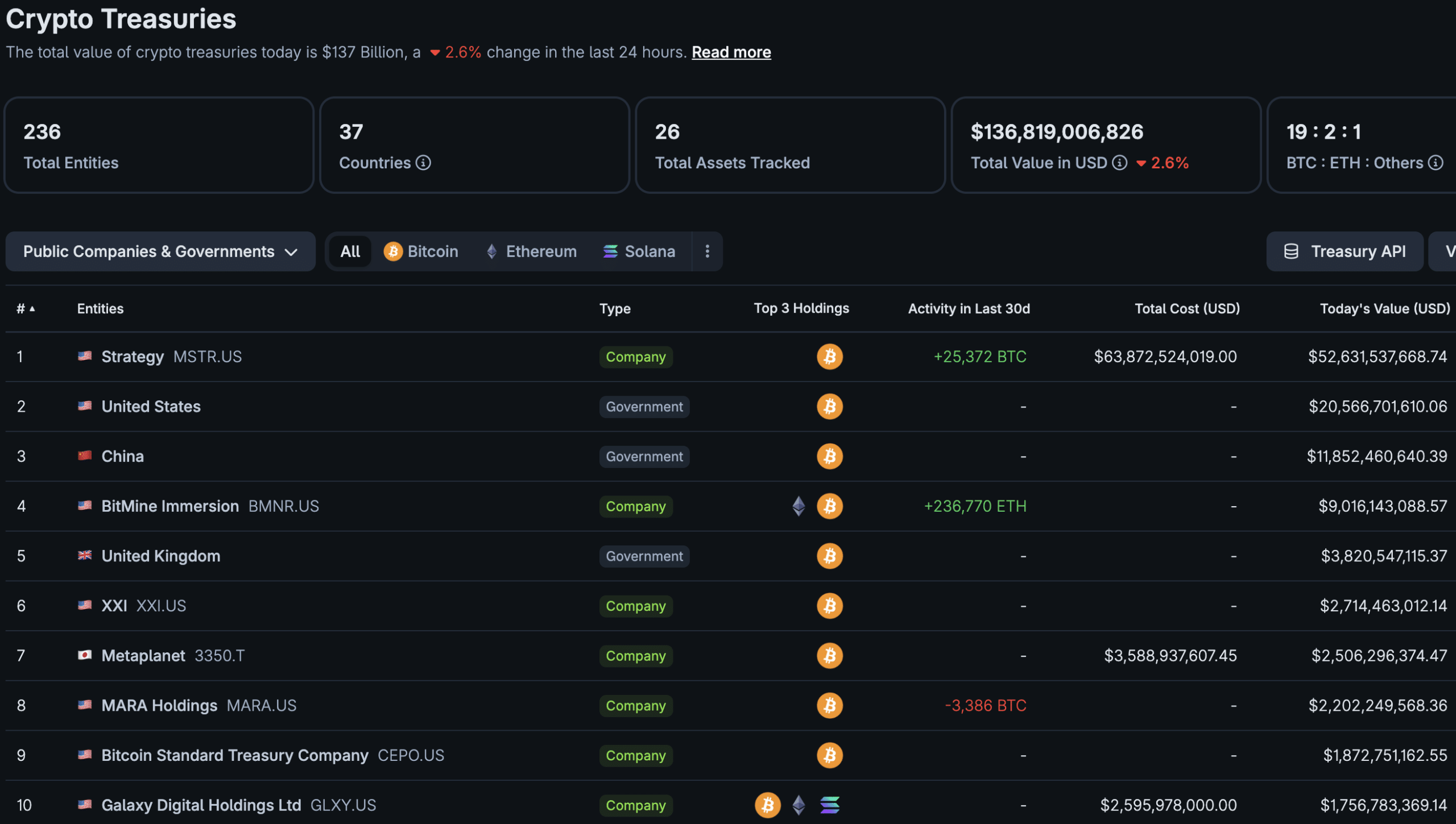
In Bitcoin news today, publicly traded companies built around holding BTC as a core reserve asset have lost $62 billion in combined market value since the beginning of October, with the total capitalization of these companies plummeting from $134 billion to around $72 billion, according to Artemis data.
Dozens of digital asset treasury companies are affected and losses on their stocks have in many cases exceeded losses on the Bitcoins they actually hold. This last detail is the one that matters the most.
Here’s the central tension this article uncovers: The premise of Treasury’s Bitcoin strategy was that corporate adoption would create a sustainable price floor and reward long-term holders, but the Crypto Crash 2026 reveals that leveraged corporate structures amplify Bitcoin’s disadvantages far more reliably than they ever amplified its advantages.
Bitcoin News Today: BTC Treasury Stocks and What the $62 Billion Number Really Tells You
The $62 billion figure is not a realized loss; no company necessarily sold a single satoshi. This is a collapse in paper value, meaning that the market’s estimate of the value of these companies has collapsed. But paper losses in leveraged structures have real-world consequences: They compress the equity cushion between a company’s assets and its debts.
Research on digital asset Treasury stocks has consistently shown that these vehicles behave like leveraged Bitcoin, with declines ranging from 1.5 to 2.5 times the underlying BTC movement during sell-offs.
This is not a bug in the strategy; it’s the inevitable calculation of buying a volatile asset with borrowed money and then listing the entire structure on a public exchange. The leverage that made these stocks exciting on the upside is the same leverage that destroys value on the downside.
(SOURCE: CoinGecko)
DISCOVER: The 12+ Most Popular Crypto Presales to Buy Now
The narrative that broke: why the strategy playbook is under pressure
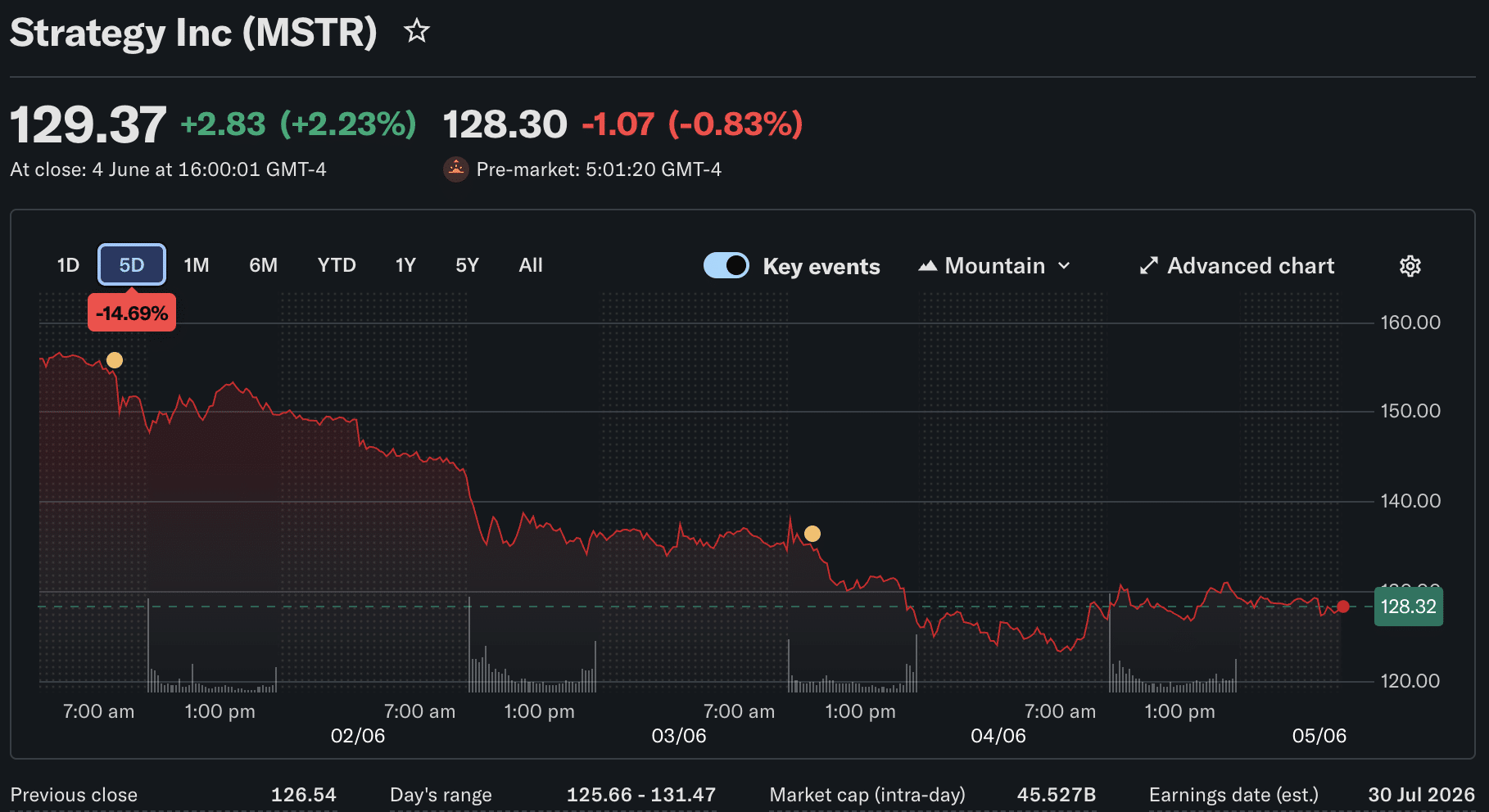
The corporate adoption meta began with MicroStrategy’s decision in August 2020 to make Bitcoin its primary reserve asset, aggressively acquiring BTC to act as a proxy ETF for investors seeking exposure to Bitcoin. This strategy has proven successful through 2021 and into 2024, prompting many companies, including Metaplanet in Japan, to follow suit.
Bloomberg pointed out that some corporate Bitcoin treasuries served more as marketing strategies than true diversification efforts, allowing companies to signal innovation and attract retail capital. When the narrative strategy suffered a $62 billion loss in market capitalization, it not only affected the balance sheets, but also undermined the narrative itself.
The “never sell” doctrine underlying MicroStrategy’s approach provided market stability by assuring investors that a large buyer would not sell. If this commitment fails under financial pressure, the market price support mechanism is threatened.
In summary, while the concept of Bitcoin as a corporate treasury is not dead, it is deeply questioned, and with the advent of regulated spot Bitcoin ETFs, the use of companies as a Bitcoin proxy now seems less relevant.
(SOURCE: Yahoo Finance)
EXCLUSIVE: Earn $10 USDC via Binance Signup
What Wiping $62 Billion Really Means to You
In other Bitcoin news today, retail investors in BTX proxy stocks, such as Strategy and Metaplanet, are experiencing worse results than those holding Bitcoin in cash, with losses estimated at $17 billion attributed to volatility drag, structural leverage and stock premiums. Investing in Bitcoin treasury companies means buying shares in companies that own Bitcoin, unlike institutional investors like BlackRock, who own it directly.
The key to watch is whether these companies will start selling Bitcoin to satisfy their debts, as large sales could challenge the “never sell” principle.
$BTC fell again to $61,000.
The sellers are in complete control and are trying to push Bitcoin below $60,000.
Once that happens, we will see total capitulation. pic.twitter.com/JWsFi9qOqJ
– Ted (@TedPillows) June 5, 2026
What happens next – Three scenarios:
Bull case: Bitcoin stabilizes, cash companies hold, debt obligations are honored, and the narrative straightens, making the $62 billion loss a minor detail of a larger success.
Base case: Prolonged losses cause stock prices to fall, enthusiasm wanes as premiums disappear, but no forced selling occurs. Spot ETFs attract new institutional capital, making the strategy viable, but less so.
Bear case: The restrictive covenants trigger Bitcoin liquidations at large companies, causing BTC prices to fall, prompting further sales, threatening the companies’ cash flow narrative, and leading to stricter regulations for companies holding digital assets.
The Bitcoin corporate treasury meta is not dead yet, but it is precarious, relying on the assumption that major holders will not be forced to sell. If this changes, the $62 billion in paper losses could become a reality.
EXPLORE: Best Meme Coin ICOs to invest in 2026
The post $62 billion is gone: Is Bitcoin corporate meta-treasury dead? appeared first on 99Bitcoins.


