




Aster price is creating a sharp bullish reversal as the Stage 4 buyback begins ahead of schedule and traders return with stronger volume.
Summary
- Aster is trading near $0.98 after a rebound from the $0.92 area.
- The team launched its Phase 4 buyout eight days early to support pricing amid market volatility.
- Technical indicators show improving momentum with an increase in the RSI, Stochastic and CCI.
Aster was trading at $0.984 at press time, down 1.8% on the day, with a weekly range between $0.9007 and $1.18. The token is down about 15% over the past week and about 59% below its September 24 all-time high of $2.41.
Trading volume increased sharply to $556 million, an increase of 62%. Data from CoinGlass shows that Aster (ASTER) derivatives volume increased 31% to $1.27 billion, while open interest increased 3.6%. This combination shows that more traders are adding exposure during a volatile period.
Start of the Aster Stage 4 takeover
In a December 2 article on X, Aster announced that it had activated its Stage 4 takeover eight days ahead of schedule. The team said the early rollout would “support holders in volatile market conditions” and the program immediately went live.
The structure reflects the previous steps. Protocol fees continue to drive redemptions, and depending on volume, the burn allocation can reach half of all tokens purchased. Aster has already repurchased 155.72 million ASTER in previous stages, including 55.72 million in stage 3 alone, of which 77.8 million are expected to be burned on December 5.
Community members described the early start as a show of commitment, with one incumbent saying the move “proves the team is delivering real value, not empty promises.”
During peak volume periods, the buyback engine has already drawn more than $2 million per day, helping to reduce circulating supply while supporting liquidity incentives and future airdrop plans.
Technical analysis of Aster price
Aster’s chart shows a clear change after a difficult end to November. A sharp decline pushed the token towards the $0.92-$0.94 zone, where buyers intervened with higher volume. The price then broke out of a short-term descending structure on December 1 and has since maintained a slight upward trajectory.
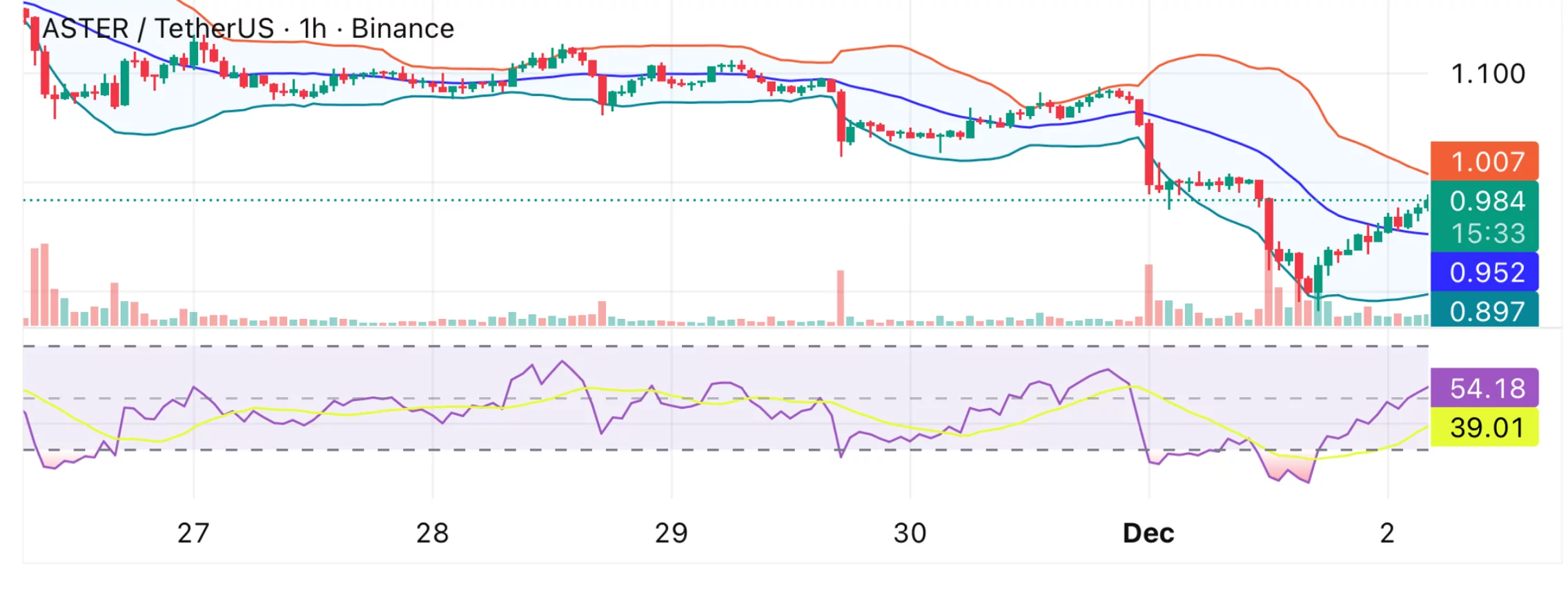
The first signs of recovery are shown by the momentum indicators. The Relative Strength Index has formed a clear bullish divergence. When price hits a low, the RSI sets a higher low, a pattern that often marks a change in uptrend.
The Stochastic RSI and Commodity Channel Index have also moved from oversold territory to higher, showing stronger short-term momentum. Although the gap between its lines is narrowing, the MACD is still negative and the ADX is near 20, indicating that the trend is still developing rather than fully formed.
The majority of short-term moving averages, such as the 10MA and 20MA, remain above the current price despite these gains. This leaves $1.00 as the key test for the bulls.
A strong daily close above this area would mark the first clear resumption of local resistance and open up room towards the $1.06-$1.14 area, where previous breakout levels lie. A crossing of this range would complete the rebound trend that began on December 1st.
Downward pressure could return if the price drops below $0.95, which could take it back to $0.92 and possibly to the $0.88 to $0.90 area if market sentiment weakens.


