




Ethereum returned to the $3,160 level following the highly anticipated FOMC meeting, where the Federal Reserve cut interest rates by 25 basis points. While rate cuts generally support risky assets, Jerome Powell’s comments added a new layer of uncertainty to the market.
Related reading
By openly acknowledging the risks of lower growth coupled with persistent inflation, Powell introduced the possibility of stagflation – a scenario that has historically challenged both stocks and cryptocurrencies. As a result, market sentiment remains fragile and investors are struggling to interpret what this macroeconomic shift could mean for Ethereum’s next move.
Despite the volatility surrounding the decision, one major whale continues to act with conviction. According to Lookonchain, the Bitcoin OG that shorted the market during the October 10 crash is once again doubling down on its bullish position on Ethereum.
Instead of taking profits or reducing exposure after the recent rally, it continued to accumulate aggressively, signaling strong confidence in ETH’s mid-term trajectory, even as overall sentiment turns cautious.
The position of the whales is accelerating, but the risks are increasing
According to Lookonchain, the whale’s position has now climbed to 120,094 ETH, valued at approximately $392.5 million. With a liquidation price of $2,234.69, this is one of the largest and most aggressive long positions currently tracked on-chain.
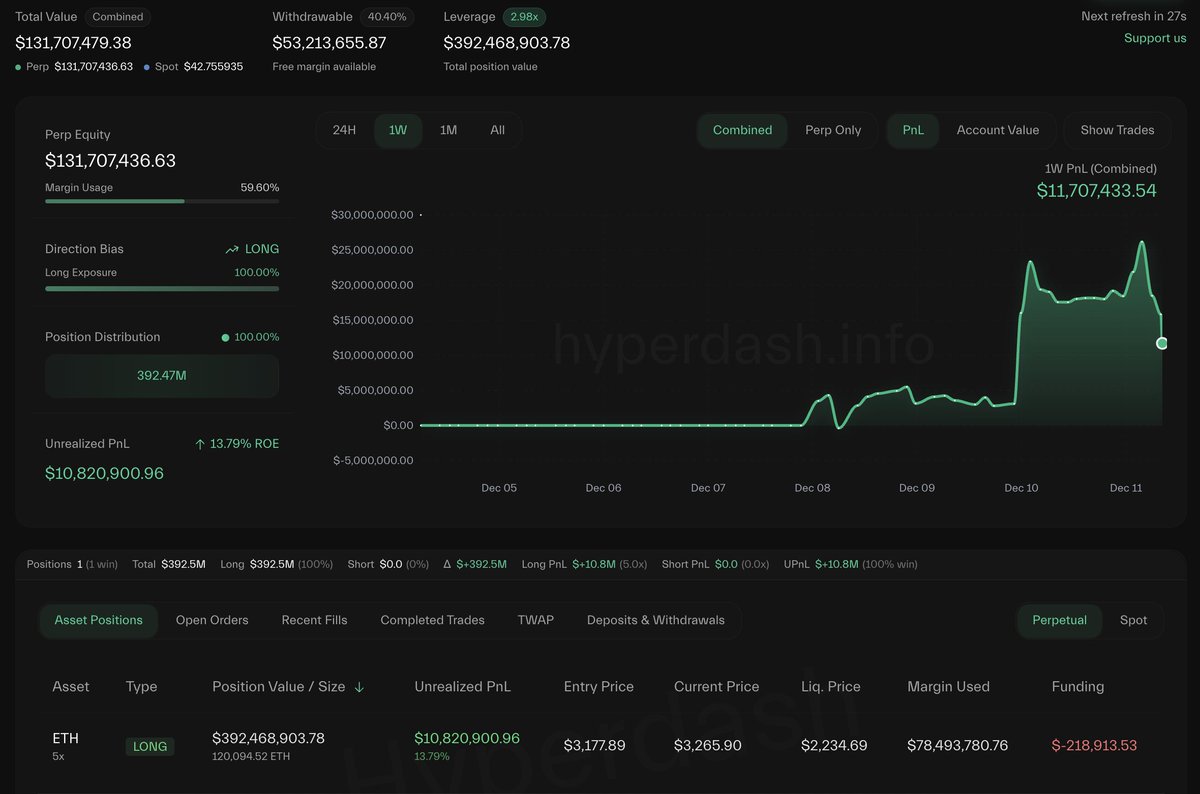
Such a massive allocation signals extreme conviction, especially from the same Bitcoin OG that managed to short the market during the October 10 crash. However, the scale of this bet also highlights how much risk is now concentrated in a single directional position.
The liquidation price is a major concern. At $2,234, it is almost $1,000 below current levels, but in highly leveraged environments, particularly during times of macroeconomic uncertainty, prices can retrace violently. Ethereum has already shown a tendency for sharp intraday movements, and with rising funding rates and market leverage reaching all-time highs, even a moderate correction could trigger cascading liquidations.
If ETH experiences a sudden spike in volatility due to changes in macroeconomic conditions, a negative reaction to the latest FOMC decision, or a broader market pullback, the whale’s position could come under significant pressure. Although large whales often influence market sentiment, this pattern illustrates how slim the margin for error has become.
Related reading
ETH tests resistance as momentum weakens
Ethereum returned to the $3,196 level after failing to hold above the $3,300 zone, signaling that the bullish momentum is starting to weaken. The daily chart shows ETH rejecting the red 200-day moving average, a key long-term trend indicator that has acted as resistance throughout the recent downtrend. Until ETH decisively breaches and closes above this level, the structure as a whole remains vulnerable.
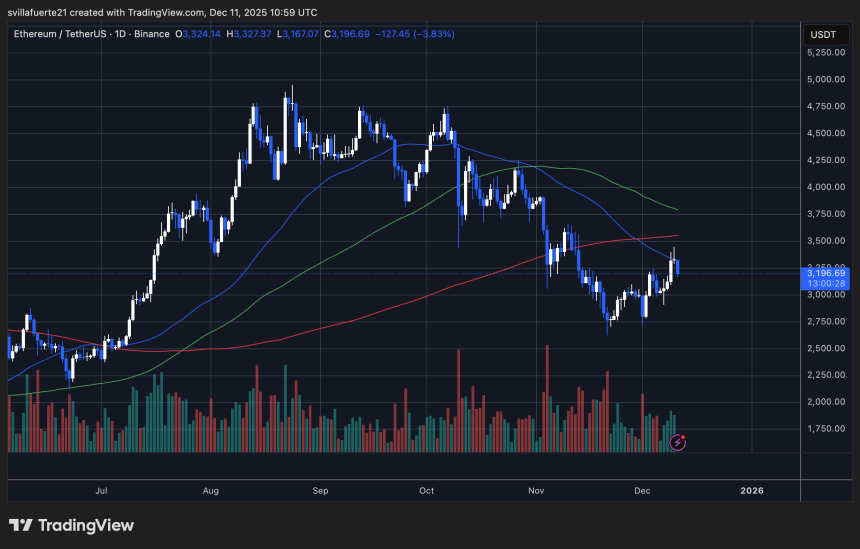
The 50-day moving average is still falling, reflecting continued selling pressure despite last week’s rebound. Meanwhile, the 100-day moving average sits well above the current price, reinforcing the heavy overhead resistance that ETH must overcome to re-establish an uptrend. Volume has also declined from the early December rebound, suggesting buyers are losing strength as prices approach major resistance levels.
Related reading: Bitcoin exchange reserves fall to lowest levels on record: the bullish signal most traders are missing
Structurally, ETH remains in a medium-term downtrend, forming lower highs and lower lows since September. Although the recent surge to the $2,800 region shows buyers are defending key support, the rejection at $3,350 shows sellers still have control at higher levels.
If ETH fails to regain the 200-day moving average soon, a retest of the $3,050 to $3,100 support range becomes likely. Conversely, a strong recovery above $3,350 could open the door for a move towards $3,500, but the market will need further momentum to get there.
Featured image from ChatGPT, chart from TradingView.com


