





Vitalik Buterin urges the Ethereum ecosystem to be more bold in what it builds at the top of the chain, while drawing a hard line around fundamental base layer guarantees, arguing that a reset of first principles on applications, wallets, and even culture may be necessary for Ethereum’s next phase.
In an article on This openness, he argued, should not descend into ambiguity about what Ethereum’s L1 is supposed to protect.
“We must not compromise on fundamental properties: censorship resistance, open source, privacy, security (CROPS),” Buterin wrote. “We should not have an ‘open-mindedness’ that leaves people without confidence about what security properties L1 will still have in a year’s time.” He added that Ethereum should not fall back into questioning fundamentals, as if “light clients” should “confidently verify the correctness of the chain.”
Where we need to rethink, he says, is the interface between Ethereum and users: the application stack, its assumptions, and the social conventions that shape what builders consider “serious” work.
Ethereum AI wallets, but with guardrails
Buterin linked part of the shift to AI, throwing out a scenario in which “wallets as browser extensions and mobile extensions will be dead within a year?” Of Farcaster, he made this point more directly: “It’s pretty obvious that the next iteration of wallets will heavily involve AI.”
However, he stressed that higher value-added use cannot simply entrust trust to a model. “I wouldn’t trust an LLM with several million transactions or funds,” he wrote, describing what he considers the “optimal workflow” for large transfers: “The AI comes up with a plan, the local client simulates it, you see the action and the simulated result and you confirm it manually.
The upshot, he suggested, is that moving away from the current interaction model, heavily based on Dapps, could reduce risks. If done “conservatively with a focus on security,” Buterin argued, removing dapp user interfaces “completely from the picture” could eliminate “a lot of attack vectors (both for theft and privacy).”
“Tear off the suit and tie”
Buterin highlighted privacy as a recent example of Ethereum’s shifting priorities at the application layer. He described last year’s “shift toward thinking about privacy as a first-class consideration,” which he said involves “a radically different Ethereum application stack” because “until now, the entire stack hasn’t been built around privacy.” This year, he said, that has extended to “increasing work on the network side of privacy, both inside and outside the EF.”
He also sketched out more provocative thought experiments at the application level, including whether “the rest of the challenge is basically just universal futures markets on top of a good decentralized oracle and allowing users to self-organize on top of that,” and even if “the ideal decentralized oracle is just a SNARK on small M-of-N LLMs on the zk-TLS of some big news site?” AI, he says, moves “apps” away from discrete products with discrete user interfaces and toward a continuous space, making “creating fewer apps and relying on users to self-organize around them” a model that could expand.
Regarding scaling, he said Ethereum is also “rethinking from the ground up the role of L2s and what types of L2s are actually most synergistic and additive to Ethereum,” describing it as another area where past assumptions may no longer hold.
Buterin presented culture as a non-technical constraint that can discreetly restrict what is built. Referring to “that whole Madam thing”, he argued that the subtext is “ripping off the suit and tie”, describing a deliberately irreverent break from “respectable” posturing: “Take the preconceived idea that you are ‘respectable’, write it down on a piece of paper, crumble it up and burn it. The psychological baptism of this leads to the intellectual baptism of unlocking greater creativity and widening windows.
He closed his article “If YOU had to write the section of the 2014 Ethereum white paper that talked about applications… what would you write? he asked, urging people to “reset all concerns about path dependence” and see what new designs emerge.
At press time, ETH was trading at $2,050.
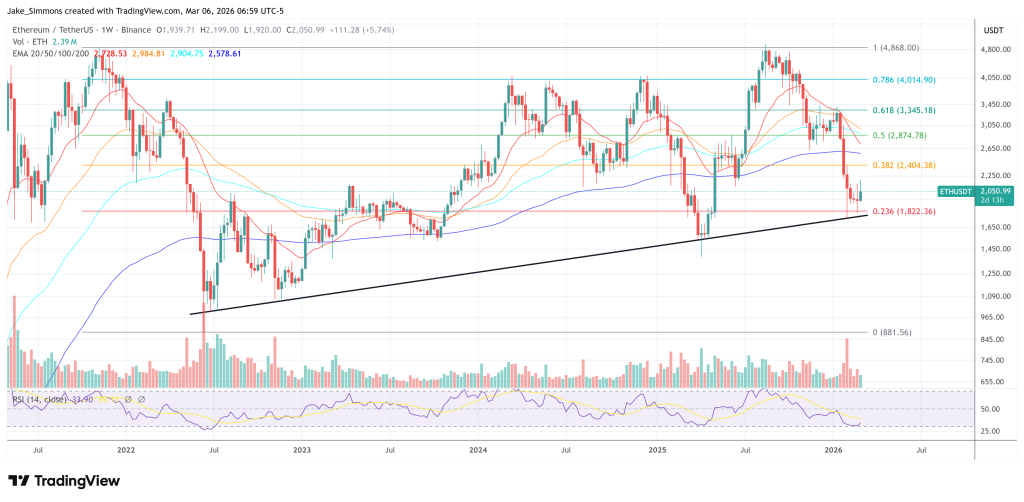
Featured image created with DALL.E, chart from TradingView.com
Editorial process as Bitcoinist focuses on providing thoroughly researched, accurate and unbiased content. We follow strict sourcing standards and every page undergoes careful review by our team of top technology experts and seasoned editors. This process ensures the integrity, relevance and value of our content to our readers.


