



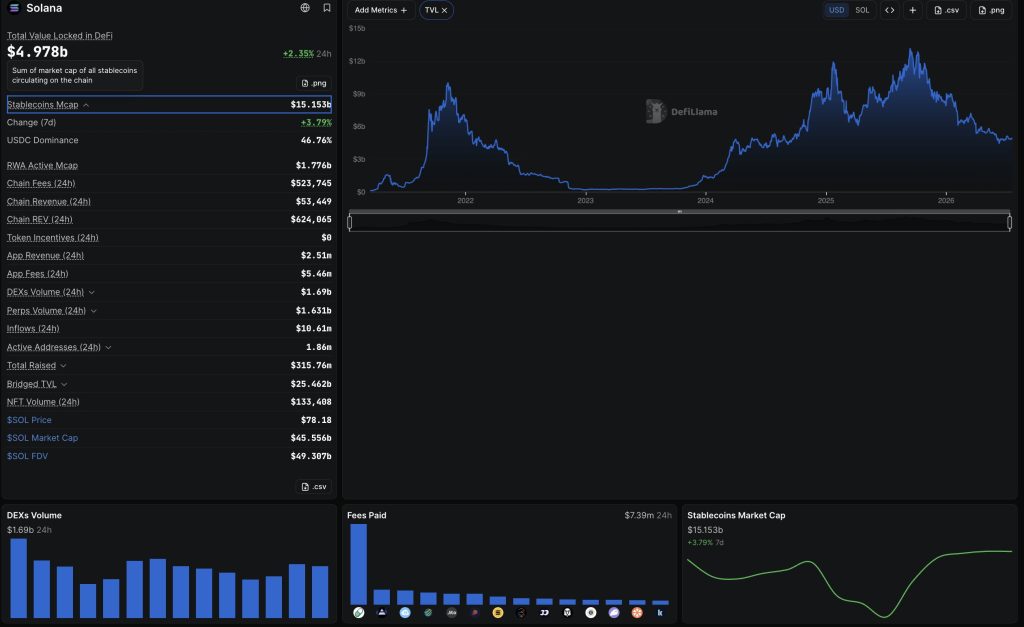
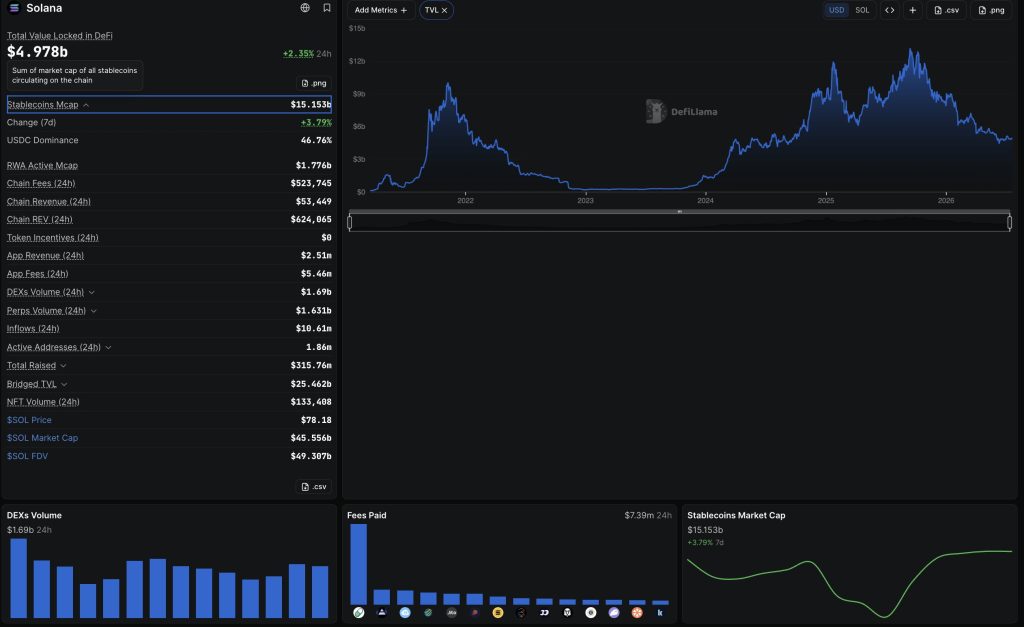
In Solana news today, the stable network’s total market capitalization surpassed $15 billion for the first time, according to data from Token Terminal. The question these figures beg is whether this supply base has structural depth or remains tied to cyclical retail flows.
USDC represents a significant portion of Solana’s stablecoin supply, with DeFiLlama reporting USDC at $7.09.Bn and total Solana stablecoins at $15.16 billion. Circle’s $250 million USDC mint on Solana was reported as part of a supply growth pattern contributing to the $15 billion milestone.
This Stablecoin surge on the Solana network comes as SOL USD climbed +3% in the last 24 hours, reaching over $78, with a daily trading volume of $1.94 billion.
Solana News: Beyond USDC/USDT and the New Stablecoins on the Block
The most structurally significant development is outside of the USDC/USDT duopoly. The non-USDC/USDT stablecoin segment on Solana reached an all-time high of $4.81 billion, driven by USD1 and USDG, according to SolanaFloor data. This segment now represents almost a third of Solana’s total stablecoin market capitalization.
USD1, a dollar-pegged stablecoin associated with World Liberty Financial, and USDG (Global Dollar) are the main drivers of this growth.
USDT sits at $2.91 billion on Solana by DeFiLlama, leaving the remaining $4.81 billion spread among these new entrants. The diversification of the issuer base is important: it signals that dollar liquidity on Solana is no longer a bipartisan dependency.
Anchorage Digital’s USDGO has reached a market cap of $1 billion on Solana, an approximately 20-fold increase since January 2026. USDGO is a regulated, USD-pegged stablecoin launched on Solana in February 2026.
Two demand engines, one supply stack
JUST IN: Total stablecoin market cap on @solana exceeds $15 billion, marking an all-time high.
Main currencies: USD, EUR, etc.
Top Assets: USDC, USDT, USD1, USDGO, etc.
Main issuers: Circle, Tether, Paxos, etc.Around 5% of all stablecoins are currently issued on Solana. pic.twitter.com/pGrojYxwfP
— Token terminal
(@tokenterminal) July 20, 2026
 (@tokenterminal) July 20, 2026
Solana’s stablecoin boom is driven by two overlapping forces that reinforce each other but are not dependent on each other. The first is the surge in retail activity: DEX trading volume on Solana increased 13.1% week-over-week, daily transactions climbed 17.3%, and TVL increased 12.5%, according to DeFiLlama metrics.
Memecoin cycle activity is generating real dollar demand on-chain, with Jupiter and Raydium being notable liquidity locations. Over $900 million in new stablecoins were issued in a single 24-hour window by Token Terminal.
The second factor is adoption at the colony level. BlockEden reports that Solana processed $650 billion in adjusted stablecoin volume as of February 2026, surpassing Ethereum and Tron combined. This figure predates the current $15 billion supply milestone by several months, implying that settlement throughput has likely increased further since then.
DeFi protocols on Solana directly benefit from greater stable liquidity, tighter spreads, higher utilization rates, and more capital efficient collateral pools, all of which stem from a larger on-chain dollar base. Solana’s growing dominance in tokenized assets, which reached a record $6 billion in the second quarter, compounds this dynamic: settlement of real-world assets and stable coin liquidity are co-located on the same chain.
The regulatory context is not peripheral here. Stablecoin legislation passed by Congress, including the Crypto Clarity Act framework being discussed for a vote in the Senate, could create clearer rules of conduct for stablecoin issuers. A clear federal standard accelerates institutional issuance and removes regulatory ambiguity that has prevented some treasury services from deploying at scale on public channels.
Discover: the best token presales
What the $15 billion figure confirms and does not confirm
In other Solana news, the $15 billion offering level confirms that Solana has accumulated a large enough dollar base to support serious DeFi and settlement activity, independent of any single issuer.
This does not confirm that this base is cycle resistant. A significant portion of current stablecoin demand on Solana is speculative liquidity adjacent to memecoins that migrate when retail attention turns.
The 15x growth of the non-USDC/USDT segment since January 2025 is impressive, but this partly reflects specific product launches (USDGO debut in February, USD1 expansion) rather than purely organic buildup of demand.
The credible bear case is a cooling of the memecoin cycle combined with stable coin legislation, which would simultaneously slow down both retail minting of USDC and institutional deployment of USDGO.
The bullish argument is that institutional settlement demand, evidenced by USDGO’s trajectory and Solana’s stable volume market share, provides a structural floor that persists despite retail withdrawals.
Circle’s aggressive strike rate and Anchorage Digital’s institutional positioning suggest that at least one major issuer is betting on the latter.
Discover: The best crypto to diversify your portfolio
The article Solana News: Stablecoin supply hits $15 billion with new issuers reshaping the mix appeared first on Cryptonews.


