



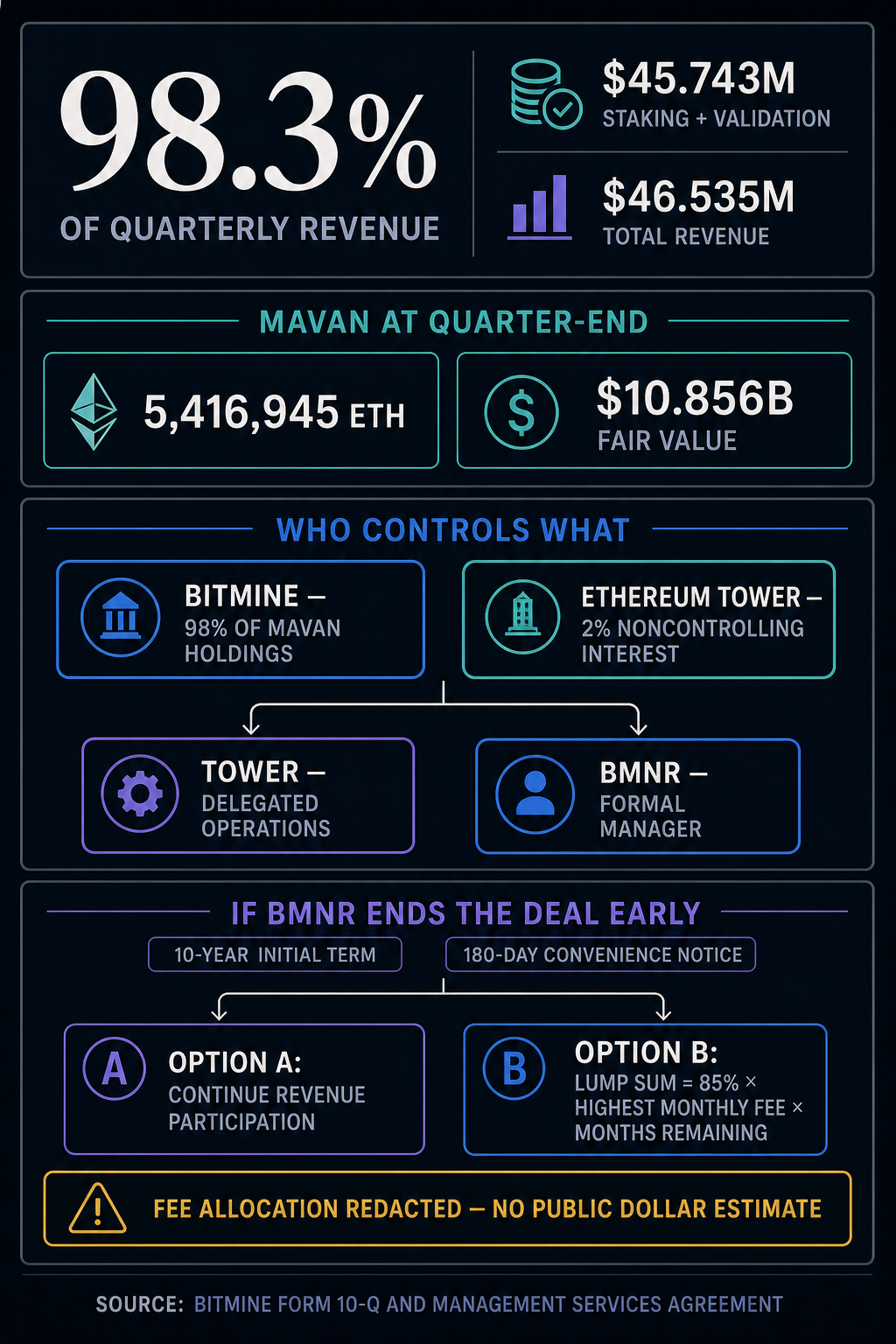
BitMine generated $45.743 million from staking and validation during the quarter ended May 31, 2026, or 98.3% of its $46.535 million in total revenue, according to a Form 10-Q filed July 14.
MAVAN, the company’s Ethereum validation network, therefore generated almost all of the reported revenue for the quarter. BitMine held 5,416,945 ETH valued at $10.856 billion at the end of the quarter. A June 1 update reported 4,718,677 ETH staked out of 5,416,901 ETH held, or about 87%, while the company’s goal of acquiring 5% of Ethereum’s supply remains prospective.

Operational dependencies of the platform include Ethereum Tower. BitMine owns 98% of MAVAN Holdings, while Tower owns the remaining 2% as a non-controlling interest. Under a management services agreement effective March 24, Tower is performing delegated strategic planning and day-to-day work on native staking, validation infrastructure and technology systems. BMNR, a subsidiary of BitMine, remains the formal manager and retains reserved powers.
Tower’s 2% interest is irrevocable and survives termination or expiration unless sold or assigned. Tower also receives a monthly revenue share from BitMine’s native staking operations, although its precise allocation is hidden in a redacted schedule. It has no right to income from third-party staking operations.
The cost of changing operator
The agreement has an initial term of 10 years and BMNR may terminate it for convenience upon 180 days’ written notice. If BMNR terminates the Agreement ahead of schedule for any reason other than certain reasons relating to Tower, including breach, insolvency or misconduct, Tower may choose one of two economic solutions.
It may continue to receive revenue sharing for the remaining term, even after ceasing to provide management services. Alternatively, he can choose a lump sum equal to 85% of his highest monthly payment over the previous 12 months, or the shortest elapsed period, multiplied by the remaining months. The redacted allocation prevents a dollar exit cost from being calculated from public records.
BitMine’s 10-Q claims that its results largely depend on MAVAN and the favorable economics of Ethereum staking. Lower yields, validator downtime, discounts or adverse protocol changes could reduce revenue and cash flow. With staking and validation providing 98.3% of quarterly revenue, these risks would affect BitMine’s reported primary revenue line. The filing does not report that MAVAN or Ethereum Tower underperformed.

Replacing a covered carrier would create a separate transition test. Tower must cease providing services and cooperate while BitMine or its representative assumes validator and technology responsibilities. Still, Tower’s 2% stake would persist, and continued revenue sharing or formula-based payment could remain alternatives. BitMine’s ETH strategy is therefore tied not only to staking returns, but also to a management relationship with a third party containing bonds that can last longer than an early split.


