




Key takeaways
- Zcash fell nearly 50% from its June 4 high of $624 before rebounding around 18% in the past 24 hours.
- A flaw in the Orchard pool cost ZEC its lead in privacy, dropping it from 11th to 16th by market capitalization.
- NEAR sits at $1.91 and WLD at $0.41 as traders closely monitor support levels for each.
Zcash Whipsaws Over Orchard Pool Flaw
The most marked swing belongs to zcash given that ZEC has been one of the most notable performers of 2026, exceeding $600 to an intraday high near $624 on June 4. The rally reversed itself within a few hours as a lack of solidity in the protected pool of the Zcash orchard, the token fell.
Security researcher Taylor Hornby had revealed the bug, which could, in theory, have allowed an undetectable counterfeit of ZEC, and the developers decided to fix it via an emergency upgrade. No funds were stolen and no exploits took place in the wild, but the disclosure was enough to spark a rush for the exit.
ZEC fell approximately 50% in a single day, falling as low as $264.80 before stabilizing. Its market capitalization grew from around $9 billion to almost $5.37 billion, while around $82 million in leveraged positions were liquidated. However, ZEC then rebounded about 18% over the next 24 hours, with 24-hour volume exceeding $2.9 billion, suggesting that buyers viewed the patched flaw as a contained event rather than a fatal event.
NEAR and WLD return their winnings
The other two tokens returned more slowly. Near Protocol’s NEAR had climbed sharply in the spring, increasing more than 200% since its February low, as silver moved into AI-themed tokens, and it changed hands near $2.41 at its recent high. It has since returned to $1.91, reversing much of that late rise.
Worldcoin’s WLD followed a similar arc on a compressed timeline as the token (issued by the iris-scanning identity project co-founded by OpenAI’s Sam Altman) jumped about 60% recently, reaching around $0.55, before returning towards $0.40. The decline left WLD about 35% below its recent high near $0.62.
Some of the attention for the above tokens came from BitMEX co-founder Arthur Hayes, whose Maelstrom fund had publicly backed all three before withdrawing. Hayes set a $10 price target on WLD and presented it as a liquid proxy for an AI and SpaceX listing trade, then revealed he sold the position a few days later, posting that the chart was “going in the wrong direction.”
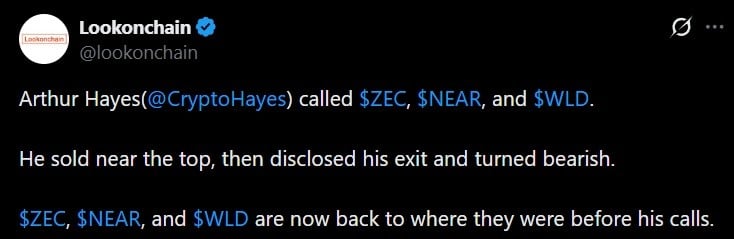
Bitcoin.com News reported that it also dropped its complete position of the ZEC after the Orchard Rift surfaces, declaring “The Holy Trinity is Dead”. For the tokens themselves, the lesson became one of how quickly narrative rallies can reverse themselves.
What Traders Are Watching Now
The most pressing question now is whether each token retains its reset level. For ZEC, the test will be whether its post-patch rebound turns into a sustainable recovery or fades as traders weigh the reputational impact of a four-year-old bug in a flagship privacy pool. On the other hand, for NEAR and WLD, the focus will be on returning the broader supply of AI tokens that lifted them in the first place.
Regardless, this episode clearly shows that all three bounces were closely related to sentiment rather than fundamentals that changed overnight. Once the hype has died down, each token now faces the difficult task of building a base without a viral narrative to carry it.


