




Veteran trader Peter Brandt sparked a new round of debate around Bitcoin after posting a chart and writing: “The banana splits. This is a horn. Richard W. Schabacker wrote about this in his 1934 book.” For market participants accustomed to Brandt’s shorthand, the message indicated a possible shift in how he interprets BTC’s recent rally structure.
The chart shared by Brandt shows that Bitcoin, on the daily time frame, rebounded from a strong February washout to $60,000 and was climbing back towards $70,000. Published candle data showed BTC closing at $72,813.62 on the day, with an intraday high of $73,210.95. Around this bounce, Brandt drew two increasingly wider curved boundaries, creating the outline of what he called a “horn.”
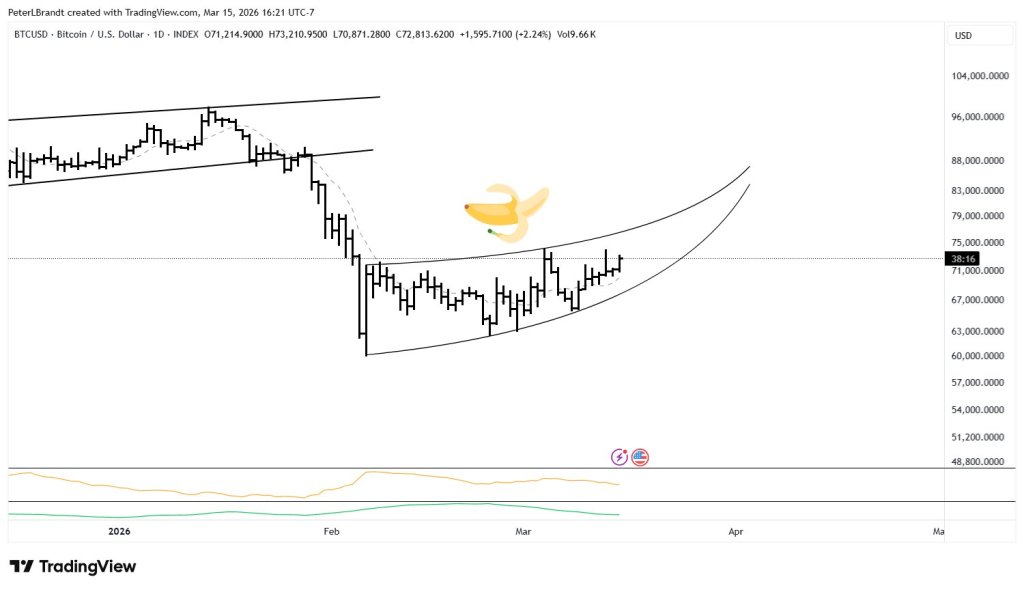
“Banana/Horn” could send $80,000 worth of Bitcoin
What makes this article confusing is that “banana” is not a standard textbook label in the same way that a flag, a wedge, or a triangle are. In context, Brandt appears to be using it descriptively: the recovery arc appears rounded and elongated, and his comment that “the banana splits” suggests that the smooth curve is beginning to open outward into a wider, more unstable formation. This is where the “horn” reference comes in.
Related reading
In classic charting parlance, a horn pattern is best understood as an expanding structure, in which the price trajectory is not tightening but extending. Brandt’s reference to Richard W. Schabacker is important because Schabacker’s prewar technical analysis work lies close to the foundations of modern classical cartography. Invoking a 1934 text, Brandt presented the configuration as old-fashioned graphic geometry rather than a crypto-native meme or one-off joke.
The problem is that Brandt himself did not present the model as established. When one user replied, “Dude, pick one. Horn or flag,” Brandt responded, “Can be either. Sorry you can’t handle the flexibility.” This response is important. This suggests that he is not yet making a categorical choice between a more conventional continuation flag and an expanded cornet-type formation. Instead, he seems to emphasize that structure is in transition and that real-time pattern recognition is rarely as clear as retrospective textbook examples.
Related reading
Read this way, the tweet is less of an accurate forecast than a warning about the character of the market. A flag would generally imply a more orderly break in the trend. A horn, on the other hand, involves wider oscillations and less controlled advance. On the Brandt chart, Bitcoin crosses the upper half of the formation, but the plotted boundaries extend outward as the price moves to the right, visually supporting the idea that volatility could be increasing rather than compressing.
As for the price target, Brandt has not annotated a measured move, so any projections should be treated as approximate. The most reasonable reading of the image is not a fixed break target but a path target along the horn itself. The upper curved boundary rises from around $70,000 in mid-March to around $83,000 to $88,000 in early April, while the lower boundary also tends to rise sharply. If Bitcoin continues to follow the upper part of the pattern, the chart appears to be pointing towards the low to mid $80,000 levels as the next visible area.
At press time, BTC was trading at $73,186.
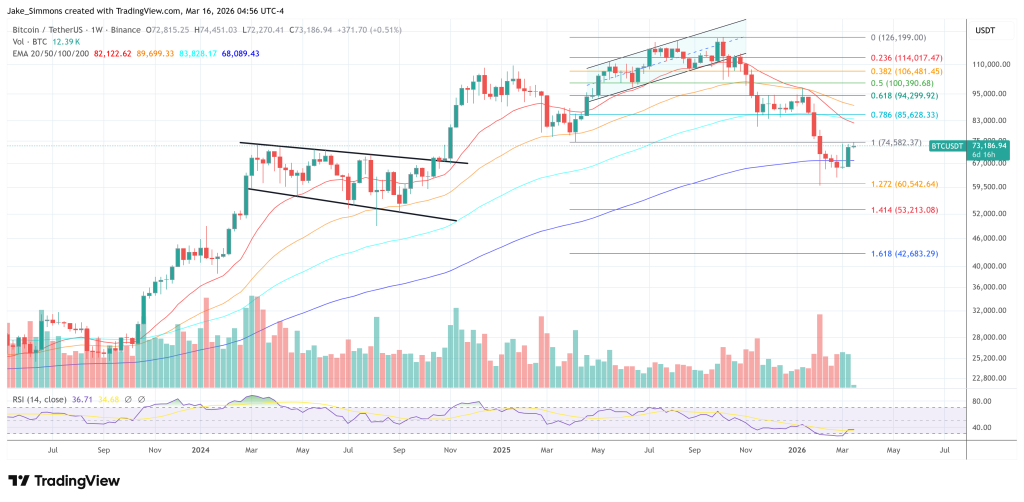
Featured image created with DALL.E, chart from TradingView.com


