




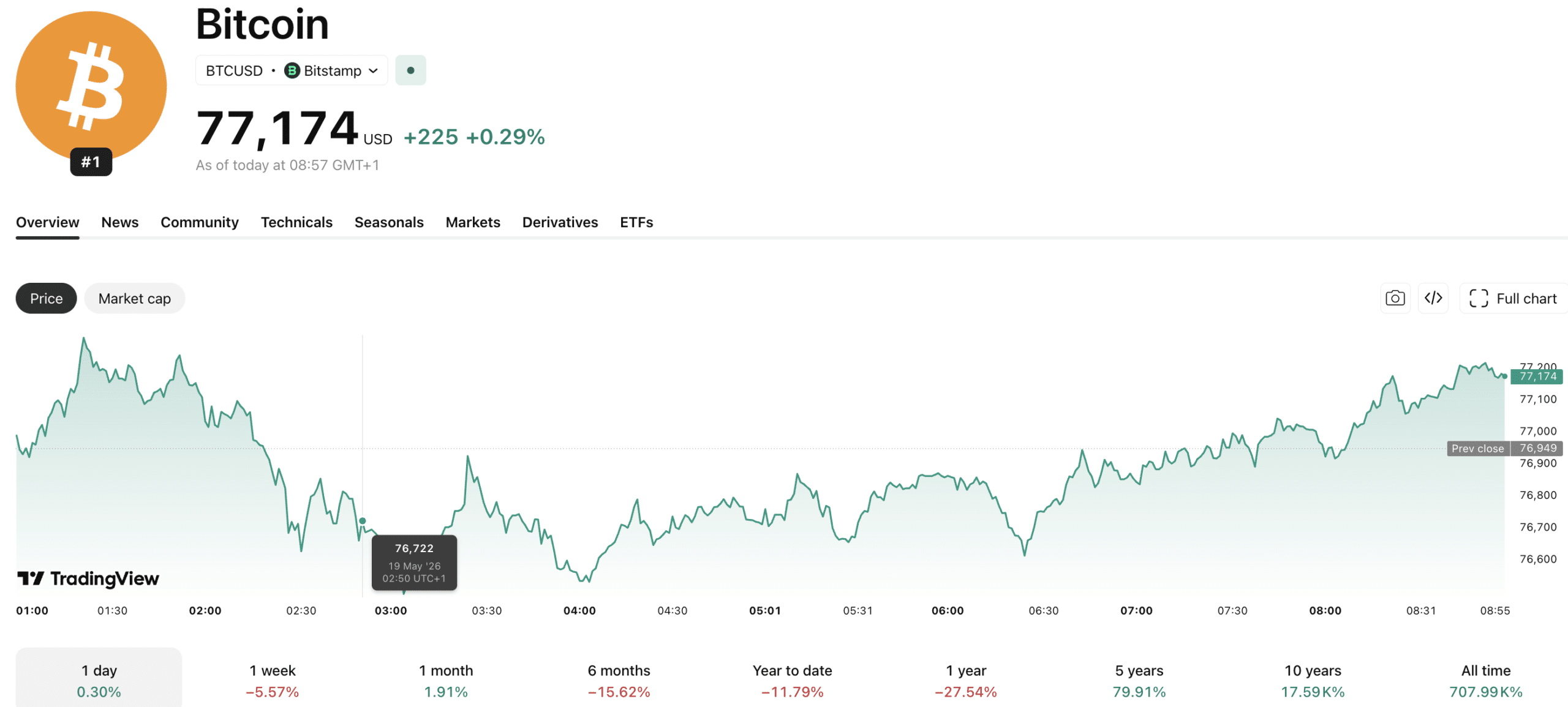
Bitcoin was trading near $77,100 at press time, down about -7% from $82,000 in a matter of days, a $5,000 drop that, at first glance, looks like a routine pullback after a prolonged rally that began near $60,000.
The analytical question is no longer whether this Bitcoin sell-off can be considered noise; it is a question of whether the structural conditions underlying the price action have already committed the market to a deeper decline.
Three converging signals: accelerating institutional ETF outflows, aggressive selling in spot and futures markets, and growing demand for protection options, are all pointing in the same direction.
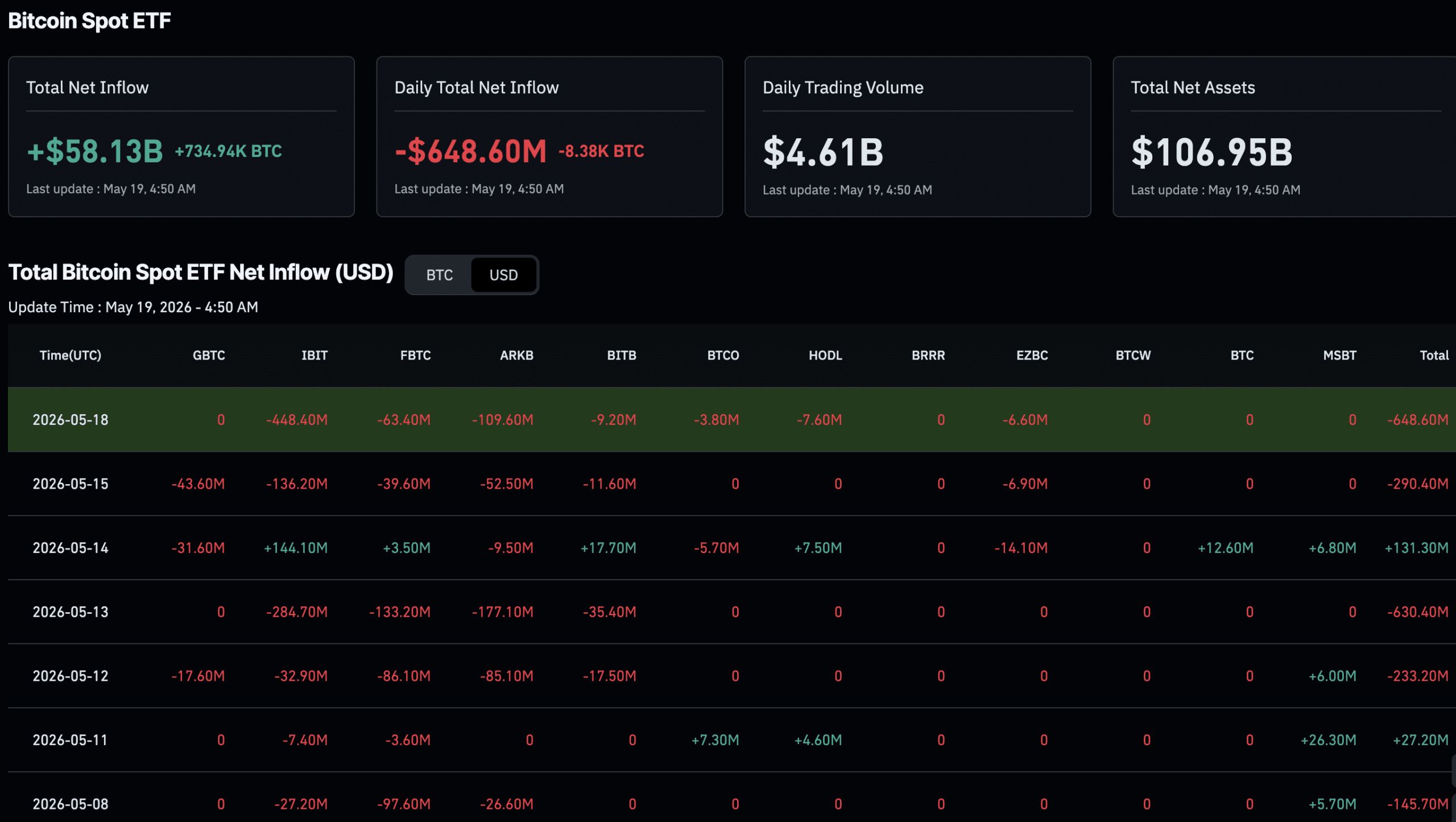
The most immediate data point reinforcing this concern comes from institutional ETF flows. U.S.-listed spot Bitcoin ETFs have lost more than $1.5 billion since May 7, according to SoSoValue data, with Monday’s single-day withdrawal reaching $648 million, the largest since Jan. 29 and the second time in a week that daily redemptions exceeded $600 million.
A higher low is set
I think we will get back above 80,000 well before the monthly close.
Wrong on a D3 close to 75k, I will then change my bias.
They won’t shake me pic.twitter.com/Vc2CCyt8Wo
– Trader Koala (@trader_koala) May 18, 2026
Can Bitcoin Price Hold $76,000 After $5,000 Flush?
The key support zone for Bitcoin is near $76,000, with a wider ask range between $74,000 and $75,000, reflecting the historical acquisition cost for short-term holders who can sell when prices are near their buying levels.
The 50-day simple moving average is essential; a daily close below this level has often indicated a move from a correction to a sustained downtrend. Current indicators show deteriorating momentum, with the RSI below 45 and the MACD moving into negative territory.
Vikram Subburaj, CEO of Giottus Exchange, warns that a break below this support could lead to a deeper correction, with a net loss of $76,000 exposing the $74,000-$75,000 region as the next test.
Leveraging Flush and ETF Exits: What On-Chain Data Really Shows
Analysis of on-chain and derivatives data highlights important technical warnings in the crypto market. The cumulative volume delta (CVD), tracked by Glassnode, has fallen, with the overall spot CVD falling from $16.9 million to negative $126.2 million during the recent sell-off, indicating aggressive selling. The CVD of perpetual futures fell even further, reaching a negative $368.5 million, suggesting that futures traders are not waiting for dip buyers before selling short.
Cryptocurrency liquidations have added to the selling pressure, triggering a cascade of stop-outs that force long positions to close. Liquidation data shows a concentrated long overhang before the decline, and open interest has not fallen enough to signal that the selling pressure is over.
(SOURCE: CoinGlass)
Additionally, options positioning reflects increasing caution. Glassnode’s options delta skew increased to 14.4%, signaling higher demand for put option protection relative to calls, suggesting a greater perception of downside risk among traders. This suggests structural anxiety rather than opportunistic buying.
Finally, data on institutional ETF flows supports this outlook, showing a net outflow of $396 million from Bitcoin spot ETFs since May 1, reversing prior inflows. Such rapid capital outflows are unusual during routine corrections, highlighting market fragility linked to liquidity deficits rather than capitulation, suggesting modest sales could trigger significant downward moves if demand for ETFs and futures declines.
Three scenarios: how far can this Bitcoin correction go?
(SOURCE: TradingView)
Case of the bull: If Bitcoin defends the $76,000 support zone at the close and ETF outflow momentum stops, the market could stabilize and attempt a recovery towards $80,000. This scenario requires a measurable return to net positive institutional ETF flows and a reset of perpetual futures funding to a neutral position – which is currently not the case. A recovery of $80,000 should be accompanied by a sustainable spot CVD becoming positive, not just a short sale covering bounce.
Reference case: Bitcoin is consolidating in the $74,500-$77,500 range in the near term as the market digests excess debt without complete capitulation. Funding rates gradually drift towards neutral and open interest contracts, and the price finds a temporary equilibrium below the previous rejection of $82,000. Rebounds in this scenario are sold by institutional participants who have already begun to reduce their exposure via ETF redemptions, capping any recovery below $80,000.
Bear case: A confirmed daily close below $76,000 triggers a deeper correction than current derivatives and on-chain data are incorporating. The $74,000 to $75,000 demand region becomes the next contested level; failure opens the way to $70,000, where a larger pocket of liquidity and longer-term moving average support converge.
Traders now watch for confirmation signals: funding rates consistently turning negative, a stronger compression of futures bases into backwardation, or a spike in realized volatility indicating that forced selling has reached a point of exhaustion. As long as these conditions are not met, the current structure does not yet promote a sustainable recovery position.
following
Disclaimer: Coinspeaker is committed to providing unbiased and transparent reporting. This article is intended to provide accurate and current information, but should not be considered financial or investment advice. Because market conditions can change quickly, we encourage you to verify the information for yourself and consult a professional before making any decisions based on this content.

Daniel Frances is a technical writer and Web3 educator specializing in macroeconomics and DeFi mechanics. Hailing from crypto since 2017, Daniel leverages his experience in on-chain analytics to write evidence-based reports and in-depth guides. He holds certifications from the Blockchain Council and is dedicated to providing “insight gain” that overcomes market hype to find real utility for blockchain.


