



Bitcoin collapses amid US-Iran clashes
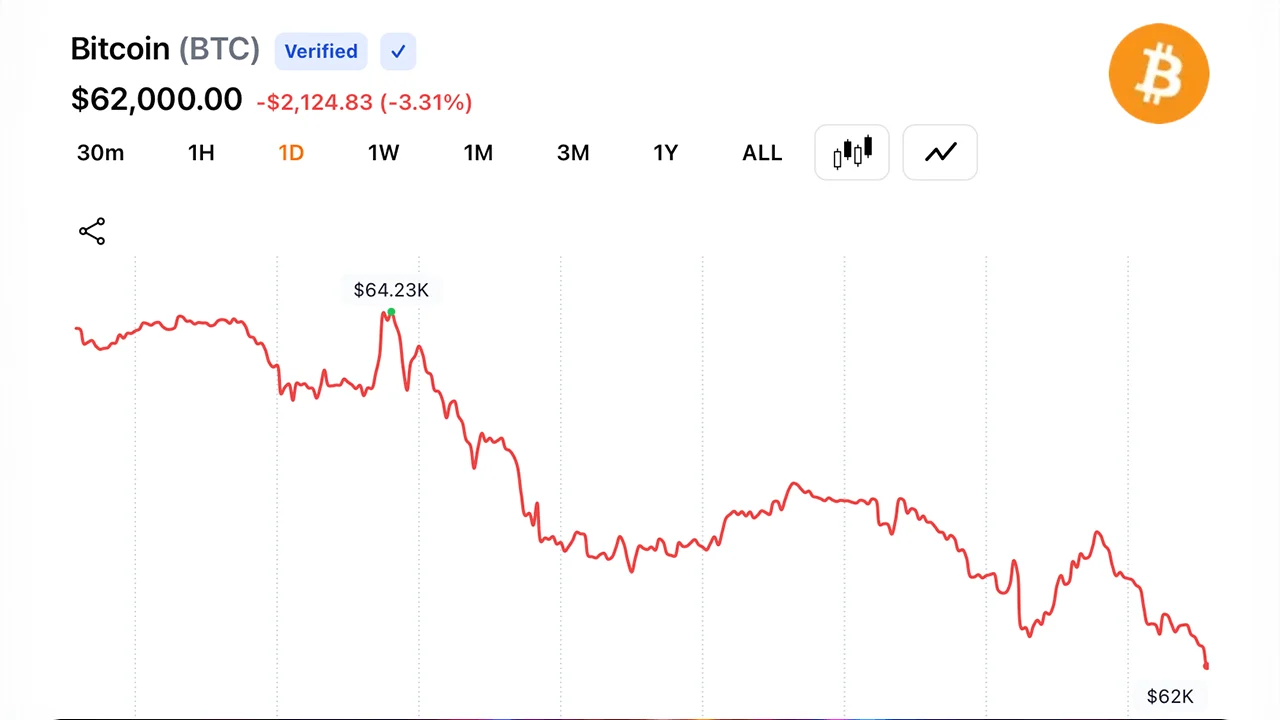
Bitcoin fell to around $62,000 on Monday as a weekend firefight between U.S. and Iranian forces threatened to trigger a new energy crisis. Market data showed the peak cryptocurrency plunged from a 24-hour high of $64,385 Sunday night to $62,037 as of 10:15 a.m. EST Monday.
While the cryptocurrency attempted to reclaim the $63,000 resistance level, another sell-off took it back to $62,200, reversing earlier gains and leaving it down almost 3%. This drop caused its market capitalization to drop from $1.28 trillion to around $1.25 trillion as of 12:40 p.m. EST. The slide, in turn, helped cut the crypto the overall market capitalization of the economy at $2.24 trillion.
Meanwhile, the slide triggered the liquidation $83 million in leveraged long positions and $12 million in short positions. Overall, liquidations across the crypto The saving topped $322 million, with liquidated long bets accounting for $267 million of the total.
After previous strikes this week, the US military upped the ante on Sunday, hitting more than 100 targets across Iran. The United States maintains that the strikes were a response to Iranian attacks on ships transiting the Strait of Hormuz. In addition to the strikes, some media outlets suggested that the U.S. military was considering a blockade of Iranian ports.
Iran, which rejects the allegations, launched retaliatory strikes against American bases and installations in five Gulf countries, including Qatar and Oman, Tehran’s ally. Iran insists Washington is violating a memorandum of understanding (MoU).
The apparent return to full-fledged combat operations came days after US President Donald Trump declared an end to the ceasefire between the two sides. The US leader also accused Tehran of violating the terms of the memorandum of understanding, which requires Iran to reopen the Strait of Hormuz.
Following the latest escalation, oil prices jumped 4.5%, with global benchmark Brent crude surpassing the $80 per barrel mark. Market concern extends beyond crude oil prices, analysts say, with investors increasingly focusing on disruptions to global refining capacity and fuel supply chains. Ongoing conflicts have affected refinery operations in the Middle East and, recently, on major global shipping routes in the Russia-Ukraine region.
“Even if crude oil prices stabilize, gasoline and diesel prices could remain high due to the limited availability of refined fuel. This creates a risk that the energy sector inflation may prove more persistent than markets currently anticipate,” a Bitunix analyst said in a recent report.
For global markets including cryptoThe central question this week goes beyond whether U.S. inflation is rising again. The bigger question is whether global capital costs will continue to rise.
As AI investments absorb significant funds, energy supply chains face uncertainty, and Federal Reserve policy remains volatile, risky assets will likely remain determined by the interplay between interest rates, liquidity conditions, and corporate financing costs.
“For Bitcoin, recovering and holding above $64,000 could improve near-term momentum. However, continued pressure from higher investment costs could keep BTC stuck in a wider consolidation range,” the analyst said.


