




While Bitcoin Price Faces New Volatility Following News of US-Iran War, and Investor Activity, Particularly on Cryptocurrency Exchanges, Begins undergo a crucial change. During the decline period, BTC transfer activity to trading platforms saw one of its biggest declines recently.
Binance Records Historically Low Bitcoin Deposits
As Monday drew to a close, the price of Bitcoin saw a brief rebound above the $73,000 markonce again reversing the bullish sentiment in the market. This new rebound can be attributed to several factors below the surface, such as BTC transfer activity to cryptocurrency exchanges.
Currently, inflows to Binance, the world’s largest trading platform, have fallen to record lows, indicating a significant change in Bitcoin flow dynamics. Darkfost, market expert and data analyst, announcement that BTC inflows have now reached levels last seen in 2022 as the market remains stable.
This decline comes against increasing uncertainty in the market, fueled by global events, making the current environment particularly difficult to interpret. Such a lack of visibility prevents investors from convincingly positioning themselves, mainly on risky assets like Bitcoin.
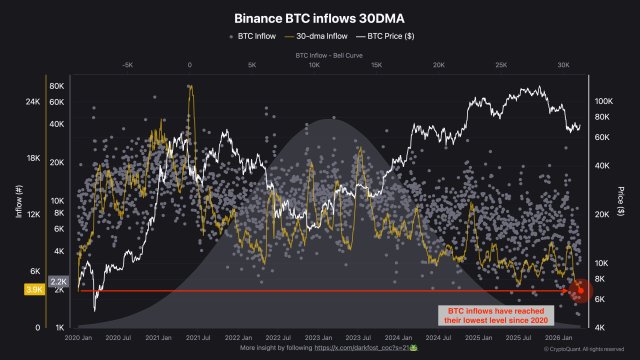
Despite these unfavorable conditions, panic does not manifest itself among the BTC Investors. According to the chart data, the 30-day moving average now stands at around 3,998 BTC, marking an over 6-year low from levels seen during the 2020 cycle.
This dramatic decline implies that fewer holders are moving their BTC to crypto exchanges, a trend sometimes linked to a decreased desire to sell immediately. Furthermore, this trend may lead to a tightening of supply of BTC on these platforms, which could change market behavior in the short term.
A massive distinction from periods of stress or euphoria
Even in times of stress or euphoria, the aforementioned figure is far from that observed then. As of July 2023, an average of 19,000 BTC was sent to exchanges per day. Additionally, as of May 2023, over 25,000 BTC was moved to exchanges daily on average.
With a historical average of around 11,000 BTC, current levels are around three times lower than that. Thus, a clear dynamic is reflected in this sharp contraction in incoming flows. Investors show no desire to move their BTC to exchanges to sell them.
However, they seem to adopt a holding strategy, which mechanically reduces short-term selling pressure. As inflow activity dries up, this situation could be a sign of renewed confidence or a cooling phase before tthe next wave of volatility arrives on the market, as evidenced on Sunday.
Darkfost argues that a structural change could also be at play here, with some flows currently being routed through alternative vehicles such as ETFs (Exchange-Traded Funds). Vehicle use ultimately reduces visibility BTC movements to crypto exchanges.
Ultimately, this type of signal indicates a market more in a waiting period than in capitulation. At the same time, BTC holders remain largely passive rather than panicked, even in an uncertain situation.
Featured image from Pixabay, chart from Tradingview.com
Editorial process as Bitcoinist focuses on providing thoroughly researched, accurate and unbiased content. We follow strict sourcing standards and every page undergoes careful review by our team of top technology experts and seasoned editors. This process ensures the integrity, relevance and value of our content to our readers.


