



Strategy, the largest Bitcoin holding company in the world with 818,334 BTC on its books, just announced to the market that it will sell Bitcoin when it makes financial sense to do so.
This sentence would have been unthinkable two years ago. For a company built entirely on the philosophy that you never sell your Bitcoin, this is a seismic shift, and it carries a direct message for ordinary investors who follow the same playbook.
The announcement came from Phong Le, Chairman and CEO of Strategy, during the company’s first quarter 2026 earnings conference call. The strategy recorded a net loss of $12.5 billion during the quarter, due to the drop in Bitcoin prices earlier in the year.
Context matters: even the most committed institutional HODLer on the planet now says that math, not mantra, should guide the decision to sell.
What HODL Really Means and Why It Took Root
HODL originated from a typo from a 2013 Bitcoin forum user who wrote “I AM HODLING” while drunk. It has become a battle cry and an acronym, meaning Hold On for Dear Life, promoting the belief that Bitcoin’s long-term trajectory is upward, encouraging investors to never sell despite price fluctuations.
This strategy made many people rich during the 2020 and 2024 bull runs, but also led others to suffer significant losses when markets fell.
Most beginners do not have the financial cushion to support large withdrawals. HODL strategies often assume that you can withstand an 80% decline without panicking, but this is unrealistic for many retail investors.
Institutions can suffer massive losses due to their reserves, which is generally not the case for individual investors. Understanding the drivers of Bitcoin volatility is crucial to developing a more resilient investment strategy.
JUST IN: Michael Saylor’s strategy proposes selling Bitcoin to pay dividends.
"You buy Bitcoin on credit, let it appreciate, then sell Bitcoin to pay the dividend." pic.twitter.com/WPCHk7fn7P
– Watcher.Guru (@WatcherGuru) May 5, 2026
DISCOVER: 99Bitcoin Readers – Earn $10 USDC when you sign up for Binance
What the Strategy Shift Really Tells Retail Investors
Le said during the earnings call: “We will sell Bitcoin when it is beneficial for the company. » The new strategy focuses on a metric called Bitcoin per share, assessing how much exposure to BTC each stock represents. If selling some of the assets can improve this metric and pay off the debt, they will move forward.
Chairman Michael Saylor likened this to real estate, where developers buy land cheaply, resell it profitably and reinvest intelligently. Saylor emphasized that selling should be viewed as an active risk management strategy rather than a weakness.
Analyst Dylan LeClair called the move a “pragmatic move,” highlighting the risk of combining leverage and ideology, especially as Strategy’s leverage ratio reaches 2.8x.
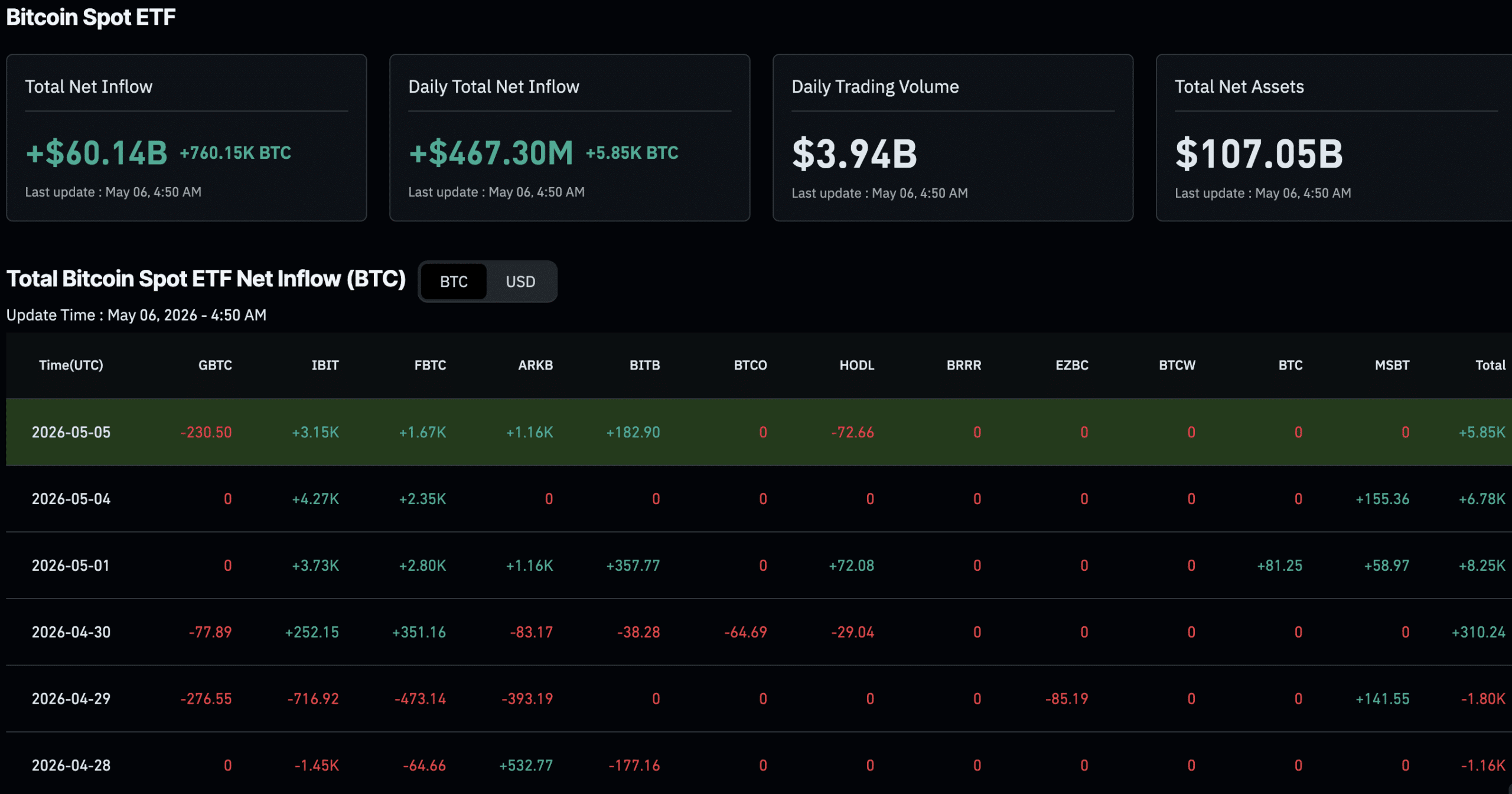
Institutional trends support this approach; for example, BlackRock’s IBIT ETF holds approximately 852,000 BTC and uses systematic rebalancing, treating selling as a strategic tool. Retail investors who view the sale negatively operate under different rules than institutional professionals.
(SOURCE: CoinGlass)
How to Create Your Own Bitcoin Trading Strategy with Scheduled Exits
The shift from “never sell” to “sell when it’s smart” doesn’t require you to abandon your Bitcoin belief. It forces you to separate emotion from execution. Here’s how to think about it practically.
The approach that is attracting the most interest among strategists is called threshold selling, setting specific, predetermined price levels or portfolio percentages at which you sell a fixed portion of your holdings, regardless of how you feel about Bitcoin that day.
For beginners, a simple version looks like this: Decide in advance that you will sell 10% of your Bitcoin every time its price doubles from your purchase price. You guarantee your profits, reduce your cost base and maintain a large position for further upside.
Taking profits does not mean leaving Bitcoin completely. This means treating your winnings like real money before the market writes them off. After Bitcoin hits major price milestones, historical data shows that volatility increases sharply, exactly when unruly investors hold too long and give back months of gains in a matter of days.
Some practical anchors for your Bitcoin trading strategy:
- Define your thresholds before you buy. Decide at which price points you will receive a 5-10% discount. Write it down. Commit to doing this before FOMO kicks in on the upside or panic sets in on the downside.
- Collect your seed capital first. One clear rule: sell enough to your first major goal to recoup your initial investment. All that’s left in Bitcoin after that is pure upside potential – psychologically much easier to hold despite the volatility.
- Rebalance when Bitcoin dominates your portfolio. If Bitcoin is growing and represents more than 20-30% of your total savings, that’s a signal to cut back – not because Bitcoin is bad, but because concentration risk is real regardless of the asset.
The goal of crypto risk management is not to maximize your Bitcoin holdings at all costs. This is to ensure that a bad quarter – like the one the strategy just had – doesn’t erase years of gains you never earned.
EXPLORE: Best Crypto Presales with Staking Rewards
Follow 99Bitcoins on XYouTube and Telegram for more crypto news and analysis.
Is the “HODL” message dead? Is it time to sell your Bitcoin? appeared first on 99Bitcoins.


