




Key takeaways
- The House Financial Services Committee has scheduled hearings on Fed policy and the CLARITY Act for July 14 and 17.
- Fed Chairman Kevin Warsh will testify on July 14, sharing the spotlight on the crypto market structure push.
- Lummis is aiming for a vote in the Senate before the August recess, with the bill requiring 60 votes.
A busy July calendar
The legislative struggle against the United States cryptocurrency market structure rules now unfold in busy July schedule as House Financial Services Committee prepares to hold meeting July 14 hearing on the Federal Reserve’s semi-annual monetary policy report, the session in which new Fed Chairman Kevin Warsh is scheduled to deliver his first testimony to Congress. The committee is also planning a hearing on July 17 in New York on how the CLARITY Act could shape digital asset and financial innovation.
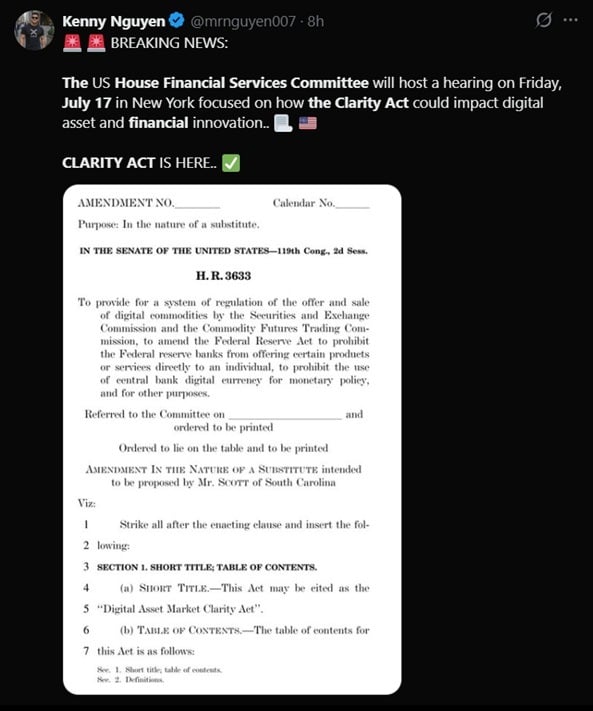
The back-to-back hearings provide a unique venue for the bill’s supporters to make their case at a time when momentum is building but a final vote remains out of reach. The July 17 session, to be held outside Washington, aims to highlight the sector’s economic challenges and the cost of ongoing regulatory uncertainty.
For Lummis, the auditions are an opportunity to keep the pressure on. The Wyoming Republican called the coming weeks decisive, arguing that the window to pass comprehensive crypto legislation this year is narrow and closing.
“We don’t do that with digital assets”
Lummis has sharpened her rhetoric as the timetable tightens, and in one of her most direct verbal proposals, she rejected the idea that the United States should let others govern the technology that Americans helped develop, saying:
“The United States did not invent the Internet and then hand it over to someone else to govern it. We don’t do that with digital assets either.”
This remark distills his central argument, which is that without clear federal rules, the United States risks ceding its lead in digital assets. She repeatedly warned that legal uncertainty was push developers and crypto companies towards friendlier jurisdictions, and that Congress must act before this drift becomes permanent.
The senator also linked the bill to a broader issue of competitiveness, saying clear rules would keep Bitcoin and open source developers based in the United States rather than spur innovation, jobs and investment overseas.
Where is the bill?
The CLARITY Act has already passed the Senate Banking Committee and has been included in the Senate legislative calendarputting it in line for a vote in the plenary room. But crossing the finish line was another matter. The measure needs 60 votes to approve the Senate, and will then have to be reconciled with the version adopted by the House in 2025 before he reached the president’s office.
Lummis placed the most likely voting window before the August recess, presenting that deadline as a forcing function. Industry advocates echoed the urgency, warning that a missed window could delay full crypto rules for years and let the market operate under a patchwork of state regulations.
Supporters outside Congress also continued to pressure lawmakers, with Michael Saylor arguing that clear rules could unlock institutional markets for BTC and related products, strengthening a coalition that has urged the Senate to act quickly.
The next verified step is the July series of hearings, beginning with Warsh’s testimony on July 14 and continuing with the July 17 session on digital asset innovation. These hearings will set the tone before any floor vote, and lawmakers will face questions about monetary policy and long-delayed efforts to draft rules for digital assets.


