




World Liberty Financial is under fire after Tron founder Justin Sun filed a federal lawsuit alleging fraud, breach of contract and illegal freezing of tokens worth up to $1 billion. Eric Trump’s response was something of a joke about a banana. WLFI’s native token, WLFI crypto, is trading at $0.07712, down 3.15% over the past 24 hours, with legal uncertainty now hanging over its liquidity like a storm cloud.
Sun filed a lawsuit in California federal court on Tuesday, April 21, 2026, claiming that WLFI secretly granted itself blacklisting powers without a token holder vote, then froze its wallet after refusing to pour hundreds of millions more into their $1 stablecoin. His previous $45 million investment, made in part through his ties to Trump, is now at the center of allegations of coercion and fraud.
Today, I filed a lawsuit in California federal court against World Liberty Financial to protect my legal rights as a holder of $WLFI tokens.
I have always been – and remain – a strong supporter of President Trump and his administration’s efforts to make America crypto-friendly.…
— HE Justin Sun


 (@justinsuntron)
 WLFI co-founder Eric Trump fired back against » Co-founder Zach Witkoff called Sun’s filing a “desperate attempt” to distract from Sun’s own misconduct, predicting a quick dismissal.
The banana joke refers to the Sun’s 2024 purchase of Maurizio Cattelan’s “Comedian,” an actual piece of fruit stuck on a wall, for $6 million. The two men posed together one day with it. This image now reads differently. This legal escalation goes beyond court drama: it surfaces deeper questions about governance, the rights of token holders, and what happens when political celebrity meets crypto finance.
Can WLFI Price Recover as Legal Pressure Mounts?
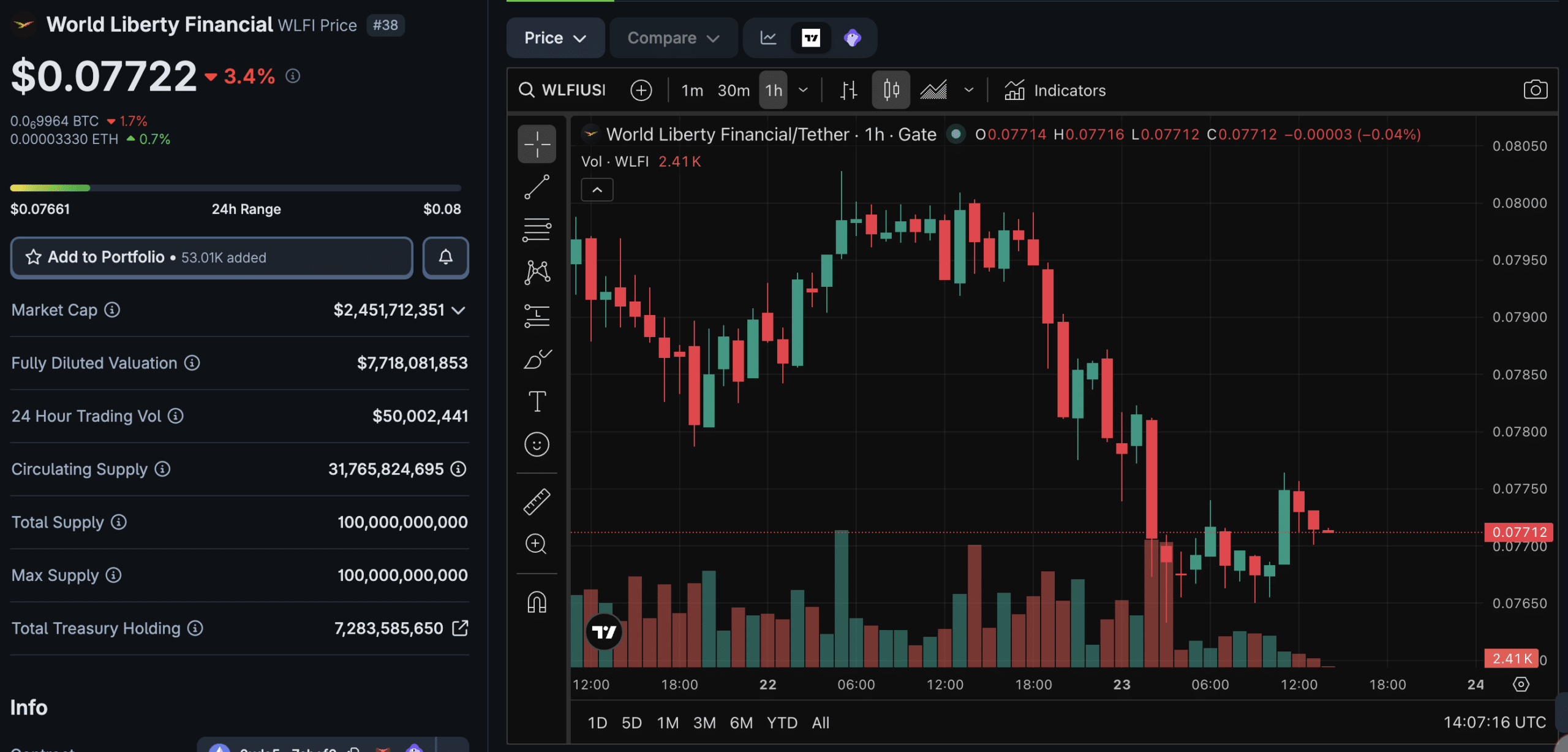
(SOURCE: CoinGecko)
$WLFI sits at $0.0772, a modest -3.4% 24-hour slide. The tradability of the token has been complicated since September 1, 2025, when sales were officially authorized. Sun’s lawsuit claims that the blacklisting of his portfolio prevents him from realizing value on a position worth more than $1 billion at peak prices.
No new analyst price targets have been identified in the last 48 hours, which in itself says something: markets are waiting, not acting. The lack of a clear breakout or breakout suggests consolidation, with traders holding their breath waiting for a court response or motion to dismiss that could serve as the next directional trigger.
Three scenarios to consider:
- Case of the bull: Witkoff’s prediction about the firing proves correct, the lawsuit quickly collapses, and sentiment rebounds toward the $0.085-$0.09 range as governance fears subside.
- Base case: Litigation drags on for months, tokens trade sideways between $0.07 and $0.08, with periodic volatility on court filing dates.
- Bear/invalidation: More blacklisting allegations surface or discovery reveals governance irregularities, prices test below $0.06 as confidence deteriorates.
Trump’s broader crypto empire has already faced scrutiny over governance, and markets have shown they can absorb the controversy, to a point. The real question is whether WLFI’s institutional credibility will survive a protracted federal trial.
EXCLUSIVE: 99Bitcoin Readers – Earn $10 USDC when you sign up for Binance
WLFI turbulence highlights governance-focused projects as Eric Trump hits back
.@justinsuntron cries a loss of 1 billion dollars on $WLFI. its bag peaked at $0.46 last September, printed ATL at $0.0785 four days ago. math only works if marked at the top. $2.5B mcap, $68B still locked, vesting vote next week.
this lawsuit is free marketing for @worldlibertyfi pic.twitter.com/ecRHLJIIvi
– Friend (@whatthetoken) April 23, 2026
When a $45 million investor ends up in federal court alleging his tokens were frozen without a vote, it calls attention to one of crypto’s oldest unresolved problems: Who actually controls the protocol?
Sun’s case, whether he succeeds or not, is a vivid demonstration of what happens when the governance literature is murky and power is centralized behind famous names.
Sun itself has faced criticism of decentralization on Tron, making this lawsuit a collision of two projects with governance question marks. For investors watching from the sidelines, the WLFI situation serves as a reminder that pre-sale and early-stage entry points carry real structural risk, not just price risk. Token freezes, undisclosed blacklist mechanisms, and post-launch liquidity restrictions can quickly turn paper gains into stranded funds.
Projects without audited governance frameworks, clear voting rights for token holders, and transparent smart contract controls carry increased risk, especially when high-profile names are involved.
The WLFI drama, with Eric Trump’s banana stunt, regardless of its legal outcome, is a useful stress test for how the crypto industry handles power when the cameras are on. No pre-sale figures are available for this article, but the broader lesson applies to any early-stage token: governance documentation deserves as much scrutiny as the price chart.
EXPLORE: Best Crypto Presales with Staking Rewards
Follow 99Bitcoins on XYouTube and Telegram for more crypto news and analysis.
The post Eric Trump Responds to Justin Sun’s WLFI Lawsuit With Banana Jab appeared first on 99Bitcoins.


