





Ethereum is consolidating around $2,300, now a level that represents a significant recovery from February lows, but still well below the highs that defined the previous cycle. The price action is tentative – neither a breakout nor a breakout – and the market is in the kind of cautious evaluation mode that tends to precede a decisive move in either direction. A report from the Arabic channel has just added a layer of order flow context that begins to explain what’s happening beneath this surface stillness.
The cumulative volume delta on Binance recorded a positive reading of around +48,400, meaning that buy orders exceeded sell orders in overall volume. The reading is not aggressive. It does not describe a market flooded with new demand or a burst of institutional conviction. What he describes is something more nuanced and arguably more significant: a gradual, quiet return of buying pressure to a market that recently had none.
The correlation coefficient between price and order flow sits at 0.66 – a moderately strong relationship that confirms that price is starting to respond to underlying demand, but also reflects that other forces remain in play. Derivatives activity, external liquidity conditions, and the broader macroeconomic environment continue to influence Ethereum’s price alongside improving spot order flow.
The market is rebalancing. The demand returns. Neither process is complete.
The buyers are back. They’re just in no hurry
The Arab channel’s report places the reading of the CVD in a context that prevents it from being misinterpreted one way or the other. A positive value of +48,400 confirms that buy orders exceed sell orders – this is the directional signal. But the scale is intentionally modest, and the report is specific about what that modesty means. This is not a wave of new institutional capital flowing into Ethereum. This is a gradual improvement in demand, consistent with a market that is recovering rather than accelerating.

This distinction is important for how the current price recovery should be assessed. Slow, steady improvement in demand tends to create more durable price structures than strong, aggressive capital inflows – the latter often reverse quickly when momentum fades, while the former tend to build up into something more sustained. The pace of CVD improvement reflects the pace of price recovery, which is exactly what a true rebalancing phase rather than a dead bounce looks like.
The 0.66 correlation coefficient adds an honest caveat that spot order flow alone is not boosting Ethereum at the moment. Derivatives positioning, external liquidity conditions and macroeconomic factors all contribute to price action – a pattern the report identifies as typical of transition phases where the market has not yet committed to a clear direction.
The perspective picture presented by the report is binary and completely honest. If the CVD continues to improve and the correlation strengthens towards 1.0, the gradual return of demand turns into a confirmed trend. If momentum stops and the positive CVD reading stabilizes, Ethereum remains bounded until a catalyst arrives to disrupt the balance.
The data currently supports the first scenario as the most likely path – but not with the kind of conviction that excludes the second scenario from consideration.
Ethereum Compresses Below Resistance as Recovery Tests Structural Ceiling
Ethereum continues to consolidate around the $2,300-$2,350 range, holding on to gains made since the February capitulation while failing to establish a clear breakout above resistance. The chart shows a clear recovery pattern from the $1,800 low with the price forming higher lows and gradually regaining lost ground. However, this progress now faces a critical technical obstacle.
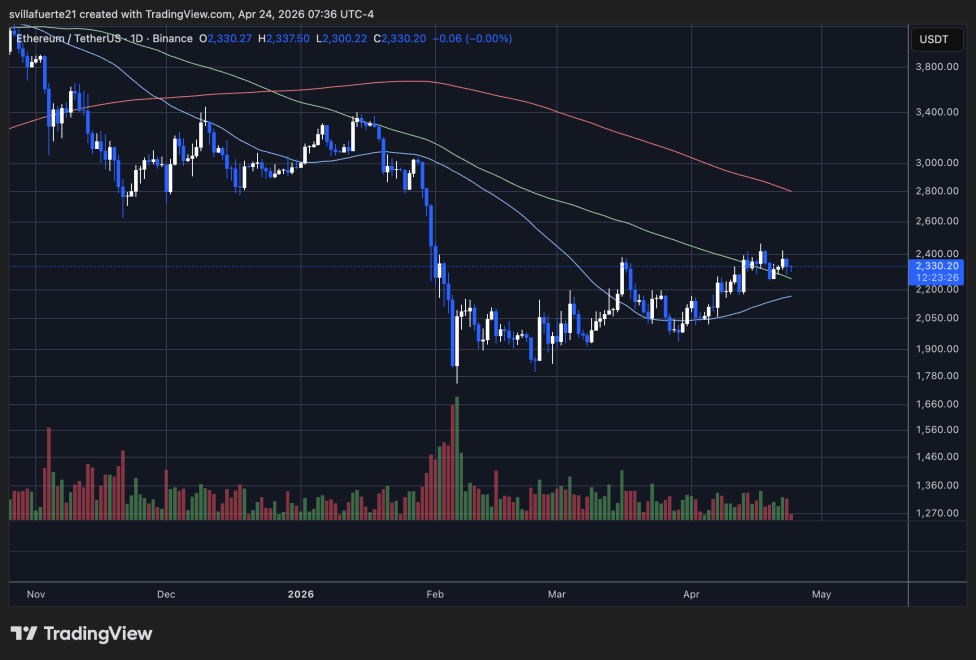
The $2,400 level emerged as a firm resistance area, closely aligning with the descending 100-day moving average. Every recent attempt to move above this area has been rejected, indicating that supply remains active and ready to absorb demand at these levels. At the same time, the 50-day moving average begins to rise below the price, currently near $2,150, providing dynamic support and confirming the near-term bullish momentum.
The evolution of volumes reinforces the current indecision. The largest increase in volumes remains linked to the February sell-off, while the recovery phase developed on relatively lower participation. This suggests that, even if demand returns, it has not yet reached the intensity necessary to cause a structural breakdown.
If Ethereum manages to reclaim $2,400 with conviction, the next resistance lies around $2,800. Failure to do so would likely prolong the consolidation, with a downside risk towards the $2,100 support zone.
Featured image from ChatGPT, chart from TradingView.com
Editorial process as Bitcoinist focuses on providing thoroughly researched, accurate and unbiased content. We follow strict sourcing standards and every page undergoes careful review by our team of top technology experts and seasoned editors. This process ensures the integrity, relevance and value of our content to our readers.


