




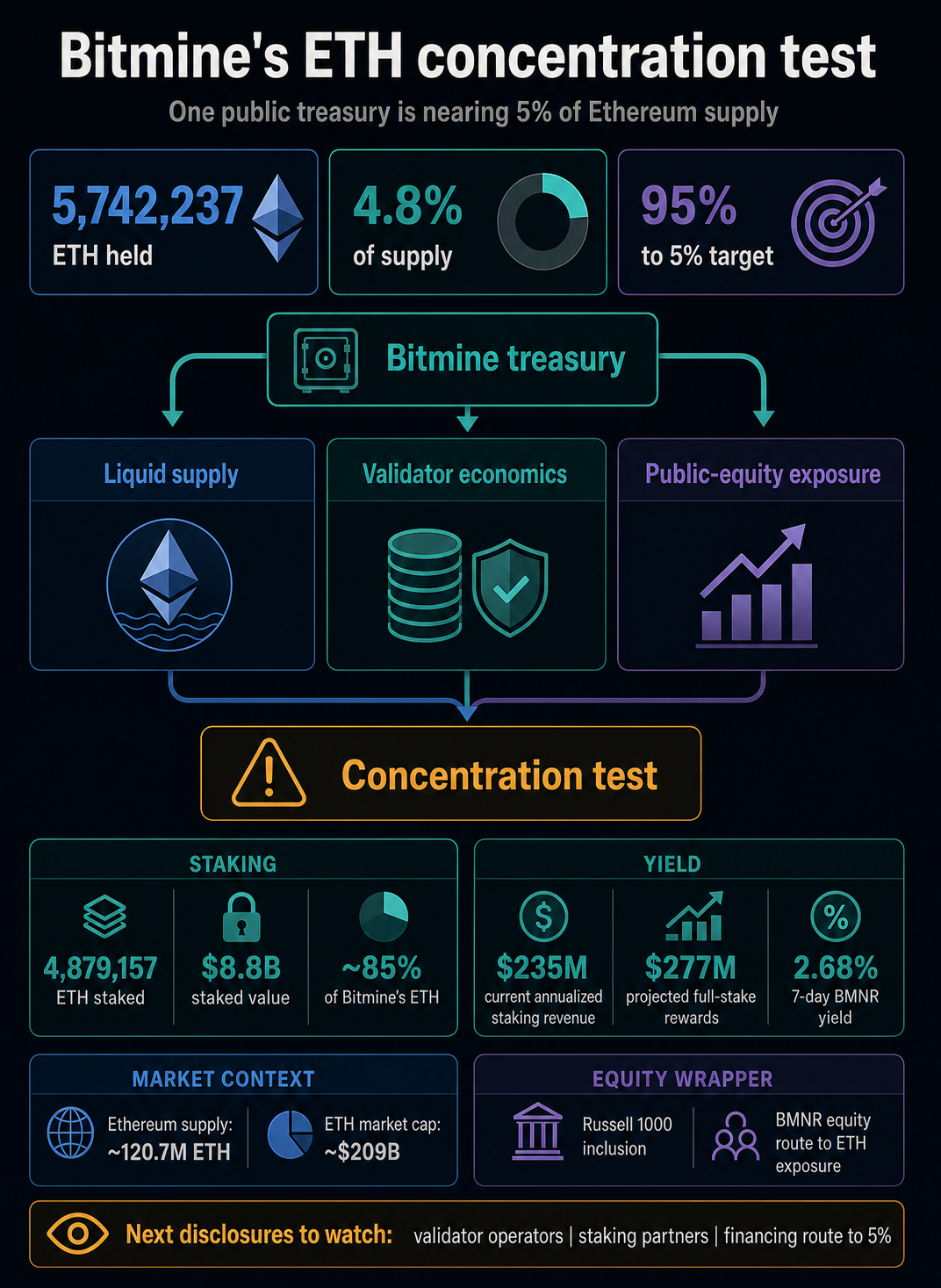
Ethereum treasury company BitMine said it now holds 5,742,237 ETH, or 4.8% of Ethereum’s 120.7 million tokens (ETH), putting a public treasury within 0.2 percentage points of its stated ownership goal of 5%.
BitMine’s purchase pace, staking choices, funding route, and eventual sales discipline now shape how demand for ETH appears in crypto markets and listed stocks.
The company said its total cryptocurrencies, cash, tradable securities and strategic holdings stood at $11.1 billion as of June 28. She also said that 4,879,157 ETH had been staked as of July 5. worth approximately $8.8 billion at $1,800 per ETH, or about 85% of its ETH position.
Nearly 5% stake changes three channels
The first change concerns the liquid supply, as BitMine’s 5.74 million ETH constitutes a concentrated claim on a share of the total Ethereum supply.
CryptoSlate The Ethereum market page listed the total supply at around 120.68 million ETH and the market cap at around $209 billion as of July 6, putting BitMine’s position in the same conversation as exchange liquidity, treasury demand, and large shareholder behavior.
The second change concerns staking, which allows ETH held by a treasury company to earn protocol rewards. BitMine projects $235 million in current annualized staking revenue and $277 million in annualized rewards if its ETH is fully staked through MAVAN and its staking partners, using a seven-day BMNR yield of 2.68%.

This transforms the company from a passive holder to a major economic player in the Ethereum validator economy.
The third change is the stock wrapper, which BitMine says was added to the Russell 1000 Large-cap Index on June 26, exposing anchor and passive investors to BMNR even when they don’t directly choose ETH.
Earlier CryptoSlate coverage linked BitMine’s treasury strategy to a broader test of the public market, while a separate analysis described Ethereum’s institutional push as increasingly funded and amplified by ETH treasury companies.

If ETH public hoards multiply and spread demand across many balance sheets, BitMine’s position could appear as a first step toward institutional depth.
If the market continues to reward larger wrappers, Ethereum demand could become more dependent on a few companies funding accumulation through public capital and moving large blocks of tokens through staking infrastructure.
For now, the main information to disclose is where the ETH staked by BitMine is located, how much is mined through MAVAN versus partners, and how the company is funding the home stretch towards 5%.
These details will determine whether this is a broader institutional demand or a concentrated proxy trade for Ethereum exposure.


