




Henry Paulson, who served as Treasury secretary from 2006 to 2009 and architected the $700 billion stabilization of TARP during the 2008 financial crisis, warned on the Bloomberg Television show. Wall Street Week that the US Treasury market faces the risk of a “brutal” crash, calling for a “break the glass” contingency plan to be prepared for immediate deployment.
The measures he proposes include closing tax loopholes, overhauling Social Security, and restructuring health care spending — a scale that indicates Paulson views the fiscal trajectory as a structural, not cyclical, problem. The U.S. national debt stood at approximately $38.9 billion as of mid-April 2026, with the debt-to-GDP ratio near 100% and the peacetime deficit reaching a record high of 7% of GDP.
What I’m watching this evening:
“Panic: The Untold Story of the 2008 Financial Crisis”
HBO / Vice-production
This is the third time I’ve watched it.
A FANTASTIC perspective on the inside baseball between the Secretary of the Treasury (Henry Paulson) and the President of the Federal Reserve Bank of New York (Tim…
– Jeff Walton (@PunterJeff) April 12, 2025
We suspect that Paulson’s intervention carries a weight distinct from the constant stream of deficit warnings that have circulated since the post-Covid fiscal expansion. A figure of his institutional position – with direct experience managing a systemic liquidity crisis – invoking emergency language in a public forum is a signal in a different category than analyst comments.
For crypto markets in particular, the more important question is not whether Paulson’s predictions prove accurate, but whether his warning accelerates the reassessment of sovereign credibility risk that has already begun to emerge in yield curve dynamics – and which transmission channel carries this reassessment into digital asset valuations.
DISCOVER: Best Crypto to Buy Right Now – CoinSpeaker Updated Guide
Stress on Treasury yields, dollar credibility and liquidity transmission channel
The mechanism works like this: When a sovereign borrower the size of the U.S. government runs a 7% peacetime deficit against a 100% debt-to-GDP ratio, the marginal buyer of Treasuries begins to demand additional yield to compensate for duration risk and fiscal sustainability concerns.
This request is independent of Federal Reserve policy. JPMorgan Chase CEO Jamie Dimon explained the dynamic directly, warning that rising Treasury yields could lead to higher borrowing costs for the government and mortgage markets regardless of Fed action, driven solely by investor demand for risk compensation in an environment of outsized issuance.
The transmission chain works like this: high auction supply without corresponding foreign or domestic demand pushes yields higher in the long run; rising long-term yields tighten real financial conditions across the economy; tighter real conditions reduce the current value of risky assets while simultaneously increasing the opportunity cost of holding non-productive assets, foremost among which is Bitcoin.
The 2022 episode remains the clearest empirical reference: Fed rate hikes caused a 65% collapse in the price of Bitcoin as capital shifted away from risky assets and toward suddenly competitive fixed income securities. A stress event in the Treasury market that caused yields to rise due to credibility erosion rather than Fed action would transmit through an identical channel, at a potentially faster speed.

Photo: Henry Paulson
Paulson’s warning adds to criticism from analysts at the American Enterprise Institute who called current fiscal policy “grossly irresponsible” and noted that bond markets are watching budget decisions with increasing vigilance. Treasury Secretary Scott Bessent has publicly dismissed these alarms, telling CBS News in June 2025 that Dimon’s failure to act on the warnings undermines the credibility of the current concern. This disagreement between the current Treasury Secretary and a former one, with senior bank executives aligned with the latter, is itself a signal worth evaluating.
DISCOVER: Kevin Warsh’s Fed Hearing and the Crypto Implications of the Changing Monetary Outlook
Bitcoin, Safe Haven Rotation and Real Yield Squeeze Trading
The cryptographic transmission of a tension event to the Treasury is not uniform: it depends essentially on which regime dominates as the tension intensifies. Two competing chains are operating here, and they are not pointing in the same direction simultaneously.
In a regime of rising yields driven by orderly fiscal concerns, transmission is negative for Bitcoin. Higher real yields increase the opportunity cost of holding an asset with no yield, institutional risk appetite contracts, and a rotation of capital into fixed income as was the case in 2022. Bitcoin’s correlation with gold has strengthened over recent macroeconomic cycles, but this correlation breaks down when real yields rise sharply – gold holds up better than Bitcoin in these environments because its safe-haven offering is more established among traditional allocators.
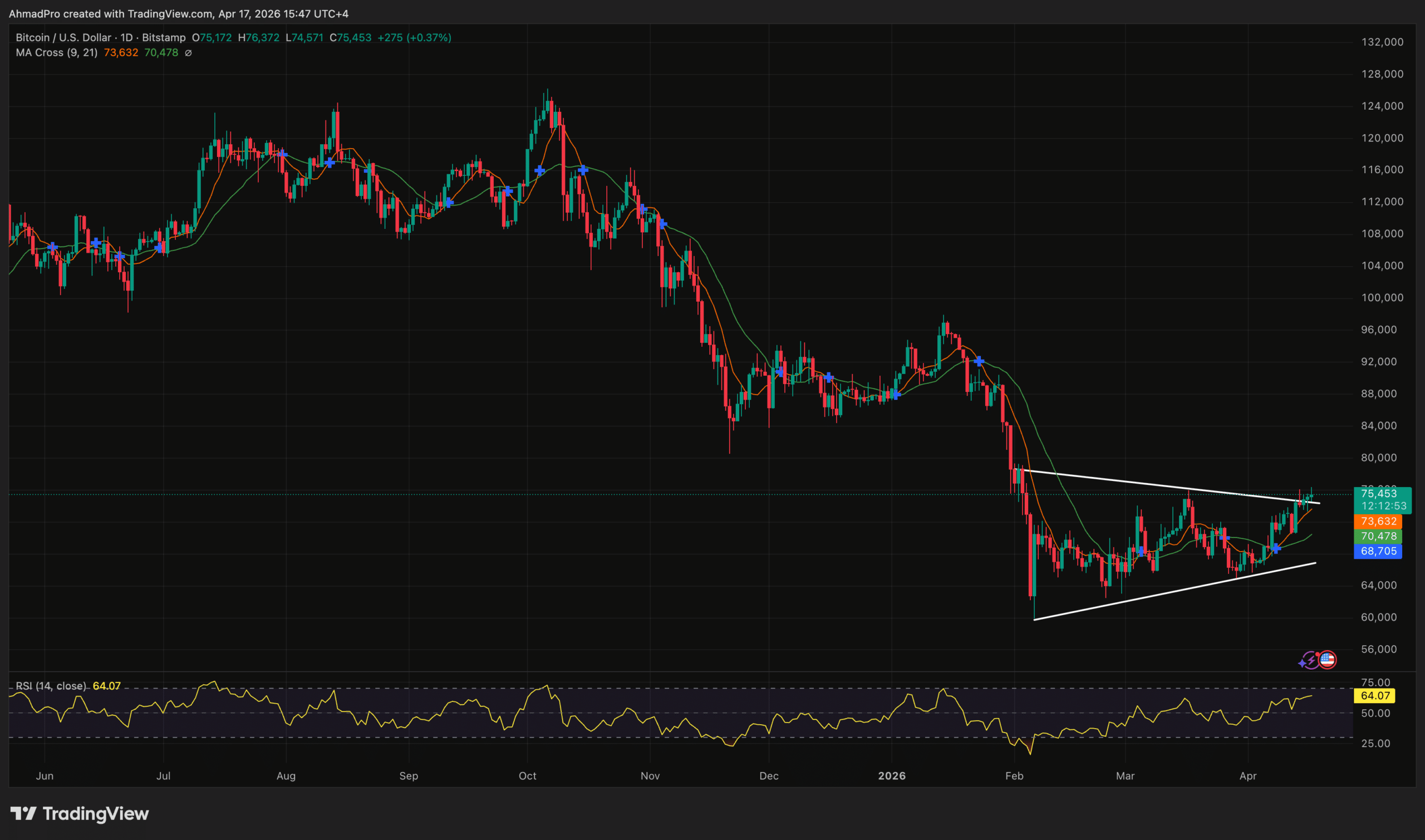
Source: Tradingview
In a regime of credibility crisis – where concerns shift from fiscal sustainability to dollar depreciation and Treasury market dysfunction – the transmission reverses. Historically, dollar weakness caused by sovereign credibility losses has resulted in a safe-haven supply of hard assets, and Bitcoin’s fixed supply schedule positions it alongside gold as a hedge against depreciation.
The bullish argument in favor of crypto in a world realized according to the Paulson scenario is precisely this channel: institutional capital, having lost confidence in the real return of long-duration Treasury bonds, turns to assets without counterparty risk and without inflationary dilution mechanisms.
EXPLORE: Best Coins to Watch – Updated Rankings from CoinSpeaker
following
Disclaimer: Coinspeaker is committed to providing unbiased and transparent reporting. This article is intended to provide accurate and current information, but should not be considered financial or investment advice. Because market conditions can change quickly, we encourage you to verify the information for yourself and consult a professional before making any decisions based on this content.

Daniel Frances is a technical writer and Web3 educator specializing in macroeconomics and DeFi mechanics. Hailing from crypto since 2017, Daniel leverages his experience in on-chain analytics to write evidence-based reports and in-depth guides. He holds certifications from the Blockchain Council and is dedicated to providing “insight gain” that overcomes market hype to find real utility for blockchain.


