




Cardano founder Charles Hoskinson recently suggested that Ripple integrate Midnight, a privacy sidechain from Input Output Global, to strengthen XRP’s role in DeFi, tokenization, and institutional finance.
He noted that the XRP Ledger is designed for payments, which limits its yield generation and on-chain lending features. Midnight could fill this gap by providing a zero-knowledge evidence-based environment without requiring Ripple to overhaul its core infrastructure.
Hoskinson estimated that this integration could unlock over $100 billion in unused XRP liquidity, a figure that merits critical evaluation.
The central question is not the technical merit of the proposal, but whether it fills a real architectural gap in the XRP ecosystem, whether the liquidity claim is valid, and the conditions necessary for this idea to move beyond an agenda-driven pitch.
Hoskinson says XRP needs midnight for its next chapter
Charles Hoskinson says Ripple may need midnight to unlock the next phase of growth in the $XRP ecosystem, according to Coinpedia.
Speaking in a recent conversation with Wendy O, he argued that XRP has a strong payments infrastructure, but… pic.twitter.com/ibwk5ubZhK
– BSCN (@BSCNews) June 10, 2026
EXPLORE: The next crypto will explode in the second quarter
Midnight and Ripple XRPL: What Each Network Really Does and Where the Structural Gap is Real
The XRP Ledger runs on a fault-tolerant Byzantine consensus protocol capable of processing approximately 1,500 transactions per second with a finality time of three to five seconds, making it a fast and cost-effective payment solution. However, it does not support programmable smart contracts for various DeFi activities.
Midnight, introduced by Input Output Global in late 2022 and detailed in a September 2023 white paper, aims to solve this problem by using a zero-knowledge proof architecture to enable confidential smart contracts.
It is designed to work on multiple blockchains, including the XRP Ledger. The proposed integration would allow XRP to be rolled onto Midnight via a cross-chain bridge, allowing access to DeFi protocols while maintaining transaction privacy.
As of now, there is no formal integration agreement between Ripple and Midnight. Although discussions have taken place between Ripple executives and IOG, no technical roadmap or partnership announcement has been made.
Cardano Whale Play: Exit Liquidity Setup?
The Cardano ecosystem is collapsing. TVL sits at just $94 million, down 87% from its peak. Yet on June 7, the biggest whales began quietly accumulating $ADA at a five-year low.
Derivatives paint a clearer picture: the best traders are net… pic.twitter.com/CTf37LJdZY
– Robert 🍌 (@iR0bertt) June 10, 2026
Web 2.5 Framing: What Hoskinson’s Competitive Positioning Really Means
This is more than a collaborative pitch between blockchain ecosystems; This is a strategic move by Hoskinson to position Midnight as critical infrastructure for institutional crypto.
Categorizing Ripple along with Tether, Circle, and Binance as part of Web 2.5, balancing traditional finance and crypto, Hoskinson suggests that XRPL serves as a bridge between traditional finance and decentralized Web3, providing reliability without full DeFi programmability.
Ripple has established a respected regulated payments network, with its RLUSD stablecoin dominating liquidity. However, XRPL does not have a large DeFi ecosystem, which Hoskinson sees as an opportunity.
Its framing benefits Midnight more significantly than Ripple in the short term, because Midnight needs access to markets and XRP represents a large pool of underutilized on-chain capital. This incentive should be considered when evaluating their pitch alongside the technical information they offer.
DISCOVER: Best Meme Coins to Buy in 2026
The $100 Billion Claim: What It Would Really Take to Unlock Unused XRP Liquidity
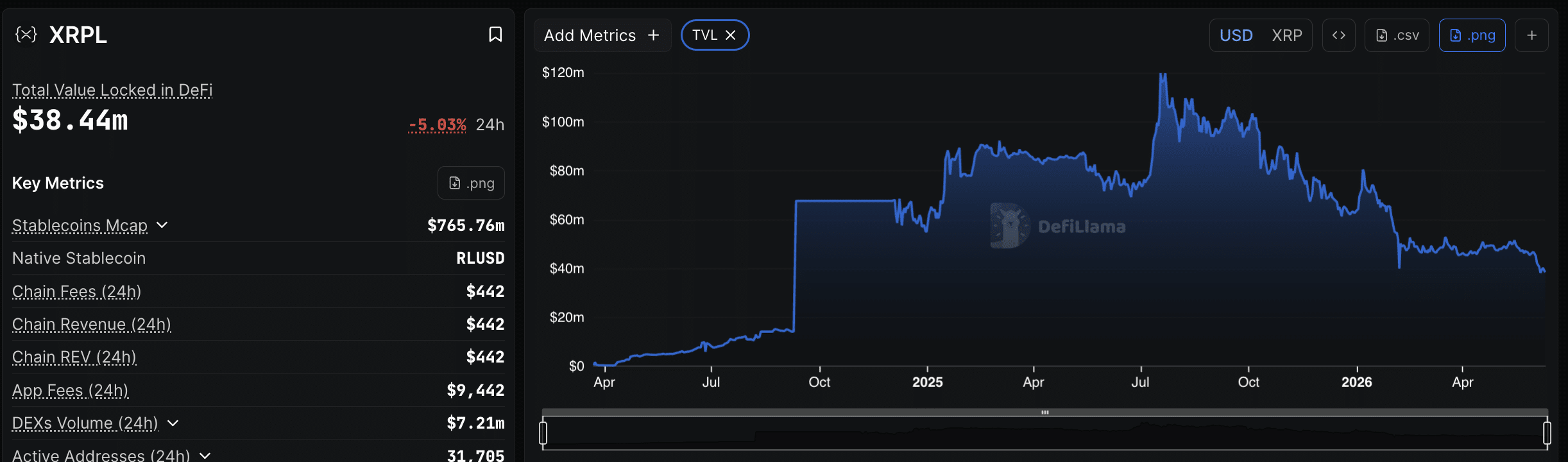
(SOURCE: DéfiLlama)
It is important to clarify the epistemic status of the $100 billion figure cited by Hoskinson regarding XRP and its DeFi potential. Neither this figure nor the related estimate of $136 billion was derived from an independently audited methodology.
This figure appears to reflect the market capitalization of XRP, reframed as dormant capital. However, it confuses total market capitalization with usable DeFi liquidity, which differs significantly.
“Inactive” XRP refers to tokens in wallets that do not generate yield or participate in DeFi activities due to XRPL’s structural limitations in supporting smart contracts. A potential Midnight integration could allow wrapped XRP to serve as collateral in DeFi, changing this dynamic.
The most significant indicator of XRPL’s potential is growing institutional interest, exemplified by a Treasury token buyout pilot led by JPMorgan, Mastercard and Ondo Finance on XRPL in May 2026.
This implication suggests that while the $100 billion figure is ambitious, it underscores the demand for a level of privacy protection to strengthen already existing institutional traction.
What Institutional DeFi and Tokenization on Ripple XRPL Would Really Need
The JPMorgan-Mastercard-Ondo pilot highlights that XRPL has gained institutional traction for tokenization without Midnight integration. However, it does not address the issue of data transparency, which poses a barrier to broader institutional use of DeFi due to the need for privacy in financial dealings.
Midnight’s zero-knowledge proof architecture provides a solution through selective disclosure, allowing institutions to demonstrate regulatory compliance without revealing transaction details.
Charles Hoskinson links the value of Midnight to the $10 trillion real asset market, suggesting that institutions will only tokenize assets on chains that ensure privacy, compliance, and interoperability.
It is important to note that XRPL’s authorized validator configurations already offer some compliance checks. The superiority of Midnight’s ZK-proof model over existing controls has not yet been independently tested, so the assumption that it is the optimal solution for XRPL’s institutional DeFi needs should be viewed with caution until further evaluation is conducted.
EXPLORE: The next crypto will explode in the second quarter
following
Disclaimer: Coinspeaker is committed to providing unbiased and transparent reporting. This article is intended to provide accurate and current information, but should not be considered financial or investment advice. Because market conditions can change quickly, we encourage you to verify the information for yourself and consult a professional before making any decisions based on this content.

Daniel Frances is a technical writer and Web3 educator specializing in macroeconomics and DeFi mechanics. Hailing from crypto since 2017, Daniel leverages his experience in on-chain analytics to write evidence-based reports and in-depth guides. He holds certifications from the Blockchain Council and is dedicated to providing “insight gain” that overcomes market hype to find real utility for blockchain.


