



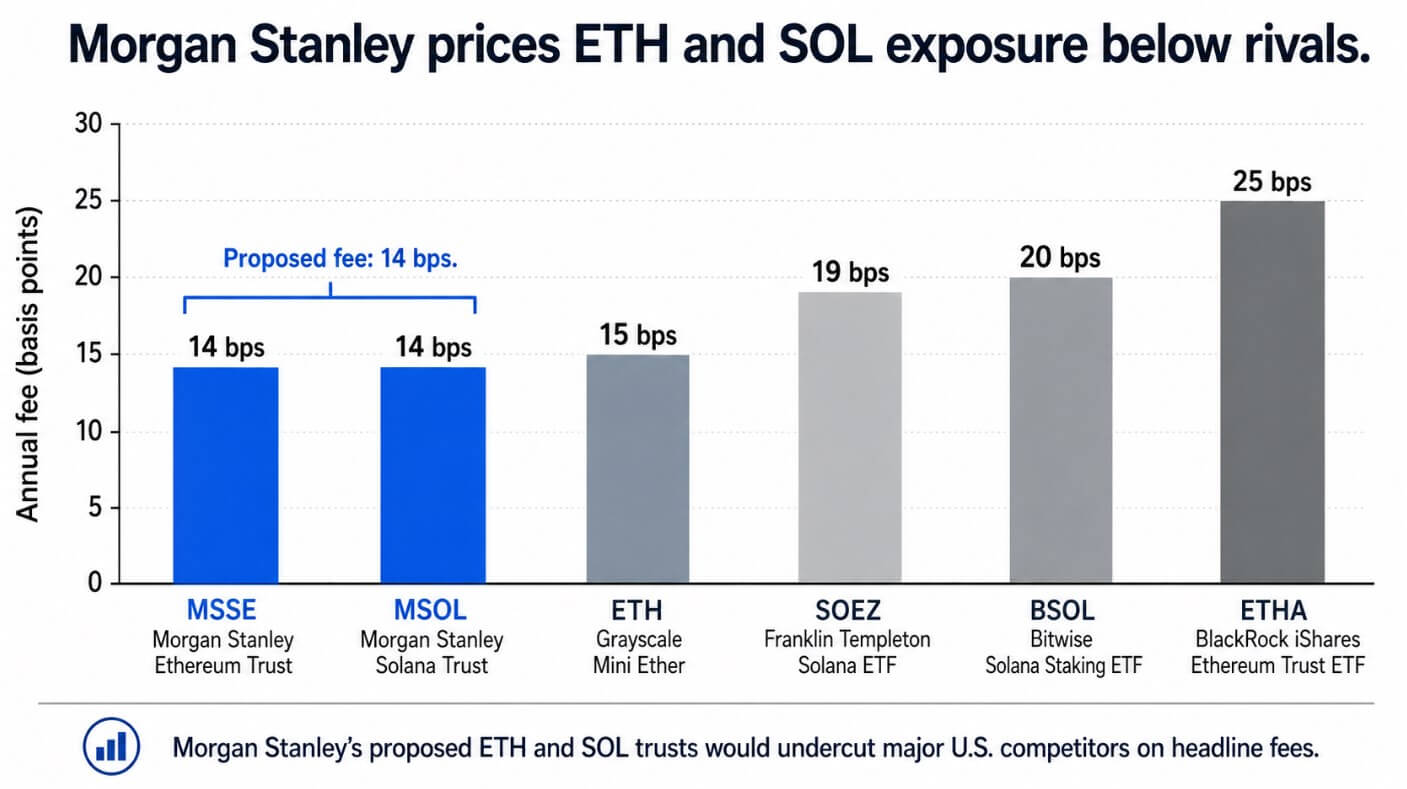
Morgan Stanley filed amended registration statements for the proposed Ethereum and Solana ETF trusts on June 18, setting an annual delegated sponsor fee of 0.14% on both products.
Eric Balchunas, senior ETF analyst at Bloomberg, described the fees offered as the lowest among ETH and SOL products globally.
The ETH trust, which is expected to trade on NYSE Arca under the ticker MSSE, intends to track ether rewards and stake a portion of its holdings. The SOL trust (MSOL) plans to hold up to 100% of its Solana.
BlackRock’s iShares Ethereum Trust ETF (ETHA) has a sponsor fee of 0.25%, Grayscale’s Mini Ether (ETH) sits at 0.15%, Bitwise’s Solana Staking ETF (BSOL) launched at 0.20%, and Franklin Templeton’s Solana ETF (SOEZ) lists a net expense ratio of 0.19%.
The filings are preliminary and the SEC must declare both registration statements effective prior to trading of the shares; neither deposit met this threshold.
Costs as post
Morgan Stanley’s 14 basis points on a crypto ETF is a statement about the direction the firm expects the institutional allocation conversation to take.
Bitcoin ETFs have solved the access problem for institutions, with BlackRock IBIT surpassing $70 billion in assets under management within 18 months of its launch.
The next question for wealth managers and advisors is whether ETH and SOL, presented cheaply and reliably enough, can occupy a second line in the digital asset portfolio alongside Bitcoin.
Morgan Stanley’s 0.14% fee positions these products as portfolio builders before the allocation question has a widely accepted answer.
The ETH trust intends to hold 50-80% of its holdings under normal market conditions, with staking service providers and custodians receiving an expected total of 5% of the rewards and the trust retaining the remainder.
The SOL Trust further extends this model, allowing up to 100% of holdings to be staked under the same 95% trust retention structure, with the delegated sponsor explicitly receiving no portion of the staking rewards.
Using Bitwise’s disclosed contemporary gross staking reward rate of 6.28% as a market benchmark, a fully staked SOL product that retains 95% of the rewards would generate approximately 5.97% before the 14 basis point fee.
For ETH, with a hypothetical 3% gross staking return with 50% to 80% staking, the retained staking contribution is between approximately 1.29% and 2.14% after fees.
Advisors comparing these products compare fee-minus-stake economics, such as gross yield, staked share and the trust’s 95% retention rate, which together determine the effective cost of exposure.
| Product | Title Fees | Staking share | Retention of trust rewards | Yield kept as an indication before fees | Indicative net after costs |
|---|---|---|---|---|---|
| Morgan Stanley ETH Trust | 0.14% | 50% to 80% of ETH | 95% | 1.43% to 2.28% | 1.29% to 2.14% |
| Morgan Stanley SOL Trust | 0.14% | Up to 100% of the GROUND | 95% | 5.97% | 5.83% |
What flow data supports
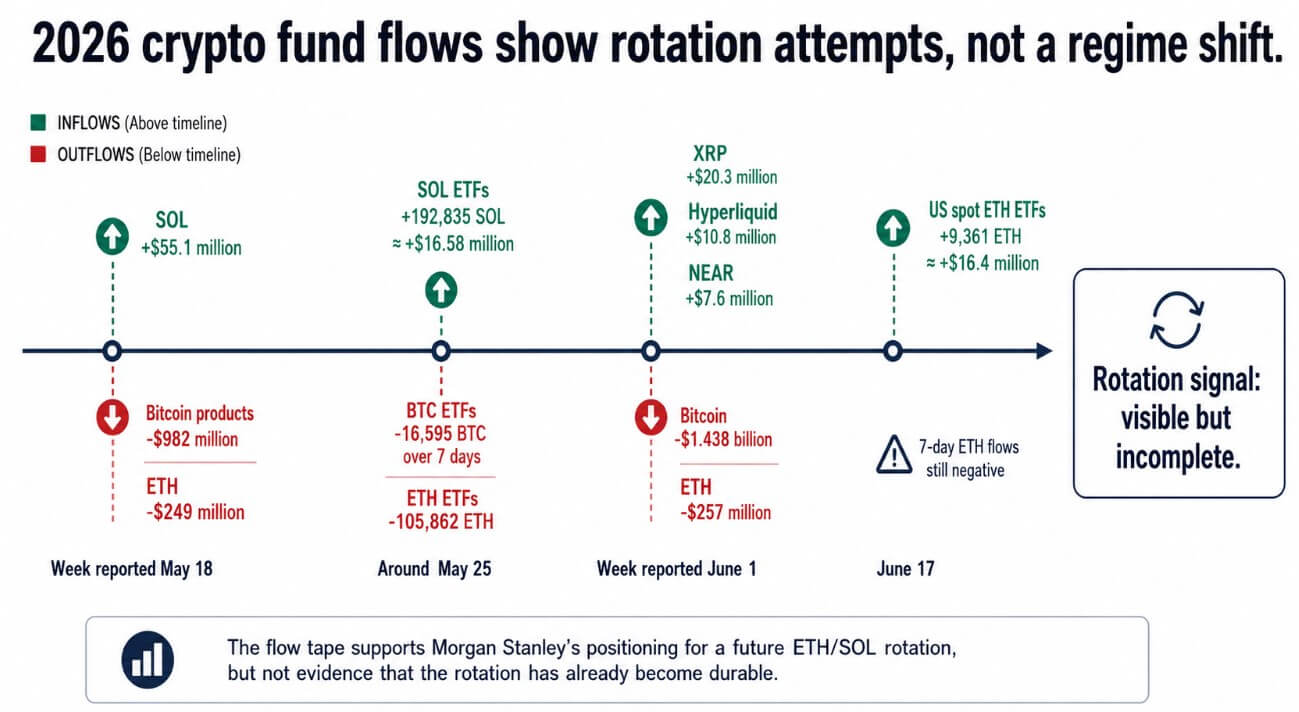
The institutional rotation into ETH and SOL has occurred in fits and starts throughout 2026, with episodic demand and no sustainable regime in place.
CoinShares’ week reported on May 18 showed Bitcoin products absorbing $982 million in outflows, while SOL attracted $55.1 million in inflows and ETH saw $249 million leave.
Around May 25, US spot ETF data showed that BTC ETFs lost around 16,595 BTC over seven days, while SOL ETFs added 192,835 SOL, or around $16.58 million, while ETH ETFs lost 105,862 ETH.
In the week reported June 1, BTC saw $1.44 billion in outflows and ETH $257 million, while positive pockets were XRP at $20.3 million, Hyperliquid at $10.8 million, and NEAR at $7.6 million.
On June 17, US spot ETH ETFs saw a single-day inflow of 9,361 ETH, or approximately $16.4 million, with seven-day ETH flows still negative at the end of the week.
The trend over these weeks is that SOL is increasing episodic demand while ETH lags Bitcoin’s own release pace, with alt-specific bids landing on XRP and Hyperliquid, and the ETH/SOL pair failing to attract sustained supply as a unit.
Morgan Stanley is positioning itself for a rotation that data shows is episodic and incomplete. The bank operates in 42 countries and Morgan Stanley Investment Management reported approximately $1.8 trillion in assets under management or supervision as of September 30, 2025.
This distribution reach means that a 14 basis point fee is also a bid for advisor storage space. When a wealth manager at a Morgan Stanley branch decides to add non-Bitcoin crypto exposure, MSSE and MSOL are already priced to win the comparison.
Two timelines for the same bet
The bull case requires four or more weeks of combined ETH and SOL inflows alongside Bitcoin flows becoming stable, with weekly SOL inflows increasing from tens of millions to hundreds of millions.
If this rotation occurs, 14 basis points becomes a structural weapon: Competitors between 0.19% and 0.25% face the choice of cutting fees or ceding market share to a brand with the distribution reach of Morgan Stanley.
A fully staked SOL product retaining 95% of the rewards at 14 basis points makes it difficult to economically justify against a non-staked 20 basis point competitor on numbers alone.
The downside scenario is that the macroeconomic environment keeps institutions in exposures only to Bitcoin or cash equivalents longer than the product deposit schedule predicts.
The Fed kept its policy rate between 3.50% and 3.75% through mid-2026, with nearly half of policymakers forecasting a possible rate hike for the year and inflation forecasts revised upward.
In this environment, the case for allocating ETH and SOL as portfolio components faces a tighter cost of capital argument than in 2024.
Low fees and staking returns require an allocation case that advisors can justify to the client before inflows materialize.
The SEC’s effective timetable adds a distinct layer of procedural uncertainty: staking treatment, custody provisions, and tax management could all require additional changes before trading in either product.
The price Morgan Stanley is competing for is advisor storage space in the allocation cycle following Bitcoin normalization.
As institutions widely accept ETH and SOL as wallet eligible, Morgan Stanley crypto ETFs with low fees and staking pass-through could have a structural first-mover advantage.


